
Goddess Chamunda
चामुण्डा
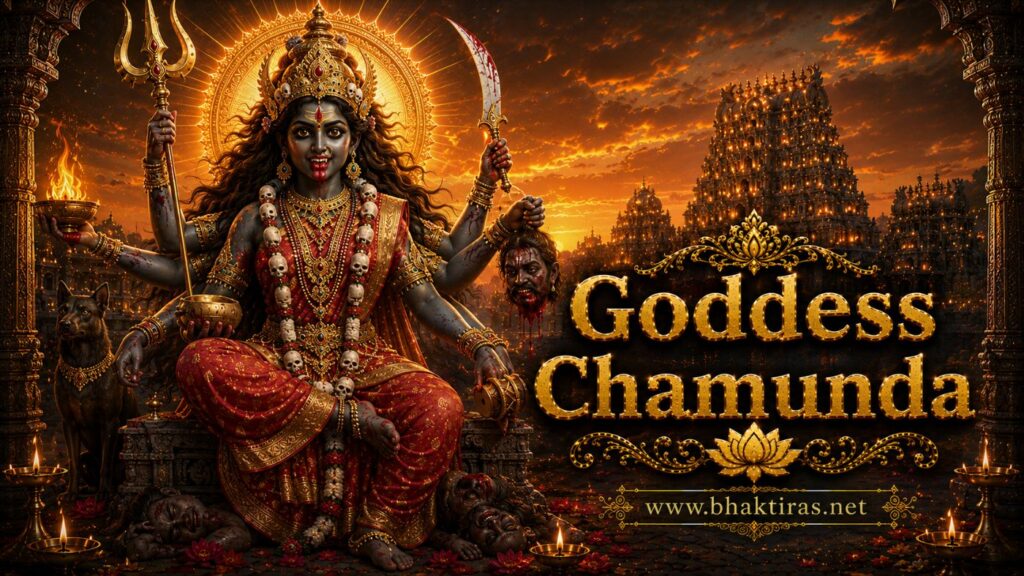
Chamunda is a fierce mother goddess who took form to slay the demons Chanda and Munda, and her name comes from that victory. She appears as a gaunt, terrifying figure wearing a garland of skulls, closely linked to Kali and Durga.
Who Is Goddess Chamunda?
Chamunda is one of the most fearsome forms of the Mother Goddess, worshipped for her power to destroy evil at its root. Her name records a single dramatic act. When the demons Chanda and Munda attacked, the Goddess brought forth a dark, wrathful energy that beheaded them both, and from that deed she earned the title Chamunda, the slayer of Chanda and Munda.
She is not a gentle, nurturing image. Chamunda is shown emaciated, with sunken eyes, bared teeth and a body that looks almost skeletal, surrounded by the marks of the cremation ground. Yet this frightening appearance carries a deep meaning for devotees. She stands at the boundary between life and death, unafraid of decay, and she offers the same fearlessness to those who worship her. Her ferocity is aimed only at what threatens dharma.
Because she shares so much with Kali and appears among the Sapta Matrikas, Chamunda is understood as a direct expression of Durga’s battle rage, the anger that a mother turns on anything that would harm her children.
Iconography and Symbols
Chamunda’s form is deliberately terrifying, and every detail speaks of her victory over death and demons.
Garland of Skulls
Around her neck hangs a mala of severed heads or skulls, each one a demon she has conquered. It marks her as the goddess who has passed through death and mastered it rather than fearing it.
Kapala and Trishula
In her hands she holds the kapala, a bowl made from a skull, along with the trishula and a sword. These weapons show her as an active destroyer of evil, while the skull-bowl connects her to the cremation ground and the truth of impermanence.
Emaciated Body and Corpse Mount
Her thin, hollow frame and her seat upon a corpse or an owl place her firmly in the world of endings. The owl, a night creature, deepens the atmosphere of the burning ground where she is most at home.
Her Place Among the Matrikas
In the Devi Mahatmya, Chamunda appears at the climax of the Goddess’s war against the asuras. When Chanda and Munda charged forward, a black goddess sprang from the brow of the angry Devi, seized the two demons and severed their heads, and the Devi named her Chamunda in honour of the feat. Because of this she is often placed among the Sapta Matrikas, and in many Matrika panels she is the seventh and most awe-inspiring figure. Where the other mothers mirror a specific god, Chamunda mirrors the Goddess’s own destructive will. She is the sharpened edge of divine anger, the mother who ends what must be ended so that creation can continue in balance.
Worship, Mantra and Offerings
Chamunda is worshipped both within the Sapta Matrika group and in her own celebrated shrines, such as the hilltop temple at Chamundi Hills in Mysuru where she is honoured as Chamundeshwari. Navaratri, and Ashtami in particular, is her high season. Devotees offer red flowers, red cloth, lamps and sometimes special tantric rites, since she is a goddess close to the esoteric traditions. People approach her to remove powerful obstacles, to break the grip of fear, and to find protection from enemies and negative forces. A quiet lamp, sincere chanting of her mantra and an offering of red hibiscus are enough for a home practice. Her worship asks for courage rather than comfort, and for the strength to face hard truths without flinching.
Stories and Legends
The Slaying of Chanda and Munda
Shumbha and Nishumbha sent their generals Chanda and Munda to capture the beautiful Goddess. In answer, the Devi’s face darkened with fury and a fierce black figure leapt out from her forehead, armed and roaring. She cut down the two demons and carried their heads to the Goddess, who blessed her with the name Chamunda so that the world would always remember this victory.
Chamundeshwari of the Mysore Hills
In the south, Chamunda is beloved as Chamundeshwari, the goddess who slew the buffalo demon Mahishasura on the hill that now bears her name. The city of Mysuru grew in her shadow, and her temple draws pilgrims who see her as both the destroyer of the demon and the guardian mother of the land.
Frequently Asked Questions
Who is Goddess Chamunda?
Chamunda is a fierce form of the Mother Goddess who was born to slay the demons Chanda and Munda. She is one of the Sapta Matrikas and is closely associated with Kali and Durga.
How did Chamunda get her name?
Her name combines Chanda and Munda, the two demon generals she beheaded in the Devi Mahatmya. The Goddess granted her this title to mark that victory.
Why does Chamunda look so fearsome?
Her emaciated body, garland of skulls and cremation-ground setting show that she has mastered death itself. Her terrifying form is aimed only at evil and offers fearlessness to her devotees.
Is Chamunda the same as Kali?
Chamunda and Kali share many features and are often identified with one another, since both are dark, wrathful forms of the Goddess. Chamunda is also counted among the seven Matrikas, where she expresses Durga's destructive power.
Where is Chamunda worshipped?
She is honoured across India within Sapta Matrika shrines and in famous temples such as Chamundeshwari on Chamundi Hills in Mysuru. Navaratri and Ashtami are the main occasions for her worship.
Chamunda stands at the edge of death so her devotees can live without fear.