
Madhushravani 2026 – The Maithil Bride's First Shravan Vrat
मधुश्रावणी
When is Madhushravani in 2026?
Madhushravani in 2026 runs for about a fortnight, roughly from 1 August to 15 August, ending on Shravana Shukla Tritiya (Saturday). It is a Maithil observance kept by a newly married bride in her first year of marriage, spread across the bright and dark fortnights of Shravan. The concluding puja falls on the Tritiya of the waxing moon.
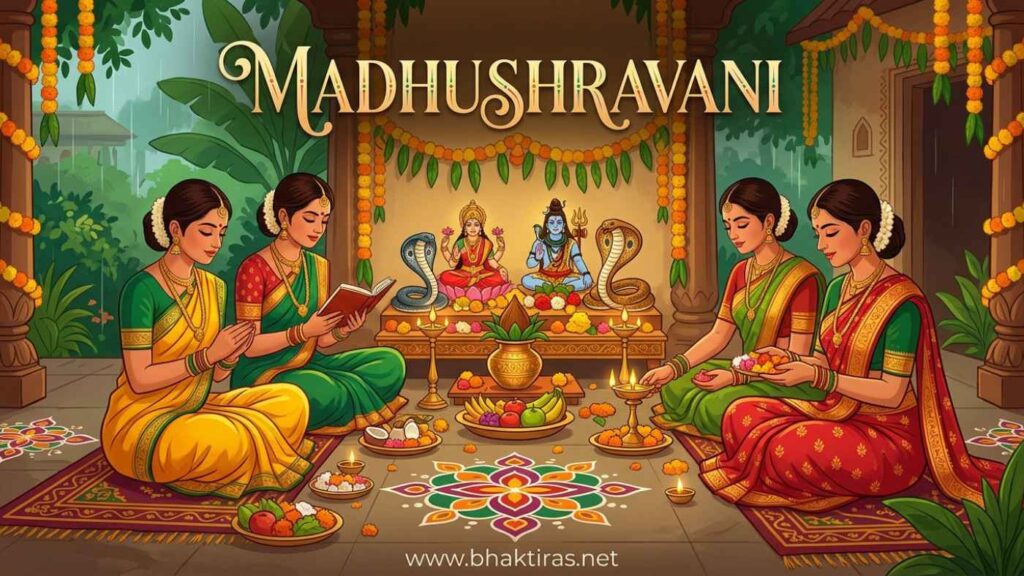
Madhushravani is a long fortnight-plus vrat kept only once in a Maithil woman’s life, during the first Shravan after her wedding, in the Mithila region of Bihar and neighbouring Nepal. The young bride returns to her mother’s home, dresses in her wedding clothes, and each day gathers flowers, listens to a fixed cycle of sacred stories, and worships Gauri along with the serpent deities Bishahari and Nag-Nagin. The observance runs from Krishna Panchami to Shukla Tritiya of Shravan and asks for the long life of her husband and the sweetness of the new marriage.
Madhushravani 2026-2028: Dates & Calendar
The next Madhushravani concludes on Saturday 15 August 2026, with the fortnight of daily worship beginning around 1 August. Because it follows the lunar month of Shravan, the closing Tritiya shifts by a few days each year.
| Year | Concluding Tritiya | Day | Notes |
|---|---|---|---|
| 2026 | 15 August | Saturday | Next occurrence; fortnight from about 1 August |
| 2027 | 4 August | Wednesday | Shravana Shukla Tritiya |
| 2028 | 24 July | Monday | Earlier this year as Shravan begins sooner |
The listed day is the culminating Shukla Tritiya puja, when the tola-pati or temi ritual is performed. The daily fasting and katha begin roughly ten to twelve days earlier, from Krishna Panchami of the same month.
Why Madhushravani Is Observed
Madhushravani is observed by a Maithil bride in her first married Shravan to pray for the long life and wellbeing of her husband and to settle gently into her new family bonds. The name joins madhu, sweetness, with Shravan, the monsoon month of the vrat.
A once-in-a-lifetime vrat
Unlike Teej or Karwa Chauth, which return every year, Madhushravani is kept only in the single Shravan that follows a woman’s wedding. This makes it a rite of passage as much as a fast, marking the bride’s move from daughter to wife within the Maithil community.
For the husband's long life
The central prayer is for the groom’s health and longevity and for an unbroken, affectionate marriage. The bride eats plain sattvic food once a day and keeps the fast through the fortnight while the elder women guide her.
Serpent goddess and Gauri
Worship centres on Gauri, the young Parvati, together with Bishahari (linked in Mithila lore with Mansa, the serpent goddess) and the Nag-Nagin. Snakes are honoured for protection of the household and for the fertility and prosperity of the coming years.
Learning the household's stories
Through the daily katha the bride absorbs the myths, values and expectations of her new family. Older women narrate a fixed cycle so the tradition passes intact from one generation of Maithil women to the next.
Deities & Figures Worshipped
Madhushravani honours Gauri with Shiva and the serpent deities of Mithila. Small clay and paste figures of the gods and snakes are shaped by hand and worshipped afresh each day.
Gauri (Parvati)
Gauri, the maiden form of Parvati, is the presiding goddess. As the ideal bride who won Shiva through devotion, she is the model the young Maithil bride looks to for a long and loving marriage.
Bishahari / Mansa
Bishahari, associated in Mithila with Mansa Devi, is the goddess of snakes and their venom. She is offered milk and lava (puffed rice) morning and evening so that she guards the family from harm and blesses it with plenty.
Nag & Nagin
The serpent couple, along with figures such as Kechua and other creatures, are moulded from paste and clay and worshipped daily. Snake worship ties the vrat to the monsoon, when serpents are most active in the fields of the region.
Shiva (Mahadev)
Shiva is worshipped alongside Gauri as her divine husband. The katha cycle retells his marriage to Parvati, holding up the pair as the ideal of a devoted, enduring union.
Key Rituals, Step by Step
Madhushravani is a daily discipline rather than a single-day festival. The pattern below repeats each morning and evening through the fortnight, building to the closing rite.
- Return to the maternal home. The bride comes back to her parents’ house, called naihar, where the whole vrat is kept under the care of the elder women of the family.
- Bridal dress and daily bath. Each morning she bathes, wears her wedding clothes and jewellery, and applies sindoor, keeping the appearance of a new bride throughout the fortnight.
- Collecting flowers. Before worship she gathers seasonal flowers and leaves, marigold, roses, cheera-meera and others, which are used fresh for the puja every day.
- Shaping the deities. Figures of Gauri, Bishahari, the Nag-Nagin and other creatures are formed from clay and pastes such as pithaar, chandan, kaajal and sindoor, then worshipped.
- Offerings to the serpents. Milk and lava are placed before the Nag Devta and Bishahari morning and evening, and on the middle days kheer is offered as prasad.
- Daily katha. In the evening the eldest woman, the bidkari, narrates the day’s story from the fixed cycle, covering the birth of the earth, Gauri’s penance, Shiva’s marriage, and the Bihula tale.
- The one meal. The bride eats arava, plain sattvic food, once a day, keeping the fast for the rest of the hours through the whole period.
- Tola-pati (temi daahan). On the concluding Shukla Tritiya, a lit lamp is brought to the bride’s knees and feet with betel leaves placed on the skin, the burn taken as a sign of the strength of her devotion and the length of her husband’s life.
Special Foods of Madhushravani
Food during Madhushravani is simple and sattvic, since the bride fasts and eats only once a day, while sweets and offerings mark the puja.
Arava (sattvic meal)
The bride’s single daily meal is arava, cooked without onion or garlic and kept plain, so the body stays light and fit for worship through the fortnight.
Kheer
On the middle days of the vrat, kheer, rice simmered in milk and sugar, is prepared and offered as prasad before being shared.
Milk and lava
Milk and lava, lightly puffed rice, are set before the Nag Devta and Bishahari every morning and evening as the standing offering to the serpent deities.
Mithila sweets
Household sweets typical of Mithila, such as thekua and khaja made from wheat, jaggery and ghee, are prepared for the family and guests during the days of the vrat.
Where Madhushravani Is Kept
Madhushravani belongs specifically to Maithil culture and is not observed across wider India, though it is shared on both sides of the Mithila region.
Bihar (Mithila)
The heartland of the vrat is the Mithila region of north Bihar, including Darbhanga, Madhubani and surrounding districts, chiefly among Maithil Brahmin and Kayastha families.
Nepal (Mithila)
Across the border in the Terai districts of Nepal, Maithil women keep the same fortnight, and the observance is documented in Janakpur and the wider Madhesh region.
Maithil diaspora
Maithil families settled elsewhere in India and abroad continue the vrat in a shortened form where possible, keeping the daily katha and the worship of Gauri and the serpent deities.
Madhushravani Do's and Don'ts
The vrat asks for daily discipline and care, so a few simple points help the bride keep it well.
Do
- Keep the fast and eat only the single sattvic arava meal each day
- Gather fresh flowers and offer them daily to Gauri and the serpent deities
- Listen attentively to the full katha narrated by the elder women
- Offer milk and lava to the Nag-Nagin every morning and evening
- Wear the bridal dress, sindoor and jewellery through the whole fortnight
Avoid
- Do not break the fast with onion, garlic or tamasic food
- Do not skip the daily katha or the flower collection
- Do not treat the closing tola-pati carelessly; the burn should be handled gently and cared for
- Do not observe it any year other than the first Shravan after marriage
- Do not use stale or wilted flowers for the daily worship
Frequently Asked Questions
When is Madhushravani in 2026?
Madhushravani in 2026 concludes on Saturday 15 August, on Shravana Shukla Tritiya, with the fortnight of daily worship beginning around 1 August. It is kept through the second half of the Shravan month by a Maithil bride in her first married year.
When is Madhushravani in 2027 and 2028?
Madhushravani concludes on 4 August 2027 (Wednesday) and on 24 July 2028 (Monday). The closing date is the Shukla Tritiya of Shravan, which shifts each year with the lunar calendar, so the fortnight of fasting begins about ten to twelve days earlier.
Why is Madhushravani celebrated?
Madhushravani is celebrated by a newly married Maithil bride to pray for the long life and wellbeing of her husband and for a sweet, lasting marriage. Kept in the first Shravan after the wedding, it also eases her into her new family through daily worship and storytelling.
Which gods are worshipped during Madhushravani?
Madhushravani centres on Gauri, the maiden form of Parvati, worshipped with Shiva. The serpent deities Bishahari (linked with Mansa) and the Nag-Nagin are also honoured daily with milk and lava for the protection and prosperity of the household.
What is the tola-pati or temi ritual?
The tola-pati, also called temi daahan, is the concluding rite of Madhushravani. A lit lamp is brought to the bride’s knees and feet with betel leaves on the skin, and the resulting mark is read in Maithil tradition as a sign of her devotion and her husband’s long life.
How long does Madhushravani last?
Madhushravani lasts about 13 to 15 days. It runs from Krishna Panchami of Shravan to Shukla Tritiya of the same month, with the bride keeping a daily fast, worship and katha through the entire span.
Who observes Madhushravani?
Madhushravani is observed only by newly married women of the Maithil community in the Mithila region of Bihar and Nepal, in the first Shravan after their wedding. The bride typically keeps the vrat at her mother’s home under the guidance of the family’s elder women.
What food does the bride eat during Madhushravani?
During Madhushravani the bride eats one plain sattvic meal a day, known as arava, prepared without onion or garlic. Kheer is offered as prasad on the middle days, and milk with lava is set before the serpent deities morning and evening.
May the flowers, stories and quiet fasting of Madhushravani bring the new bride a long and loving marriage.