
ISKCON Rath Yatra 2026 – The Global Festival of Chariots
इस्कॉन रथ यात्रा
When is ISKCON Rath Yatra in 2026?
ISKCON Rath Yatra follows the Puri tithi of Ashadha Shukla Dwitiya, which falls on Thursday, 16 July 2026. Because ISKCON runs the Festival of Chariots in cities across the world, individual centres schedule their own procession on a convenient summer weekend between late May and August. London, for example, held its 2026 chariot parade to Trafalgar Square on 24 May, while many other cities pull their chariots close to the traditional July date.
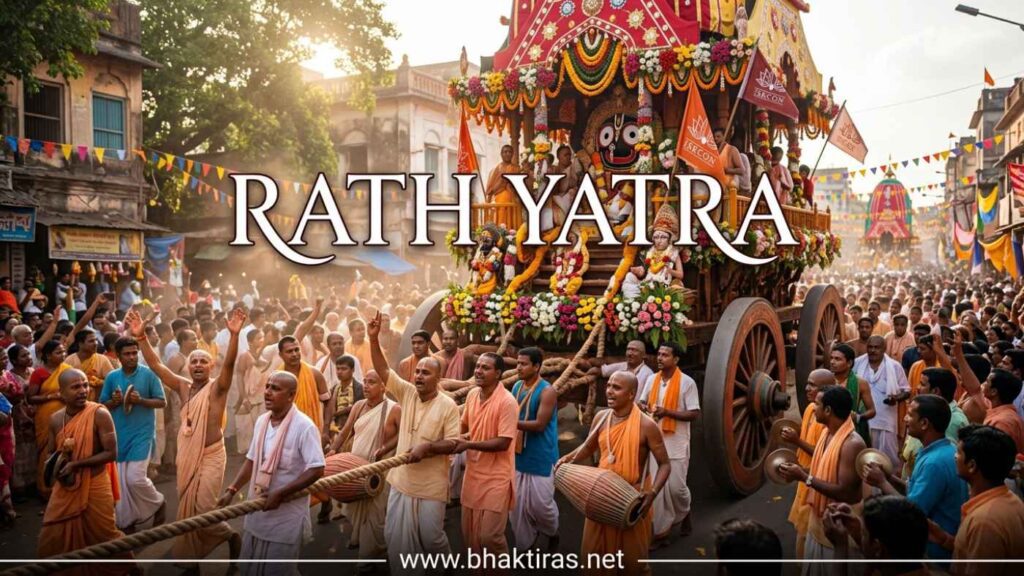
ISKCON Rath Yatra, known in the West as the Festival of Chariots, is the international celebration of Lord Jagannath’s annual journey, run by the Hare Krishna movement in cities across the globe. Devotees pull three towering wooden chariots carrying Jagannath, his brother Baladeva and sister Subhadra through public streets, accompanied by nonstop kirtan, dancing and free vegetarian prasadam. It follows the Puri tithi of Ashadha Shukla Dwitiya, which lands on 16 July in 2026, though each city fixes its own summer date. The festival carries Srila Prabhupada’s mission of making Jagannath’s mercy available to everyone.
ISKCON Rath Yatra 2026-2028: Dates & Calendar
The reference tithi is Ashadha Shukla Dwitiya, the same day as the Puri Rath Yatra. It falls on 16 July in 2026. Individual ISKCON cities hold their chariot processions on a nearby summer weekend, so local dates vary.
| Year | Puri Tithi Date | Day | Notes |
|---|---|---|---|
| 2026 | 16 July | Thursday | Next occurrence (reference tithi) |
| 2027 | 5 July | Monday | Ashadha Shukla Dwitiya |
| 2028 | 24 June | Saturday | Ashadha Shukla Dwitiya |
These are the traditional tithi dates. Because ISKCON runs the festival worldwide, cities such as London, New York, Los Angeles and Toronto pick their own weekend around this window, so always check your local ISKCON centre for the exact parade date.
Why ISKCON Celebrates Rath Yatra Worldwide
ISKCON Rath Yatra takes the ancient Puri chariot festival to the wider world, offering Jagannath’s blessings to anyone who joins the procession, regardless of background.
The heart of the festival is a simple, radical idea: Lord Jagannath leaves his temple once a year and comes out onto the open road so that everyone can see him, touch his chariot ropes and receive his mercy. In a traditional temple, access is bounded by ritual and custom. On Rath Yatra day, those boundaries fall away, and that inclusiveness is exactly what the Hare Krishna movement wanted to share globally.
Prabhupada's global mission
The Festival of Chariots was carried out of India by A.C. Bhaktivedanta Swami Prabhupada, ISKCON’s founder. He organised the first Western Rath Yatra in San Francisco’s Golden Gate Park in 1967, sketching a canopied cart himself and having deities of Jagannath, Baladeva and Subhadra carved for the parade. From that one procession the festival has spread to cities on every continent.
Jagannath's mercy for all
Jagannath means Lord of the Universe, a much loved form of Krishna. His large round eyes and open, welcoming form express a deity who does not turn anyone away. Pulling his chariot is treated as an act of devotion open to believers and curious onlookers alike, which is why crowds of every faith join in.
The chariot as a symbol
In Vaishnava teaching the chariot journey represents the Lord coming to reclaim the hearts of his devotees, and the act of pulling the ropes stands for turning our lives back towards the divine. Kirtan, the congregational chanting of holy names, is the sound that carries the whole procession.
Deities on the Chariots
Three deities ride in three separate chariots at every ISKCON Rath Yatra, exactly as at Puri.
Lord Jagannath
Jagannath, a form of Krishna, is the presiding deity. His distinctive image has a broad black face, huge circular eyes and no visible arms or legs, a form devotees describe as the Lord’s most merciful and approachable aspect. His chariot is usually the tallest and is often draped in yellow.
Lord Baladeva (Balarama)
Baladeva, Krishna’s elder brother, is worshipped as the origin of spiritual strength and the first expansion of the Lord. He rides his own chariot, traditionally recognised by white or green colours, and his presence signifies the protective, supportive side of devotion.
Subhadra
Subhadra, the sister of Jagannath and Baladeva, rides the smallest of the three chariots, usually decorated in red or black. In the trio she represents the Lord’s internal energy, and her chariot is placed between her two brothers in the procession.
How an ISKCON Rath Yatra Unfolds, Step by Step
A typical city festival runs as a morning-to-evening event, moving from the chariots to a stage programme and a prasadam feast.
- Installing the deities. Before the parade, devotees ceremonially bring Jagannath, Baladeva and Subhadra from the temple and seat them on their three decorated wooden chariots, offering flowers, incense and arati.
- Cleaning the path. Following the Puri custom of Chhera Pahara, a senior devotee sweeps the ground before the chariots with a golden broom, a gesture of humility signalling that all are servants before the Lord.
- Pulling the ropes. The public is invited to grip long thick ropes and haul the chariots along the route by hand. This shared pulling is the emotional centre of the day and needs hundreds of willing hands.
- Harinam procession. As the chariots roll, kirtan groups lead continuous chanting of the Hare Krishna maha-mantra with mridanga drums and karatala cymbals, and devotees dance the whole way.
- Reaching the festival ground. The chariots arrive at a park or square, such as Trafalgar Square in London, where a fairground of stalls, exhibits and food awaits.
- Stage programme. A cultural stage hosts bhajans, classical Indian dance, drama and short talks on Krishna consciousness for the gathered crowd.
- Prasadam feast. Thousands of plates of free sanctified vegetarian food are served to everyone present, a hallmark of every ISKCON Rath Yatra.
- Closing arati. As evening falls, a final arati is offered to the deities before they are respectfully returned to the temple.
Prasadam and Festival Foods
Food at ISKCON Rath Yatra is prasadam, vegetarian dishes first offered to Krishna and then distributed free to all, without charge or restriction.
Khichuri
A soft one-pot dish of rice and lentils cooked with vegetables and mild spices, khichuri echoes the mahaprasad tradition of Puri and is a common savoury offering at Jagannath festivals.
Halava
A warm semolina pudding made with ghee, sugar and cardamom, halava is one of the most widely served ISKCON prasadam sweets and is easy to prepare in large quantities for festival crowds.
Free prasadam plates
Volunteers serve tens of thousands of full vegetarian meals over the course of a big city festival, typically rice, dal, subji, a flatbread and a sweet, given freely so no visitor leaves hungry.
Jagannath sweets
Cultural stalls often sell or distribute laddu, pera and other milk sweets associated with Jagannath, alongside cooling drinks for a warm summer day.
Major Host Cities Around the World
ISKCON Rath Yatra is a truly global event, with each city adding its own flavour while keeping the three-chariot core the same.
London, United Kingdom
One of the oldest Western festivals, London’s chariots are hand-pulled from Hyde Park corner down to Trafalgar Square, drawing many thousands for a full afternoon of kirtan, culture and prasadam in the centre of the city.
New York City, USA
New York’s Ratha Yatra rolls down Fifth Avenue to a festival ground near Washington Square Park or the waterfront, one of the events that traditionally opens the North American chariot season.
Los Angeles, USA
The Los Angeles festival travels along the seafront and famously ends on Venice Beach, where a large stage and food marquee host the crowd through the day.
Toronto and Melbourne
Toronto pulls its chariots through the downtown core to the lakeside, while Melbourne and other Australian cities run summer processions, showing how far the festival has travelled from its Odisha roots.
Durban, South Africa
Durban hosts one of the largest Rath Yatra celebrations outside India, a multi-day event that has become a fixture of the South African Hindu calendar.
San Francisco, USA
The original Western Rath Yatra site, San Francisco continues to hold its Golden Gate Park festival each year, honouring the place where Srila Prabhupada launched the tradition in 1967.
ISKCON Rath Yatra Do's and Don'ts
Anyone is welcome to join, and a little etiquette keeps the day joyful and respectful for everyone.
Do
- Join in pulling the chariot ropes, it is considered a blessing and is open to all.
- Chant and dance with the kirtan party, no experience needed.
- Accept and honour the free prasadam that is offered to you.
- Dress modestly and comfortably for a long outdoor procession in summer heat.
- Ask ISKCON volunteers about the deities and the festival, they are happy to explain.
Avoid
- Do not climb onto the chariots or touch the deities unless a priest invites you.
- Do not bring or consume meat, alcohol or intoxicants at the festival.
- Do not treat the prasadam or the deities carelessly, both are considered sacred.
- Do not push through the crowd around the ropes, pull in rhythm with others.
- Do not leave litter on the parade route or festival ground, help keep it clean.
Frequently Asked Questions
When is ISKCON Rath Yatra in 2026?
ISKCON Rath Yatra follows the Puri tithi of Ashadha Shukla Dwitiya, which falls on Thursday, 16 July 2026. Because the festival is held in many cities worldwide, each ISKCON centre schedules its own chariot procession on a nearby summer weekend, so local dates range from late May to August.
When is ISKCON Rath Yatra in 2027 and 2028?
The reference tithi for ISKCON Rath Yatra is Monday, 5 July 2027 and Saturday, 24 June 2028. These follow the Hindu lunar calendar, the same as the Puri Rath Yatra, while individual city festivals are held on convenient weekends around those dates.
How is ISKCON Rath Yatra different from the Puri Rath Yatra?
The Puri Rath Yatra is the original festival held at the Jagannath Temple in Puri, Odisha, on a single fixed tithi with newly built chariots each year. ISKCON Rath Yatra is the worldwide version run by the Hare Krishna movement, which recreates the festival in hundreds of cities across the globe on their own summer dates, using reusable chariots and inviting the general public to take part.
Who started ISKCON Rath Yatra outside India?
Srila Prabhupada, the founder of ISKCON, brought the Festival of Chariots to the West. He organised the first Rath Yatra outside India in San Francisco’s Golden Gate Park in 1967, and from there the festival spread to cities on every continent.
Which gods are worshipped at ISKCON Rath Yatra?
Three deities are worshipped at ISKCON Rath Yatra: Lord Jagannath, a form of Krishna and Lord of the Universe, his elder brother Baladeva (Balarama) and their sister Subhadra. Each rides in a separate chariot during the procession.
Can anyone join ISKCON Rath Yatra?
Yes, ISKCON Rath Yatra is open to everyone regardless of faith or background. Members of the public are warmly invited to pull the chariot ropes, chant with the kirtan, watch the stage programme and receive free vegetarian prasadam.
What food is served at ISKCON Rath Yatra?
Only vegetarian prasadam is served at ISKCON Rath Yatra, meaning food first offered to Krishna and then distributed free to all. Typical items include khichuri, halava, rice, dal, subji and Indian sweets, given without charge so every visitor can partake.
What do the three chariots represent?
The three chariots carry Jagannath, Baladeva and Subhadra, and their journey represents the Lord coming out among his devotees to give his blessings directly. Pulling the ropes symbolises drawing our own lives back towards the divine, and the whole procession moves to the sound of the Hare Krishna chant.
Wherever the chariots roll this summer, you are welcome to pull a rope, share the prasadam and chant along. Jai Jagannath!