
Goddess Devasena
देवसेना
Devasena is the celestial consort of Lord Murugan and the daughter of Indra, king of the gods. In Tamil she is called Deivayanai. Her marriage to Murugan was divinely ordained after his victory over the demon Surapadman. She embodies kriya shakti, the power of ordered divine action and dharma.
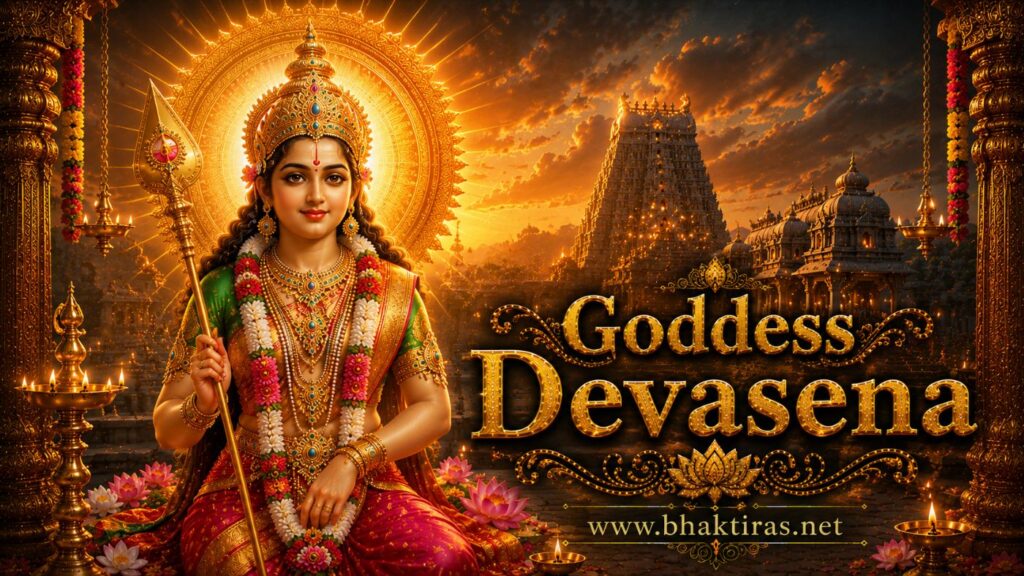
Who Is Goddess Devasena?
Goddess Devasena is the divine wife of Lord Murugan, the youthful war-god of the Tamil people who is also known as Kartikeya, Skanda and Subrahmanya. Where Murugan carries the spear and leads the armies of heaven, Devasena walks beside him as the queen of divine order, the daughter of Indra himself and a princess of the celestial realm.
Her Sanskrit name, Devasena, carries a beautiful double meaning. It is the name of a goddess, and it also means “the army of the devas” – the very forces her husband was chosen to command. In this way her name and her marriage tell a single story: the commander of heaven’s army and the goddess who is that army, joined together.
In Tamil Nadu she is loved by another name, Deivayanai, often explained as “she who rides the divine elephant.” This title ties her to her mount, the celestial elephant Airavata’s line, and to the dignity and steadiness that an elephant represents in Indian thought. She is not a fierce or wild goddess. She is calm, regal and composed, a figure of settled dharma rather than sudden fury.
Devasena is almost always worshipped in the company of her husband. In the great Murugan temples of the Tamil country you will find her standing on one side of the deity, with his second consort Valli on the other. Together the three form a familiar and beloved sight, and much of Devasena’s meaning comes precisely from this pairing – what she is, and what she is not, next to Valli.
The Daughter of Indra
Devasena’s story begins in Amaravati, the shining city of the gods, for she is the daughter of Indra, king of the devas and lord of the heavens. To be Indra’s daughter is to be born into the highest celestial royalty, and this heritage shapes everything about her. She is a princess of heaven long before she becomes the bride of a god.
The tradition tells us that Devasena was raised in her father’s court among the immortals, familiar with the order and ceremony of the divine world. This upbringing matters, because it explains the kind of goddess she becomes. Her dignity is not learned by struggle; it is the natural bearing of one born to rule alongside kingship.
Some accounts of the Skanda tradition describe her as one of two divine maidens entrusted to the care of the gods, a daughter of the celestial order who was destined from the start for a great and ordained marriage. Whatever the version, the thread is constant – Devasena belongs to heaven by birth, and her hand is not given lightly. When the moment comes, it is Indra himself who bestows her, and that gift is treated as a matter of cosmic importance, sealing an alliance between the throne of the gods and the young commander who would save them.
The Ordained Marriage to Murugan
The Rise of Surapadman
The heavens had fallen into shadow. The mighty demon Surapadman, together with his brothers, had grown so powerful through austerity and boon that he seized the three worlds. He drove the devas from their thrones, imprisoned them, and cast a long fear over the celestial city. Indra, the king of the gods, could not defeat him. The devas needed a champion who did not yet exist – a warrior born to end this darkness.
The Coming of Murugan
From the fiery grace of Lord Shiva, Murugan was born, the six-faced god of unconquerable youth. The devas turned to him and made him the commander of their armies. Carrying the divine Vel, the spear given by his mother the Goddess, Murugan marched against Surapadman. In the great battle at the shore of the sea, he broke the demon’s power, and with the Vel he split Surapadman in two – transforming the demon into his peacock mount and his rooster banner, so that even the defeated foe was drawn into service.
Indra's Gift
With the heavens freed and order restored, the gratitude of the devas had to find its form. Indra, whose throne Murugan had rescued, gave to the young victor the most precious thing in his house – his own daughter, Devasena. The marriage was no accident of romance. It was ordained, arranged and celebrated as a sacred duty, the fitting union of the deliverer of heaven with the princess of heaven. In this ceremonial wedding, the alliance between the king of the gods and the commander of the gods was made complete, and Devasena became the queen at Murugan’s side.
Devasena as Kriya Shakti – the Power of Divine Action
In the deeper theology of the Murugan tradition, Devasena is understood as kriya shakti – the power of divine action, of ordered will made real. The Shaiva schools speak of three great powers of the Divine: iccha shakti, the power of desire or loving will; jnana shakti, the power of knowledge; and kriya shakti, the power of action that brings the will into the world. Devasena is that third power, the force that carries out dharma in a fitting and ceremonious way.
This is why her marriage is described as the sampradaya union – the ordained, ritual, ceremonial marriage arranged according to sacred custom. She does not come to Murugan through longing or through a hard-won courtship. She comes through the proper channels of heaven: chosen by her father, given in a sanctioned rite, joined to the god by the correct order of things. Her love is expressed as faithful order, as duty perfectly kept.
To worship Devasena, then, is to honour the principle that divine action follows a right and dignified path. She stands for everything that is settled, lawful and complete – the reward that follows victory, the marriage that follows valour, the peace that follows a righteous war. Where fierce goddesses burn away disorder, Devasena embodies the calm authority of order restored.
Devasena and Valli – the Two Consorts
Murugan is a god with two beloved wives, and the whole meaning of Devasena shines most clearly when she is set beside the other, Valli. The two goddesses are not rivals in the tradition; they are two halves of a single truth, and Tamil devotion cherishes them together.
Devasena is the celestial bride, the daughter of Indra, given in an ordained and ceremonious marriage. Valli, by contrast, is the daughter of a hunter chieftain, a girl of the hills whom Murugan wooed and won through a long and playful courtship. Devasena’s is the sampradaya marriage, the arranged and sanctioned union; Valli’s is the kalavu or love marriage, born of mutual longing.
Read as theology, the two consorts are two shaktis of the god. Valli represents iccha shakti, the power of loving desire and freely given grace – the way the Divine reaches down to the lowly and draws them near through love. Devasena represents kriya shakti, the power of ordered action and formal dharma – the way the Divine acts through right structure and sacred custom. Together they mean that Murugan holds both grace and order, both the wild tenderness of love and the steady dignity of law. A devotee stands before all three – god and both goddesses – and receives the fullness of the divine embrace.
Iconography & Symbols
Devasena is rarely depicted alone. Her form is read alongside her husband and her sister-consort, and each detail carries meaning.
The Regal Bride
She is shown as a graceful, richly ornamented goddess, standing to one side of Murugan while Valli stands on the other. Her bearing is calm and queenly, the composure of one born in the court of heaven.
The Elephant
Her Tamil name Deivayanai links her to the divine elephant. The elephant signals royal dignity, strength held in stillness, and the celestial pedigree she carries as the daughter of Indra, whose own mount is the great elephant Airavata.
The Lotus
As a goddess of purity and settled auspiciousness, she is often associated with the lotus, the flower that opens in clear order and represents beauty that rests upon dharma.
Consort Posture
In temple bronzes and stone she is placed in the sanctified position of the wedded queen, her presence completing the triad of Somaskanda-like family groupings where the god is flanked by his consorts.
How Goddess Devasena Is Worshipped
Because Devasena is honoured as part of Murugan’s divine family, her worship is woven into the wider devotion to the six-faced god. Devotees turn to her for a blessed and orderly married life, for domestic harmony, and for success that comes through right conduct.
- Offering worship to Murugan flanked by Devasena and Valli, honouring the god together with both his consorts as a complete divine family.
- Praying for a happy and stable marriage and for harmony within the home, since Devasena presides over the ordained, well-ordered union.
- Celebrating the divine wedding of Murugan and Devasena during temple festivals, especially at Tiruparankunram where the marriage is commemorated with grand ceremony.
- Reciting Murugan’s names and hymns along with the simple mantra Om Devasenayai Namah in her honour.
- Seeking her grace for victory, discipline and the successful completion of righteous undertakings, in keeping with her nature as kriya shakti, the power of divine action.
Temples & Sacred Sites
Devasena is present in every major Murugan shrine, but two of the six great Padai Veedu (battle-camp) temples of the god are especially bound to her story.
- Tiruttani: One of the six sacred abodes of Murugan, set upon a hill in Tamil Nadu. Tradition holds this as the place where Murugan, having ended the war, found peace and settled with Devasena. It is a temple of calm after victory, where the god’s married dignity is especially felt.
- Tiruparankunram: Near Madurai, this is the celebrated site of the divine wedding of Murugan and Devasena. As the temple that commemorates their marriage, it is deeply associated with Devasena, and her presence there marks it as a place devotees visit to pray for auspicious unions.
- The six Padai Veedu shrines: Across Palani, Swamimalai, Thiruchendur, Pazhamudircholai and the sites above, Devasena is enshrined beside Murugan as the honoured queen, so that pilgrims on the Aru Padai Veedu circuit worship her throughout their journey.
Prayers & Mantras
The simplest and most cherished way to call upon the goddess is her seed salutation, offered with a quiet heart before her image beside Lord Murugan.
Devanagari: ॐ देवसेनायै नमः
Transliteration: Om Devasenayai Namah
Meaning: “Om, salutations to Devasena.” This short mantra bows to the celestial consort of Murugan, honouring her as the daughter of Indra and the goddess of ordained dharma. Repeated with devotion, it is a prayer for a harmonious married life, for domestic peace, and for the grace of divine order in one’s affairs.
Frequently Asked Questions about Goddess Devasena
Who is Goddess Devasena?
Devasena is the divine consort of Lord Murugan (Kartikeya) and the daughter of Indra, king of the gods. In Tamil she is called Deivayanai. She was given to Murugan in an ordained marriage after his victory over the demon Surapadman, and she embodies kriya shakti, the power of divine action and ordered dharma.
Who are the two wives of Murugan?
Murugan has two consorts, Devasena and Valli. Devasena is the celestial daughter of Indra, joined to him in a divinely ordained, ceremonial marriage. Valli is a hunter chieftain's daughter, won through a loving courtship. Together they represent the god's ordered power and his loving grace.
What does Devasena represent?
Theologically, Devasena represents kriya shakti, the power of divine action and formal, ordered dharma. Her marriage is the sampradaya union, the arranged and sanctioned rite. She stands for order restored, for the ceremonial and lawful side of the Divine, in contrast to Valli's grace of love.
Why is Devasena called Deivayanai?
Deivayanai is her beloved Tamil name, commonly explained as "she who rides the divine elephant." The elephant links her to the celestial royalty of her father Indra and expresses her regal, dignified character. Under this name she is worshipped throughout the Tamil Murugan temples.
What is the difference between Devasena and Valli?
Devasena is the daughter of Indra, married to Murugan through an ordained, arranged rite, and she embodies kriya shakti, the power of ordered action. Valli is a forest chieftain's daughter, won through love, and she embodies iccha shakti, the power of loving grace. The two together complete the god.
Which temples are sacred to Devasena?
Devasena is enshrined beside Murugan in all his great temples. Tiruparankunram near Madurai is famed as the site of her wedding to Murugan, and Tiruttani is honoured as the place where the god settled in peace with her after the war. Both are among the six sacred abodes of Murugan.
What is the mantra of Goddess Devasena?
Her simple seed mantra is Om Devasenayai Namah (ॐ देवसेनायै नमः), meaning "salutations to Devasena." Recited with devotion beside prayers to Murugan, it is offered for a harmonious married life, domestic peace, and the blessing of divine order in one's undertakings.
May the calm grace of Goddess Devasena, the ordained consort of Lord Murugan, bless your home with harmony and your life with the steady dignity of dharma.