
Goddess Valli
वल्ली
Valli is the younger and dearly loved consort of Lord Murugan (Kartikeya). A girl of the Kurava hunter-tribe, found as an infant in a millet field, she was wooed by Murugan while she guarded the fields. In Tamil devotion she stands for iccha shakti, the loving longing of the soul that draws the Lord down to the humble.
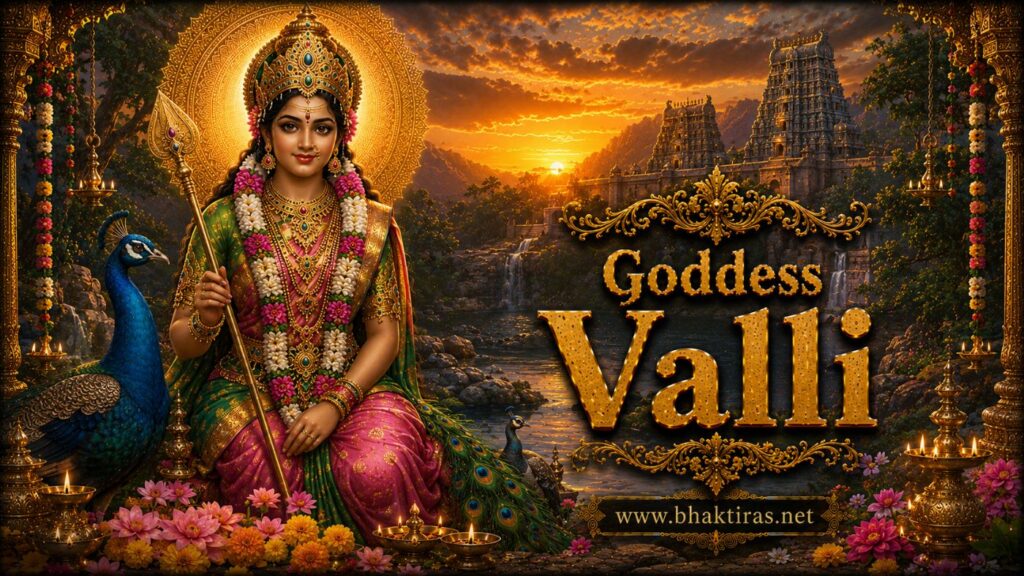
Who Is Goddess Valli?
Valli is the younger of Lord Murugan’s two consorts, and among Tamil devotees she is the one spoken of with the softest affection. Where Devasena, the daughter of Indra, is the bride of the heavens and of dignity, Valli is the bride of the earth and of the hills – a girl of the forest, dark and lithe, who watched over her father’s millet crop and won the heart of a god without ever leaving her village.
Her story belongs to the Kurava people, a hunting and gathering tribe of the Tamil hills. She was not born into any royal or celestial house. She was found, an unknown infant, lying in a field, and she was raised by simple folk who knew nothing of the greatness that would come to their door. That humble beginning is the whole point of her. Valli is proof that the divine does not wait for the worthy to climb up to it; sometimes the divine comes down, in disguise, and does its own patient courting.
In the theology of Tamil Shaivism she carries a precise meaning. She is iccha shakti, the power of desire and longing, but a desire turned wholly toward God. When a soul aches with love and calls out with no thought of its own smallness, that ache is Valli. And the answer to that ache – the Lord who cannot stay away – is Murugan coming to her millet field.
She is worshipped standing at Murugan’s side in nearly every great Tamil temple of the god, a quiet folk-goddess who reminds the crowd that love, and not status, is the road that reaches heaven.
The Hill Maiden of the Kurava People
The tradition tells that Valli was found as a baby in a field of tinai, the small hill-millet the Kurava tribe grew on the slopes. The chieftain of the tribe, a hunter named Nambi, had no daughter, and when the infant was placed in his arms he took her home and raised her as his own. She grew up among the drums and the game-trails, learning the ways of the forest people rather than the ways of palaces.
As she came of age, her task was the humblest and most ordinary one a hill-girl could be given. She sat in a raised watch-hut in the millet field, a tinai punam, and kept the parrots and the wild birds from stripping the ripening grain. Day after day she guarded the crop, clapping and calling out, alone under the sky with the hills around her.
It is this picture that Tamil devotion loves – not a queen on a throne but a barefoot girl in a field, doing plain work, unaware that the Lord of the six hills had already set his heart on her. The setting matters. Valli’s holiness does not descend from her birth or her wealth, because she had neither. It rises from who she is: pure, unspoiled, and capable of a love strong enough to hold a god.
How Murugan Won Valli's Love
The Lord Comes as a Hunter
Murugan had heard of the hill-girl and came to the millet field himself, taking the form of a young hunter of her own people. He spoke to her kindly and asked for her love, but Valli, guarding her crop and shy of a stranger, would not give her heart so easily. She turned him away with a girl’s caution, and the disguised god withdrew to think again.
The Lord Comes as an Old Man
Murugan returned in a second disguise, this time as a frail old man, weary and asking for food and water. Valli, gentle by nature, cared for the old traveller and gave him what he asked. But when the old man began to speak of love and of taking her as his own, she grew alarmed and drew back once more, unwilling to be won by trick or by pity.
Ganesha as the Wild Elephant
Then Murugan called on his elder brother, Lord Ganesha, and Ganesha appeared in the field as a wild tusker crashing out of the forest. Terrified, Valli ran straight to the only shelter near her – the old man, who at that moment shed his disguise and stood revealed as the shining Lord Murugan. In her fear she had run into the arms of the very one who loved her, and now she saw him truly. Her resistance melted into recognition, and she gave him her love freely at last. So the god and the hill-maiden were joined, and Ganesha, the elephant who had frightened her, is remembered with a smile as the brother who brought the two together.
Valli as Iccha Shakti – the Power of Loving Grace
Behind the tender story lies a teaching. In Tamil Shaiva thought the Lord’s grace works through three powers, and Valli is named as iccha shakti, the power of loving desire. Murugan’s two consorts are read as two of these forces held close on either side of him: Devasena as the shakti of action and lordly power, and Valli as the shakti of yearning, the pull of pure love.
What does it mean that God fell in love with a nameless tribal girl and courted her in disguise? It means grace does not measure birth. Valli had no lineage, no learning, no place at any high table. She had only an open and unspoiled heart. And that, the tradition insists, is exactly what the Lord seeks. The soul that longs for God with no pride and no bargaining is the soul God comes running to meet.
So the disguises are not a trick played on Valli; they are a picture of how the divine draws near to us. God comes softly, sometimes unrecognised, testing whether our love is true. And when at last we run – even in fear, even in confusion – toward the only refuge there is, we find we have run straight into the arms of the one who was seeking us all along. Valli is that running. She is the devotee’s love answered by the Lord’s love, the low made high by grace alone.
Valli, Murugan and Devasena
In the great Tamil temples Murugan rarely stands alone. On one side is Devasena, the celestial bride, daughter of the king of the gods, given to him after his victory over the demon Surapadma. On the other side is Valli, the earthly bride, the hill-girl he wooed himself. Devotees see the two as complementary rather than rival – two loves that together make the Lord whole.
Devasena carries the note of order, of the heavens, of a marriage arranged in glory. Valli carries the note of intimacy, of the earth, of a love won through patience and disguise. One is the bride of Murugan’s power; the other is the bride of his tenderness. Together, standing at his shoulders, they show that the same Lord receives both the mighty and the lowly, both the crowned and the barefoot, and joins them in himself.
Tamil worshippers, given the choice, often speak to Valli first, feeling that a girl of the hills who was once as ordinary as themselves is the easiest doorway to a god who might otherwise seem far above them.
Iconography & Symbols
The Young Hill-Girl
Valli is shown as a slender, youthful woman, gentle-faced and often darker in complexion, marking her as a daughter of the forest people rather than a fair celestial. Her simplicity is deliberate – she is beauty without ornament of rank.
At Murugan's Left
In temple images she usually stands to one side of Lord Murugan, with Devasena on the other, hands folded or holding a lotus or a garland. Her placement beside the god is her theology made visible: the humble devotee raised to stand at the Lord’s very shoulder.
The Millet Field
Her origin story keeps the tinai millet close to her memory. The field she guarded, the raised watch-hut, and the parrots she scared away all became emblems of a love that grew out of ordinary daily work rather than grand ceremony.
The Vine
Her very name recalls a creeper that clings and climbs. It is a fitting image for iccha shakti – the soul’s love winding upward toward God, holding fast, reaching for the light above.
How Goddess Valli Is Worshipped
Valli is honoured wherever Lord Murugan is worshipped, and her presence beside him is part of nearly every act of devotion to the god. Her worship carries a warm, folk quality – the love of ordinary people for a goddess who was once one of them.
- Offering prayers to Valli standing beside Murugan, so that the god is approached through his tender bride rather than his power alone.
- Chanting Om Vallyai Namah or her name together with Murugan’s, asking that one’s love for God be made pure and unwavering.
- Celebrating Thaipusam and Skanda Shashti, the great Murugan festivals, when Valli and Devasena are carried in procession at the Lord’s side.
- Devotees who seek a loving marriage or a heart fixed on God often turn to Valli, remembering how her sincere love drew the Lord to her.
- Simple offerings of millet, flowers, and lamps echo the humble field where the god first came to her.
Temples & Sacred Sites
Valli is present in the major Murugan temples of Tamil Nadu, where she stands with Devasena at the god’s side. A few sites are especially tied to her story and her name.
- The Arupadaiveedu (Six Abodes of Murugan) – Tiruttani, Palani, Swamimalai, Thiruchendur, Pazhamudircholai and Thiruparankundram all enshrine Murugan with Valli and Devasena beside him.
- Thiruttani – especially linked to Valli, remembered in tradition as near the hill country where the god wooed her.
- Vallimalai – a hill site in the Tamil country whose very name honours Valli and her origin among the hills.
- Murugan temples across Tamil Nadu, Sri Lanka and the Tamil diaspora – wherever the god is installed, Valli is carved and worshipped at his shoulder.
Prayers & Mantras
Valli is invoked in the simplest way, by her name spoken with love, often paired with the name of Lord Murugan. Her chief mantra is short enough for anyone to hold, which suits a goddess who honours the humble.
ॐ वल्ल्यै नमः
Om Vallyai Namah
“I bow to Goddess Valli.” This simple salutation offers loving reverence to the hill-maiden bride of Murugan, asking that the devotee’s own love for God become as sincere and unshaken as hers.
Frequently Asked Questions about Goddess Valli
Who is Goddess Valli?
Valli is the younger and dearly loved consort of Lord Murugan (Kartikeya). She was a girl of the Kurava hunter-tribe, found as an infant in a millet field and raised in the Tamil hills. In devotion she represents iccha shakti, the loving longing of the soul that draws God near to the humble.
How did Murugan marry Valli?
Murugan wooed Valli while she guarded her father's millet field, first coming disguised as a young hunter and then as an old man. When she resisted, he asked his brother Ganesha to appear as a wild elephant. Frightened, Valli ran into the old man's arms, who revealed himself as Murugan, and she gave him her love.
What does Valli represent?
Valli represents iccha shakti, the power of loving desire and grace. She is the yearning of the devotee's heart, the sincere love that reaches God regardless of birth or status. Her story teaches that the divine comes down to meet even the lowliest soul who loves purely.
Why is Ganesha part of Valli's story?
When Valli kept resisting Murugan's courtship, he called on his elder brother Ganesha, who appeared as a wild elephant to frighten her. In her fear she ran to Murugan for shelter, and so their love was won. Ganesha is remembered fondly as the brother who brought the couple together.
How is Valli related to Devasena?
Valli and Devasena are the two consorts of Lord Murugan, standing on either side of him in temples. Devasena, daughter of Indra, is the celestial bride of his power, while Valli, the hill-girl, is the earthly bride of his tenderness. Together they show the Lord receiving both the mighty and the humble.
Where is Goddess Valli worshipped?
Valli is worshipped across Tamil Nadu wherever Lord Murugan is honoured, especially at the six sacred abodes of Murugan such as Tiruttani and Palani. Sites like Vallimalai carry her name, and she is worshipped beside the god in Murugan temples throughout South India, Sri Lanka and the Tamil diaspora.
What is the mantra of Goddess Valli?
The simple mantra of Goddess Valli is 'Om Vallyai Namah' (ॐ वल्ल्यै नमः), meaning 'I bow to Goddess Valli.' Devotees chant it, often together with Murugan's name, to ask that their own love for God become as sincere and steadfast as hers.
May Goddess Valli teach us that no heart is too humble for God, and that pure and steadfast love is itself the path that reaches him.