
Theppotsavam 2027 – Madurai's Luminous Float Festival
தெப்போற்சவம்
When is Theppotsavam (the Madurai Float Festival) in 2027?
Theppotsavam, the Madurai Float Festival, is expected around 1 February 2027, on the full moon of the Tamil month Thai (Thai Purnima). On this night the decorated images of Goddess Meenakshi and Lord Sundareswarar are floated on an illuminated raft around the Mariamman Teppakulam tank. The exact date is set by the Tamil lunar calendar, so confirm it locally closer to the time.
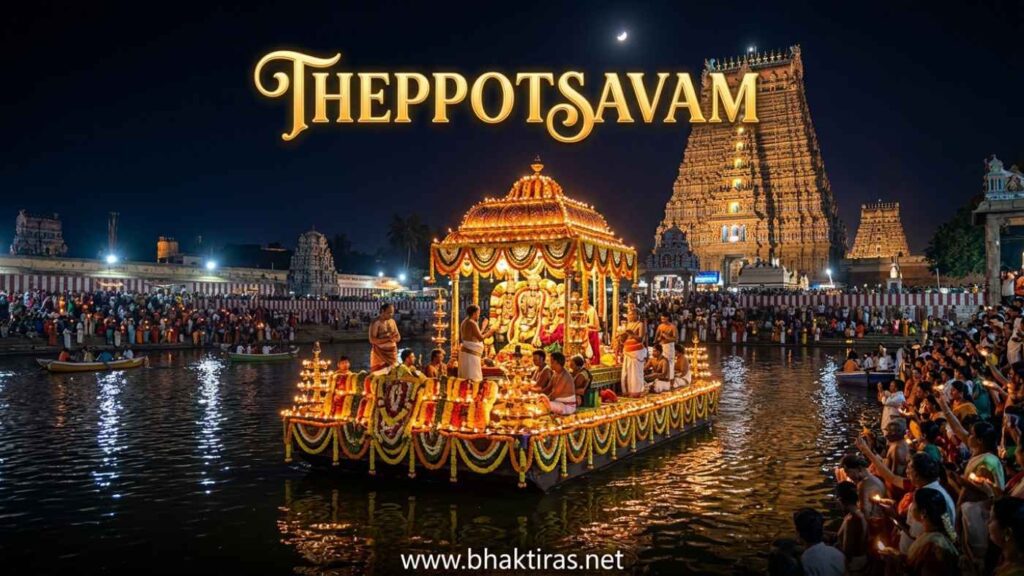
Theppotsavam is the float festival of Madurai, held on the full-moon night of the Tamil month Thai. The bronze processional images of Goddess Meenakshi and her consort Lord Sundareswarar, a form of Shiva, are dressed in silk and gold, seated on a raft strung with lamps and flowers, and drawn slowly around the vast Mariamman Teppakulam tank as nadaswaram and drums carry across the water. It marks their divine wedding, and the reflection of hundreds of lamps on the dark tank makes it one of South India’s quietest, most luminous nights.
Theppotsavam 2026-2028: Dates & Calendar
Theppotsavam falls on Thai Purnima, the full moon of the Tamil month Thai, which lands in late January or early February. Because it follows the moon, the date shifts by a week or two each year.
| Year | Date | Day | Notes |
|---|---|---|---|
| 2026 | 1 February | Sunday | Held on Thai Purnima at Mariamman Teppakulam |
| 2027 | 1 February (approx) | Monday | Next occurrence – confirm locally |
| 2028 | Late January (approx) | – | Thai Purnima shifts earlier; date to be confirmed |
The float is usually taken around the tank three or five times over the evening, with the final circuit late into the night. Some years the temple spreads the celebration across several days, with the main teppam on the full-moon night itself.
Why Theppotsavam Is Celebrated
Theppotsavam celebrates the married life of Goddess Meenakshi and Lord Sundareswarar, giving the deities a night of leisure on the water after their grand wedding earlier in the year.
In Madurai temple tradition, the festivals of the year tell the story of Meenakshi’s reign, her wedding to Sundareswarar, and their life together. The float festival is the gentle, domestic chapter: the divine couple simply enjoying a boat ride, honoured by their people.
The divine couple at leisure
After Meenakshi’s celebrated wedding, Theppotsavam lets the goddess and her consort be taken out for a calm evening on the tank. It is less a spectacle of power than a family scene, the deities cared for and adorned like a beloved couple on an outing.
A king's birth star
The Madurai float festival is timed to the Poosam (Pushya) birth star of King Thirumalai Nayak, the 17th-century ruler who dug the enormous Mariamman Teppakulam tank. Celebrating on his star links the festival to the man whose engineering made it possible.
Water, lamp and reflection
Taking the deities onto water, encircled by lamps whose light doubles in the tank’s surface, carries the old idea of the sacred meeting the elements. The stillness of the water and the slow ropes give the night its meditative, unhurried mood.
Deities & Figures Worshipped
Theppotsavam honours the presiding couple of the Madurai Meenakshi temple: Goddess Meenakshi and Lord Sundareswarar, a form of Shiva.
Meenakshi
Meenakshi, the fish-eyed goddess and a form of Parvati, is the ruling deity of Madurai. Born a princess and crowned queen before her wedding, she is worshipped here as sovereign in her own right, with Sundareswarar as her consort.
Sundareswarar
Sundareswarar, ‘the beautiful lord’, is the Madurai form of Shiva and Meenakshi’s husband. On the float his image sits beside hers, the two carried together to mark their union.
Mariamman
The tank itself, Vandiyur Mariamman Teppakulam, takes its name from a shrine of the mother goddess Mariamman at its centre island, around which the float circles.
Key Rituals, Step by Step
The evening moves slowly and deliberately, from the dressing of the deities to the last circuit of the float across dark water.
- Adorning the deities. The processional images of Meenakshi and Sundareswarar are bathed, dressed in silk, and covered in gold ornaments and fresh garlands inside the temple.
- Procession to the tank. The decorated deities are carried in procession from the Meenakshi temple to the Mariamman Teppakulam tank, accompanied by nadaswaram, thavil drums and devotees.
- Mounting the float. The images are seated on the theppam, a raft built up with a lamp-lined pavilion, flowers and coloured cloth, moored at the tank’s central island shrine.
- Lighting the lamps. As dusk falls, rows of oil lamps on the float and around the tank are lit, their reflections spreading across the water.
- Drawing the float. Ropes handled from the banks pull the raft slowly around the central island, circling it three or five times through the evening.
- Aarti on the water. Priests offer worship and camphor aarti to the couple as the float moves, with music sounding from the shore.
- The final circuit and return. After the last round, often late at night, the deities are brought ashore and carried back in procession to the temple.
Special Foods of Theppotsavam
There is no fixed festival menu, but temple prasadam and Madurai’s own street food are part of the night for the crowds who line the tank.
Temple prasadam
Offerings made to the deities, such as sweet pongal, sugar-and-ghee rice and coconut, are shared as prasadam among devotees who come for darshan of the float.
Sakkarai pongal
Sweet pongal, jaggery-sweetened rice with cardamom, ghee and cashews, is the taste of the Thai month across Tamil Nadu and often appears around the festival.
Madurai street food
Around the crowded tank, vendors sell jigarthanda, the city’s famous cold milk drink, along with murukku, sundal and roasted snacks for families waiting through the long evening.
Theppotsavam Do's and Don'ts
A few simple courtesies help you enjoy a crowded night festival by the water.
Do
- Arrive early to find a spot along the tank steps before the crowds settle in.
- Carry a light shawl; the night by the open water can turn cool in Thai.
- Keep children close, as the banks are packed and the water is deep.
- Watch the full circuits patiently, as the float moves slowly by design.
- Confirm the year’s date with the temple, since it follows the lunar calendar.
Avoid
- Do not climb or lean on tank barriers to get a closer view of the float.
- Do not use flash or block others’ view when the deities pass on the water.
- Do not litter the tank surrounds; carry your waste back with you.
- Do not push through crowds; the darshan is slow and there is time for all.
- Do not assume last year’s date applies, as Thai Purnima shifts each year.
Frequently Asked Questions
When is Theppotsavam in 2027?
Theppotsavam, the Madurai Float Festival, is expected around 1 February 2027, on the full moon of the Tamil month Thai. As the date is fixed by the Tamil lunar calendar and announced by the temple, confirm it locally closer to the time.
When is Theppotsavam in 2026 and 2028?
In 2026 the Madurai Float Festival was held on 1 February, on Thai Purnima. In 2028 it is expected in late January as the Thai full moon shifts earlier; both should be confirmed against the temple’s announcement rather than treated as fixed.
Why is Theppotsavam celebrated?
Theppotsavam celebrates the married life of Goddess Meenakshi and Lord Sundareswarar by taking them out for a serene evening on the temple tank. At Madurai it is also timed to the birth star of King Thirumalai Nayak, who built the great Mariamman Teppakulam tank in the 17th century.
Which deities are worshipped during Theppotsavam?
Theppotsavam honours Goddess Meenakshi, the fish-eyed form of Parvati and presiding deity of Madurai, together with her consort Lord Sundareswarar, a form of Shiva. Their processional images are floated side by side to mark their union.
Where does the Madurai Float Festival take place?
The Madurai Float Festival is held at the Vandiyur Mariamman Teppakulam, the largest temple tank in Tamil Nadu, with a shrine on its central island. The decorated float circles this island several times through the night.
What is the meaning of the word Theppotsavam?
Theppotsavam combines the Tamil ‘theppam’, meaning a raft or float, with ‘utsavam’, a festival, so it literally means the float festival. The deities are carried on the theppam around a sacred tank, giving the celebration its name.
How is the float moved around the tank?
The theppam is a raft built up with a lamp-lit pavilion and moored at the tank’s central island. It is drawn slowly around the island by long ropes handled from the banks, usually three or five circuits, while music and aarti continue from the shore.
Are float festivals held only in Madurai?
No, float festivals are held at several South Indian temples, especially in Tamil Nadu and Andhra Pradesh, where deities are floated on temple tanks. The Madurai Theppotsavam on the Mariamman Teppakulam is the best known and grandest of them.
May the lamps on the water light your path this Thai Purnima. Theppotsavam Nalvazhthukkal.