
Paryushan Parva 2026 – Eight Days of Jain Forgiveness & Fasting
पर्युषण पर्व
When is Paryushan Parva in 2026?
Paryushan Parva runs from Tuesday, 8 September to Tuesday, 15 September 2026 for Svetambara Jains, ending on Samvatsari, the day of forgiveness. It is an eight-day period of fasting, self-restraint, daily discourses and the reading of the Kalpa Sutra, observed in Bhadrapada (August-September) by the Jain community across India and the diaspora.
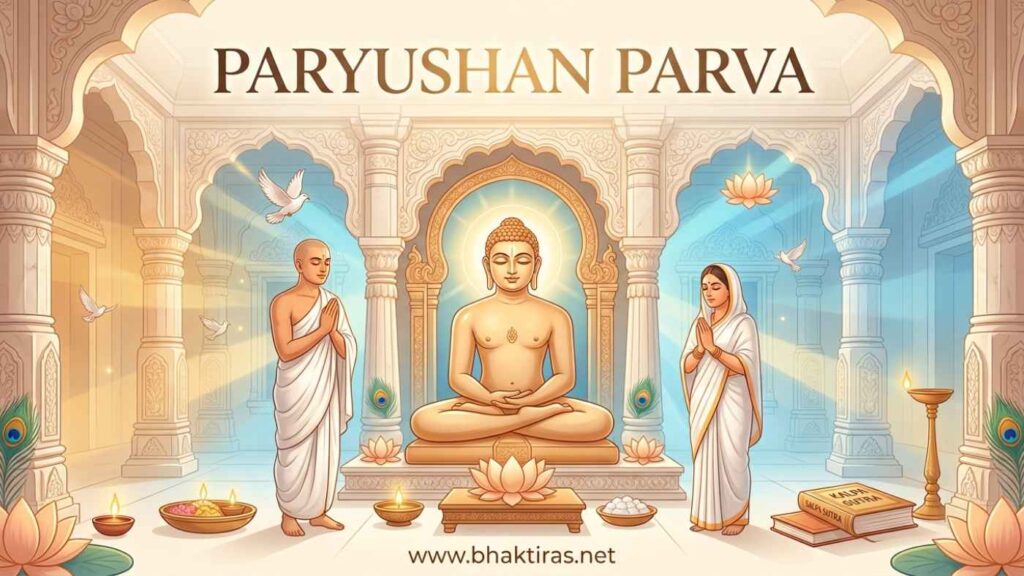
Paryushan Parva is the most important festival in the Jain year, an eight-day season of inner housekeeping rather than outward celebration. Observed by Svetambara Jains in the month of Bhadrapada (August-September), it asks each person to fast, quieten the senses, listen daily to the Kalpa Sutra, and settle old accounts of the heart. The eight days build toward Samvatsari, when Jains ask and grant forgiveness with the words Michchhami Dukkadam. In 2026 it falls from 8 to 15 September.
Paryushan Parva 2026-2028: Dates & Calendar
For Svetambara Jains, Paryushan Parva 2026 runs from 8 to 15 September, ending on Samvatsari. The dates shift each year because they follow the Jain lunar calendar, closing on Bhadrapada Shukla Chaturthi.
| Year | Paryushan begins | Samvatsari (last day) | Notes |
|---|---|---|---|
| 2026 | Tue, 8 September | Tue, 15 September | Next occurrence – 8-day Svetambara Paryushan |
| 2027 | Sat, 28 August | Sat, 4 September | Ends on Bhadrapada Shukla Chaturthi |
| 2028 | Thu, 17 August | Thu, 24 August | Some communities may observe Samvatsari on Wed, 23 August |
Svetambara Jains keep an eight-day Paryushan; Digambara Jains observe the parallel ten-day Das Lakshan Parva, which begins the day the Svetambara festival ends.
Why Paryushan Parva Is Observed
Paryushan Parva is observed as an annual retreat for the soul: a set-aside week for fasting, study and self-correction so a person can shed accumulated karma and begin again with a lighter conscience.
The word Paryushan carries the sense of drawing near and staying close – close to one’s own conduct, and, for wandering monks, staying put in one place during the rains rather than travelling. During these days the outside world is turned down and the inner one is turned up.
A rains retreat, turned inward
The festival grew from the monastic practice of pausing all travel during the monsoon to avoid harming the tiny lives that flourish in the wet season. That pause became a fixed season of study and restraint for monks, nuns and lay Jains alike, held every year in Bhadrapada.
Ten virtues, one week
Paryushan is built around ten cardinal virtues, among them forgiveness, humility, honesty, contentment and non-attachment. Each is taken up as something to practise, not merely admire, over the eight days.
Culminating in forgiveness
Everything points toward Samvatsari, the final day. Fasting and study prepare the mind so that the act of seeking pardon is sincere rather than a formality. Jains ask forgiveness of every living being they may have hurt, in thought, word or deed.
The Kalpa Sutra retold
Across the eight days the Kalpa Sutra is read aloud, recounting the life of Bhagwan Mahavira and the earlier Tirthankaras. Hearing it each year keeps the ideals of non-violence and detachment close and personal.
What Paryushan Honours
Jainism does not centre on a creator god, so Paryushan honours the Tirthankaras – the enlightened teachers who showed the path – and, above all, the discipline of the soul itself.
Bhagwan Mahavira
The twenty-fourth and last Tirthankara, whose life and teachings are read from the Kalpa Sutra through the festival. His example of extreme non-violence and self-conquest sets the tone for the eight days.
The twenty-four Tirthankaras
The line of ford-makers who crossed the ocean of rebirth and taught others to do the same. Paryushan recalls their combined message rather than worshipping a deity for favours.
The soul's own effort
Ultimately the festival turns attention to one’s own atma – the soul – which each person is responsible for purifying through fasting, restraint and forgiveness. The work is personal and cannot be outsourced.
Key Practices, Day by Day
Paryushan is kept through disciplines of body and mind rather than large public rites. These are the threads that run through the eight days.
- Upvas (fasting). Devotees take up fasts ranging from a single day to the complete atthai of all eight days on boiled water alone; many keep partial fasts, giving up green vegetables, roots or a meal.
- Kalpa Sutra reading. The community gathers daily at the upashray or temple to hear the Kalpa Sutra recited and explained, following the life of Mahavira through the week.
- Pratikraman. Each day includes pratikraman, a structured review and repentance in which one looks back over conduct and asks pardon for faults committed knowingly or unknowingly.
- Samayik. Devotees sit in samayik, a set period of equanimity and meditation, withdrawing from activity to steady the mind and cultivate calm.
- Restraint and non-violence. Ahimsa is kept with extra care – simpler food, careful speech, gentleness toward all life – so that non-violence is lived, not just read about.
- Daan (charity). Giving to those in need, supporting the needy and animals, and offering to the community are woven through the festival as an expression of compassion.
- Swadhyay. Time is set aside for self-study of scripture and reflection, so that the discourses heard by day are absorbed rather than passing by.
- Samvatsari and Michchhami Dukkadam. On the eighth and final day, after the year’s most intense fasting and prayer, Jains seek and grant forgiveness with the words Michchhami Dukkadam – may any harm I have caused be forgiven.
Food During Paryushan Parva
Paryushan is a season of eating less, not feasting. What is eaten follows strict Jain rules, and the celebratory dishes appear only when the fast is broken.
Boiled water and fasting
Those keeping the full atthai take only boiled, cooled water (usually before sunset) for eight days. Even lighter fasts avoid grains or restrict eating to one daytime meal.
No root vegetables
The Jain diet excludes onion, garlic, potato and other roots throughout, since pulling a root harms the whole plant and the many organisms in the soil. Cooking and eating are finished before dusk.
Simple sattvik meals
Those not fasting eat plain, freshly cooked sattvik food – moong dal, rice, roti and mild vegetables – kept simple and taken during daylight.
Parna (breaking the fast)
The fast is broken gently the morning after Samvatsari, traditionally with sugarcane juice or a light preparation, before returning to normal food. The parna is a quiet, grateful moment rather than a banquet.
Paryushan Across Communities
Paryushan is kept wherever Jains live, and its shape shifts a little between the two major traditions and between homeland and diaspora.
Svetambara tradition
The eight-day Paryushan described here, ending on Samvatsari, is the Svetambara observance, strong across Gujarat, Rajasthan, Maharashtra and Madhya Pradesh.
Digambara tradition
Digambara Jains observe the parallel Das Lakshan Parva for ten days, focusing on the ten virtues, which begins as the Svetambara festival closes.
Gujarat and Rajasthan
In the Jain heartland, upashrays and temples fill for daily Kalpa Sutra readings, and long fasts including the atthai are common. Families arrange charity and community meals for breaking fasts.
The diaspora
Jain centres in the United States, the United Kingdom, East Africa and elsewhere hold Paryushan with pravachans, pratikraman and Kalpa Sutra recitals, often streaming discourses so scattered families can observe together.
Paryushan Parva Do's and Don'ts
A few gentle guidelines help keep the spirit of restraint and forgiveness that the festival is about.
Do
- Attend the daily Kalpa Sutra reading and discourses
- Keep a fast within your capacity, even a partial one
- Do pratikraman and reflect honestly on your conduct
- Seek and grant forgiveness sincerely on Samvatsari
- Give in charity and show compassion to all beings
Avoid
- Do not eat root vegetables, onion or garlic
- Do not eat or cook after sunset
- Do not turn fasting into a competition or display
- Do not carry grudges into or out of Samvatsari
- Do not act carelessly toward any living creature
Frequently Asked Questions
When is Paryushan Parva in 2026?
Paryushan Parva 2026 runs from Tuesday, 8 September to Tuesday, 15 September for Svetambara Jains, ending on Samvatsari. It is an eight-day festival observed in the Jain lunar month of Bhadrapada.
When is Paryushan Parva in 2027 and 2028?
Paryushan Parva falls on 28 August to 4 September in 2027, and on 17 August to 24 August in 2028 for Svetambara Jains, ending on Samvatsari each year. The dates move annually because they follow the Jain lunar calendar; in 2028 some communities may keep Samvatsari on 23 August.
Why is Paryushan Parva celebrated?
Paryushan Parva is observed as the Jain year’s chief period of spiritual purification. Over eight days Jains fast, hear the Kalpa Sutra, practise pratikraman and restraint, and cultivate ten virtues, ending on Samvatsari, the day of universal forgiveness.
How long does Paryushan Parva last?
Paryushan Parva lasts eight days for Svetambara Jains, ending on Samvatsari. Digambara Jains observe the parallel Das Lakshan Parva for ten days, which begins as the Svetambara festival ends.
What is Samvatsari?
Samvatsari is the final and most sacred day of Paryushan Parva, the day of universal forgiveness. Jains seek and grant pardon from every living being with the words Michchhami Dukkadam, meaning may any harm I have caused be forgiven.
What does Michchhami Dukkadam mean?
Michchhami Dukkadam is the Jain phrase of forgiveness exchanged on Samvatsari. It means may any wrong or harm I have done to you, knowingly or unknowingly, be forgiven and rendered fruitless – a request to wipe the slate clean.
What is the difference between Paryushan and Das Lakshan Parva?
Paryushan Parva is the eight-day Svetambara observance ending on Samvatsari, while Das Lakshan Parva is the ten-day Digambara observance focused on the ten cardinal virtues. They fall in the same season, with the Digambara festival beginning as the Svetambara one ends.
What do Jains eat during Paryushan?
Jains eat very simply during Paryushan or fast outright. Those keeping the full atthai take only boiled water for eight days; others avoid grains, roots, onion and garlic, and finish all eating before sunset.
May the eight days bring stillness, and Samvatsari bring peace of heart – Michchhami Dukkadam.