
Lord Rama
राम
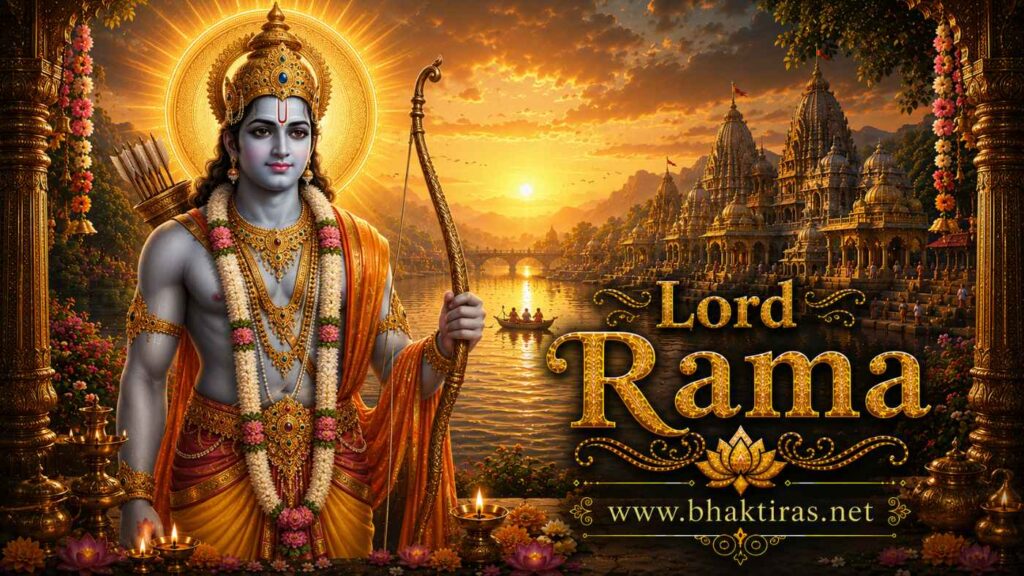
Lord Rama is the seventh avatar of Vishnu and the beloved prince and king of Ayodhya, revered as Maryada Purushottam, the perfect man of dharma. The hero of the Ramayana, he honoured his father's word through a fourteen-year exile, rescued his wife Sita from the demon-king Ravana, and reigned so justly that his rule, Rama Rajya, became the ideal for all time.
Who Is Lord Rama?
Lord Rama is one of the most cherished figures in the whole of Hindu devotion, the seventh avatar of Vishnu who took human birth to walk among people and show, by living it, what a life of righteousness looks like. He is not worshipped only as a distant deity in the heavens; he is loved as a son, a brother, a husband, a friend and a king who felt sorrow and joy exactly as we do, and who chose the harder, truer path at every turn.The Divine Prince of Ayodhya
Born the eldest son of King Dasharatha and Queen Kausalya in the great city of Ayodhya, Rama belonged to the Ikshvaku line of the Suryavamsha, the Solar dynasty whose kings had long been protectors of dharma. From his earliest years he carried himself with a gentleness and steadiness that drew everyone to him, and the people of Ayodhya loved him as their own heart.
Vishnu Come to Earth
When the demon-king Ravana grew so powerful that the earth groaned under his cruelty, the gods prayed to Vishnu for relief. Vishnu agreed to be born as a mortal, veiling his own divinity so that he could defeat Ravana within the bounds of the boon that made the demon nearly invincible. So the infinite took a cradle in Ayodhya, and dharma itself put on a human face.
Why He Is Loved
What makes Rama beloved is not power but character. He kept his word when keeping it cost him a kingdom. He honoured his parents even when their command was painful. He treated the humble vanara and the boatman with the same courtesy he showed sages and kings. In a single life he answered the quiet question every heart carries – how should a good person live?
Maryada Purushottam – the Ideal of Dharma
Rama is honoured above all as Maryada Purushottam, the supreme man who lives always within maryada – the sacred boundaries of right conduct. The title carries a whole philosophy of life.The Meaning of Maryada
Maryada means limit, restraint, the line one does not cross even when crossing it would be convenient. To call Rama the Purushottam, the highest of persons, is to say that he never once stepped outside those limits for his own gain. Where another prince might have argued, bargained or forced his will, Rama accepted the claim of duty, of promise, of elders, of truth – and he accepted it with grace, not resentment.
Dharma Over Desire
Again and again Rama placed dharma above his own comfort and even his own happiness. He gave up the throne he was about to inherit rather than let his father’s promise be broken. He endured the loss of Sita, the hardship of the forest and the weight of kingship without complaint. His life teaches that righteousness is not the reward we get for being good, but the very path we walk, whatever it costs.
A Living Standard
Because Rama held to dharma so completely, his conduct became a measuring line for all who came after. Parents still hold him up to children; sages still point to him; the very phrase Rama Rajya, the rule of Rama, means a time when justice, honesty and compassion govern the land. He is the proof that goodness and greatness are the same thing.
Birth, Youth and the Winning of Sita
The early story of Rama moves from the joy of his birth to the sage Vishwamitra’s forest, and finally to the assembly at Mithila where he won Sita by lifting a bow no other man could even stir.The Long-Awaited Birth
King Dasharatha, ageing and childless, performed a great sacrifice for the gift of sons. From the sacred fire came a divine offering of payasam, which his queens shared. In time Kausalya gave birth to Rama, Kaikeyi to Bharata, and Sumitra to the twins Lakshmana and Shatrughna. Ayodhya rang with celebration, for the light of Vishnu had entered the world. This is the day devotees keep as Ram Navami.
Under the Sage Vishwamitra
While still a youth, Rama was taken by the sage Vishwamitra to guard his forest hermitage from marauding demons. There the young prince, with Lakshmana beside him, mastered sacred weapons and freed Ahalya from a long curse with the touch of his feet. It was Vishwamitra who then led the brothers onward to the court of King Janaka at Mithila.
The Breaking of Shiva's Bow
Janaka had vowed to give his daughter Sita in marriage only to the one who could string the mighty bow of Shiva, an heirloom so heavy that many mighty kings had failed even to lift it. When Rama stepped forward, he raised the bow with ease, and as he bent it to string, it snapped with a sound like thunder. Sita placed the garland of victory around his neck, and so the perfect man met the perfect woman, Vishnu and Lakshmi united once more on earth.
The Fourteen-Year Exile
On the very eve of his coronation, Rama’s path turned from the throne to the forest. How he met that turn, without a word of protest, is one of the deepest lessons of his life.Kaikeyi's Two Boons
Years earlier, Dasharatha had granted Queen Kaikeyi two boons for saving his life in battle. Now, worked upon by her maid Manthara, she called them in. With the first she demanded that her son Bharata be crowned; with the second, that Rama be sent into the forest for fourteen years. The old king was broken, torn between love for his son and the promise he could not unsay.
Honouring His Father's Word
Rama did not argue for a moment. To him his father’s word was sacred, and a promise given must be kept even if the giver himself wished to take it back. Calmly he set aside silks for bark, the palace for the wilderness, and prepared to leave. Sita refused to stay behind, choosing the forest with her husband, and Lakshmana would not be parted from his brother. Together the three walked out of Ayodhya.
Life in the Forest
For long years they lived as ascetics among the woods and rivers, visiting sages, defending the hermitages from demons, and living simply on what the forest gave. Dasharatha, unable to bear his grief, passed away, and Bharata, who wanted no part of a throne won by his mother’s scheming, placed Rama’s sandals on it and ruled only as their servant until his brother should return. The exile tested every bond of the family, and every bond held.
The Abduction of Sita and the War with Ravana
The heart of the Ramayana turns on a single grief – the loss of Sita – and the long, faithful struggle to win her back, in which the humblest allies proved the greatest.The Golden Deer and the Abduction
Ravana, the ten-headed king of Lanka, plotted to seize Sita. A demon took the shape of a golden deer to lure Rama away, and a cry in Rama’s voice drew Lakshmana off too. Left alone, Sita was carried off by Ravana in his flying chariot to Lanka across the sea. Rama’s grief on returning to the empty hermitage is among the most human passages in all scripture – god himself weeping for a lost love.
Hanuman and the Vanara Alliance
Searching southward, Rama befriended Sugriva, the exiled vanara prince, and helped him regain his kingdom. In return the vanaras joined the search, and it was Hanuman – mighty, devoted and fearless – who leapt across the ocean to Lanka, found Sita in Ravana’s grove, gave her Rama’s ring, and carried back her token of hope. From that moment Hanuman became the very image of loving service, Rama’s greatest devotee.
The Bridge and the Battle
To cross the sea, the vanara army built a bridge of floating stones, the famous Ram Setu, over which the host marched to Lanka. There followed a great war. Ravana’s brothers and champions fell one by one, and at last Rama faced Ravana himself. With arrows blessed by the gods he struck down the demon-king, freeing Sita and lifting the shadow that had lain over the world. Dharma had triumphed over adharma.
The Return to Ayodhya and Rama Rajya
With Ravana defeated and the fourteen years complete, Rama, Sita and Lakshmana turned homeward – and the joy of that return still lights lamps across India every year.The Homecoming – Diwali
Rama returned to Ayodhya on the very day the exile ended. The people, who had waited fourteen long years, lined the streets and rooftops and lit rows of oil lamps to welcome their prince home through the darkness. That festival of lamps is Diwali, kept ever since as the celebration of light returning, of righteousness restored, of the beloved coming back to those who longed for him.
The Coronation
Rama was crowned king of Ayodhya with Sita beside him, Bharata joyfully returning the throne he had only kept in trust. The whole city rejoiced, and the sages blessed the reign that was to come. The one who had given up a kingdom for a promise now received it back, made worthy by all he had endured.
The Ideal Reign
The rule that followed became the measure of good government for all ages – Rama Rajya. In it there was no hunger, no injustice, no fear; the strong did not oppress the weak, the seasons came in their time, and every subject was heard. When people long for a just and gentle world, it is Rama Rajya they name. It remains less a memory than a promise of what dharma can build.
Rama, Sita, Lakshmana and Hanuman
Rama is rarely worshipped alone. The image most dear to devotees shows him with the three who shared his story most closely, together forming a family of devotion.Sita, the Faithful Consort
Sita, the avatar of Lakshmi, is Rama’s shakti and his equal in dharma. She chose the forest over the palace, endured captivity with unbroken faith, and stands as the model of steadfast love and inner strength. In worship the very name Sita Ram is spoken as one word, for the two cannot be parted. Where Rama is the ideal man, Sita is the ideal of devotion and grace.
Lakshmana, the Devoted Brother
Lakshmana gave up his own comfort, his home and even sleep to serve his brother through the exile. He is the picture of loyalty and selfless love, standing always a step behind Rama, sword ready, asking nothing for himself. In many temple images he is seen at Rama’s side, the younger brother who made his brother’s cause his whole life.
Hanuman, the Perfect Devotee
Hanuman holds a place all his own. His strength was matched only by his humility, and his heart belonged entirely to Rama. It is said that wherever the name of Rama is sung, Hanuman is present, listening. For countless devotees he is the doorway to Rama – the servant whose love is so pure that following him leads straight to the Lord. Together, Rama, Sita, Lakshmana and Hanuman fill the heart of Hindu devotional life.
The Festivals of Rama
Three of the great festivals of the Hindu year turn on the life of Rama, marking his birth, his victory and his return, and together they carry his story through every season.Ram Navami – His Birth
Ram Navami falls on the ninth day of the bright half of Chaitra, celebrating the birth of Rama in Ayodhya. Temples are decorated, the Ramayana is recited, and at noon – the traditional hour of his birth – a small cradle holding the infant Rama is rocked amid singing and joy. Devotees fast, sing bhajans and share the sweetness of the day, welcoming the Lord into the world once more.
Dussehra – Victory over Ravana
Dussehra, or Vijayadashami, marks the day Rama slew Ravana, the triumph of good over evil. In the weeks before, the Ramlila is enacted in towns across the north, retelling the whole story, and on the tenth day towering effigies of Ravana and his brothers are set ablaze. The burning is a yearly reminder that pride and cruelty, however mighty, must fall before righteousness.
Diwali – His Return
Diwali crowns the cycle, remembering the night Rama came home to Ayodhya after fourteen years and the people lit lamps to guide and greet him. Homes are cleaned and adorned with rows of diyas, and the light in every window echoes the welcome of that first homecoming. Of all his festivals, Diwali speaks most tenderly of Rama – not the warrior, but the beloved returning at last.
How Lord Rama Is Worshipped
Devotion to Rama is warm and simple at its core, resting more on love and the repetition of his name than on elaborate ritual. These are some of the ways devotees draw near to him:- Chanting the name of Rama – Ram Naam – which is held to be as powerful as the Lord himself; even a single heartfelt ‘Ram’ is believed to purify and protect.
- Repeating the sacred pairing ‘Sita Ram’, joining the Lord and his consort in one loving breath, a practice carried by saints and villagers alike.
- Reciting the Ramayana of Valmiki or the Ramcharitmanas of Tulsidas, especially the beloved Sundara Kanda and the Ramcharitmanas during Navratri and Ram Navami.
- Singing the Hanuman Chalisa and Rama bhajans, for love of Hanuman leads naturally to love of Rama.
- Keeping the Ram Navami fast and rocking the cradle of the infant Rama at midday in homes and temples.
- Visiting Ayodhya, his birthplace, and the grand Ram Mandir, along with the many Rama and Hanuman temples across India.
- Greeting one another with ‘Jai Shri Ram’ and ‘Sita Ram’, turning even everyday speech into remembrance of the Lord.
Prayers & Mantras
The mantras of Rama are gentle and easy to hold in the mind, and among all sacred names his is said to be the sweetest to repeat. Chanting them steadies the heart and turns it toward dharma.The Taraka Mantra
श्री राम जय राम जय जय राम – Shri Ram Jai Ram Jai Jai Ram. This simple chant, sung by Samarth Ramdas and countless saints, means ‘Glory to Sri Rama, victory to Rama, victory, victory to Rama.’ It can be sung endlessly, and is one of the most loved of all Hindu chants.
The Rama Naam
राम राम – Ram Ram. The bare name of the Lord, repeated as a japa, is itself called the Taraka mantra, the one that ferries the soul across. Saints from Tulsidas to Mahatma Gandhi lived and died with this name on their lips, holding it to be a direct path to liberation.
The Six-Syllable Mantra
ॐ श्री रामाय नमः – Om Shri Ramaya Namah, ‘I bow to Lord Rama.’ Chanted with devotion, it invokes his protection, calms the mind and draws the qualities of Rama – patience, courage and truthfulness – into the devotee’s own life.
Frequently Asked Questions about Lord Rama
Who is Lord Rama?
Lord Rama is the seventh avatar of Vishnu, the prince and later king of Ayodhya, and the hero of the Ramayana. Revered as Maryada Purushottam, the ideal man of dharma, he is worshipped for his righteousness, his honouring of every duty and promise, and his victory over the demon-king Ravana.
Why is Rama called Maryada Purushottam?
Maryada Purushottam means 'the supreme man who lives within the bounds of right conduct'. Rama earned the title because he never crossed the line of dharma for his own gain. He kept his word, honoured his parents and elders, and treated all beings with justice and courtesy, becoming the standard for ideal human conduct.
Why did Rama go into exile?
Rama went into a fourteen-year forest exile to honour his father Dasharatha's word. Queen Kaikeyi called in two boons the king had once granted her, demanding that her son Bharata be crowned and Rama banished. Rather than let his father break a promise, Rama accepted the exile calmly, choosing duty over the throne.
Why is Diwali linked to Lord Rama?
Diwali celebrates the day Rama returned to Ayodhya after fourteen years of exile and his victory over Ravana. Overjoyed to have their beloved prince home, the people lit rows of oil lamps to welcome him through the night. The festival of lamps has marked that joyful homecoming and the triumph of light ever since.
Who is Rama's wife, and who are his brothers?
Rama's wife is Sita, the daughter of King Janaka of Mithila and an avatar of the goddess Lakshmi. His three younger brothers are Lakshmana, who shared his exile, Bharata, who ruled Ayodhya in his name, and Shatrughna. Together they are honoured as a model of a devoted, dharmic family.
What is the power of the name of Rama?
The name of Rama, the Ram Naam, is held to be as powerful as the Lord himself and is called the Taraka mantra, the one that carries the soul across. Saints teach that repeating 'Ram' or 'Sita Ram' with love purifies the heart and is itself a direct path to liberation, needing no elaborate ritual.
What is Rama Rajya?
Rama Rajya is the name given to Rama's reign in Ayodhya, remembered as the ideal of just and gentle government. In it there was no hunger, injustice or fear; the strong did not oppress the weak and every subject was cared for. The phrase has come to mean any rule guided fully by dharma and compassion.
Which texts tell the story of Lord Rama?
The oldest and most authoritative is the Sanskrit Ramayana of the sage Valmiki. Deeply loved across northern India is the Ramcharitmanas of the poet-saint Tulsidas, written in Awadhi, which retells Rama's life with intense devotion. Both are recited, sung and enacted at festivals throughout the year.
May the name of Rama light your heart as those first lamps lit Ayodhya – Sita Ram, Jai Shri Ram.