
Goddess Sita
सीता
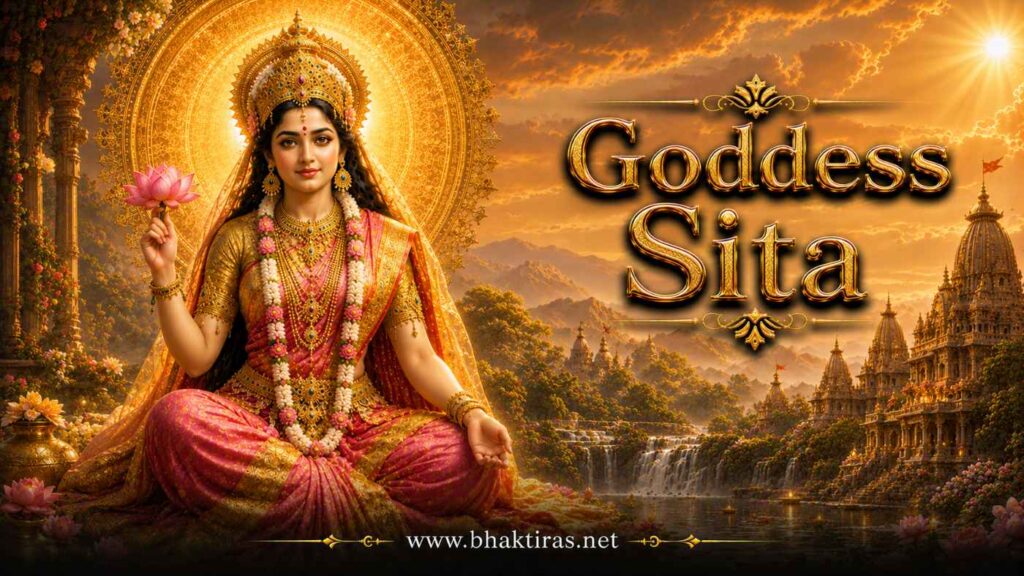
Sita is the wife of Lord Rama and an avatar of the goddess Lakshmi. Found by King Janaka in a furrow of a ploughed field, she is the daughter of the Earth and princess of Mithila. Honoured in the Ramayana, she embodies devotion, courage, patience and unshaken purity, and is worshipped inseparably as Sita-Ram.
Who Is Goddess Sita?
Sita is the heart of the Ramayana. She is the wife of Lord Rama and, in the deeper reading of the epic, an incarnation of the goddess Lakshmi, born on earth to walk beside Vishnu in his human form. To speak of Rama without Sita is to leave the story half-told, which is why the two are named together as Sita-Ram, one breath, one blessing.
Yet Sita is far more than a companion. Millions of Hindus turn to her as a goddess in her own right – the one who shows what love, loyalty and courage look like when life turns hard. Her name itself carries her beginning: ‘Sita’ means the furrow, the groove a plough cuts through the soil, because that is exactly where she was found, rising from the earth like a gift.
She is called Janaki after her foster father King Janaka, Maithili after her home city of Mithila, and Vaidehi after Videha, the kingdom Janaka ruled. Each name is a small window onto her life. Together they point to a woman who was a princess, a wife, an exile, a captive and a mother, and who through all of it kept a dignity that no misfortune could take from her.
Devotees do not remember Sita only for what she suffered. They remember her for how she carried herself through suffering – upright, clear, unwilling to bend her sense of right. That inner steadiness is the real reason she is loved.
Daughter of the Earth – Her Birth and Childhood
Sita’s story begins not with a mother’s arms but with the soil of Mithila.
Found in the furrow
King Janaka of Mithila was a rare kind of ruler – a philosopher-king as at ease with quiet reflection as with governing. One account tells that during a great yajna, or on some tellings simply while ceremonially ploughing a field to bring rain, his plough struck something in a furrow. When the earth was cleared away, there lay an infant girl, radiant and unharmed. Janaka lifted her up, and in that moment a childless king became a father.
Because she was drawn from the furrow, he named her Sita. Because the Earth herself, Bhumi, had given her, Sita is also called Bhumija – ‘born of the earth’. Janaka and his queen raised her as their own daughter, and so she became Janaki.
The princess of Mithila
Sita grew up in a court known less for its riches than for its wisdom, and the values of that household shaped her. She was gentle without being timid and thoughtful without being cold. Stories from her girlhood already hint at an unusual strength: it is said that as a child she once lifted, without effort, the enormous bow of Shiva that no grown warrior in Mithila could so much as move. Janaka, watching, understood that this was no ordinary daughter, and quietly resolved that only a man who could match that strength would be worthy of her.
The Marriage to Rama
When Sita came of age, Janaka set a condition for her marriage that would decide everything.
The swayamvara and Shiva's bow
Janaka possessed Pinaka, the mighty bow of Shiva, an heirloom so heavy that many men were needed simply to move the chest that held it. He declared that whoever could lift the bow and string it would win Sita’s hand. Kings and princes came from far kingdoms, and one after another they failed – some could not even shift it.
Into this gathering came Rama, prince of Ayodhya, travelling with his brother Lakshmana and the sage Vishvamitra. When his turn came, Rama walked to the bow, raised it as if it weighed nothing, and drew the string – and in the effort the great bow snapped in two with a sound like thunder. Sita, watching, had already chosen him in her heart; now the choice was sealed before all.
Sita-Ram, one name
Sita placed the garland of marriage around Rama’s neck, and their union has been celebrated ever since as the ideal of married love. It was not a match of convenience but of true regard, and the epic returns again and again to the depth of feeling between them. From that day the two names are spoken as one – Sita-Ram – and for countless devotees those syllables are themselves a mantra, a way of holding both the divine consorts in a single word.
Exile, Abduction and Captivity
Not long after the wedding, palace intrigue in Ayodhya sent Rama into fourteen years of forest exile. Sita’s response to that news reveals her character more than almost anything else.
Her choice to go
As a new princess she could have stayed in comfort at the palace. Instead she insisted on going with Rama into the wilderness. Her words to him are among the most quoted in the epic: a wife’s place, she said, is beside her husband, and the forest with him would be dearer to her than any palace without him. This was not blind obedience – it was a decision made with open eyes, a woman claiming her right to share her partner’s fate. Lakshmana joined them too, and the three lived simply among the sages of the woods.
The abduction by Ravana
The peace of those years was broken when Ravana, the ten-headed king of Lanka, resolved to take Sita for himself. He tricked Rama and Lakshmana away from the hermitage with a golden deer, then came in the disguise of a wandering ascetic and carried her off through the sky to his island kingdom. As she was borne away, Sita tore off her ornaments and let them fall to the earth below, leaving a trail for Rama to follow – even in that helpless moment, she was thinking, acting, resisting.
Steadfast in the Ashoka Vatika
In Lanka, Ravana held Sita in the Ashoka Vatika, a grove of ashoka trees, and pressed her ceaselessly to accept him as her lord. She refused, month after month, with a firmness that never wavered. She would not so much as look at him directly, keeping a blade of grass between them as a sign of the distance she held. Her purity was itself a wall no threat could breach. When Hanuman finally found her, a small and starved figure guarded by demons, he brought Rama’s ring as a token, and his words of comfort steadied her through the darkest stretch of her captivity. She sent back a jewel from her hair so Rama would know she still lived and still waited.
The Agni Pariksha and Return
The great war that followed ended with Ravana’s defeat and Sita’s rescue. But the reunion the epic gives us is not the simple joy one might expect.
The fire ordeal
When Sita was brought before Rama, questions hung in the air about the long months she had spent in another man’s house. To answer the doubts of the world – and, the epic suggests, to let her own truth stand plainly before everyone – Sita chose to walk into fire, the agni pariksha. She did not flinch. The god Agni himself rose from the flames untouched and led her out unharmed, declaring her purity beyond question. Fire, which consumes everything false, could find nothing in her to burn.
It is a passage many devotees hold with tenderness rather than triumph. What it shows is not that Sita needed proving, but that her truth was so complete that even fire bowed to it.
Home to Ayodhya
With the exile’s fourteen years complete, Rama, Sita, Lakshmana and their companions returned to Ayodhya, where Rama was at last crowned king. The city lit rows of lamps to welcome them home, and that homecoming is remembered every year as Diwali. For a time, Sita reigned beside Rama as queen, and the kingdom knew the peace of Ram Rajya.
Lava, Kusha and the Return to the Earth
The last chapter of Sita’s life is the one that asks the most of those who love her.
The second exile
Even after the fire had spoken, whispers about Sita’s time in Lanka lingered among some of Ayodhya’s people. Bound by his idea of a king’s duty to his subjects’ faith, Rama sent Sita away from the palace while she was pregnant. She was left near the ashram of the sage Valmiki, who took her in with compassion. It is a moment that has troubled and moved readers for centuries, and the epic does not soften Sita’s grief – she felt the wrong of it deeply, yet she carried herself with the same dignity she had shown in every trial before.
The twin sons
At Valmiki’s hermitage Sita gave birth to twin boys, Lava and Kusha, and raised them there in the quiet of the forest. Under Valmiki’s teaching the brothers grew strong and learned, and the sage taught them the whole of the Ramayana – Rama’s own story – as a song. Years later, when the boys sang that song before Rama’s court without knowing he was their father, the king recognised his sons and learned that Sita still lived.
Returning to her mother
Rama asked Sita to return and once more affirm her purity before the assembly. Sita had endured enough. She called upon her true mother, the Earth from which she had come, to take her back if she had ever been untrue. The ground opened, and Bhumi rose to receive her daughter, drawing Sita gently down into her lap. So the goddess who had begun in a furrow returned to the earth, closing her story where it started. It is not read as defeat but as a homecoming – the daughter of the Earth going home, on her own terms, when she had given all she was asked to give and more.
Sita as the Ideal – Strength, Not Just Suffering
It is easy to read Sita’s life as a chain of hardships endured, and older tellings sometimes framed her only as the patient wife. A closer look shows something braver.
Every turning point in her story carries a choice she made. She chose to lift Shiva’s bow’s weight as a child. She chose Rama at the swayamvara. She chose the forest over the palace, insisting on her right to share her husband’s path. In captivity she chose refusal over comfort, holding her ground against Ravana for as long as it took. Walking into fire, she chose to let her own truth answer the world. And at the end she chose to return to the Earth rather than perform her innocence a second time. These are not the acts of a passive figure – they are the acts of a woman with a clear will and a strong sense of self.
Her patience, too, is a kind of power. It takes far more strength to stay dignified through injustice than to lash out against it. Sita’s calm was never weakness; it was the composure of someone who knew exactly who she was and would not let anyone, not even fate, tell her otherwise. Devotees who face their own long struggles find in her a companion who understands – one who suffered and yet was never diminished. That is why she is worshipped as a goddess: not because she bore pain, but because pain could not touch what was truest in her.
How Goddess Sita Is Worshipped
Sita is rarely worshipped alone; she is honoured beside Rama, and to invoke one is to invoke both. Here are the main ways devotees turn to her.
- Chanting Sita-Ram: The joined name is repeated as a mantra, whether murmured on a mala or sung in kirtan. Many hold that saying ‘Sita’ before ‘Ram’ honours the mother first, and that the pair together carries more grace than either name alone.
- Sita Navami (Janaki Navami): Her appearance day, marked in the month of Vaishakha, is kept with fasting, readings from the Ramayana and worship of Sita and Rama together. Married women especially observe it, praying for the wellbeing and long life of their families.
- Vivaha Panchami: The anniversary of Sita and Rama’s wedding is celebrated with great warmth, above all at Janakpur in Nepal, where the divine marriage is re-enacted with processions, music and joy.
- Reciting the Ramayana and Ramcharitmanas: Reading or listening to the epic – especially Tulsidas’s Ramcharitmanas – is itself an act of devotion to Sita, whose life the text unfolds with such love.
- Diwali: The festival of lamps recalls Sita and Rama’s return to Ayodhya, and lighting a diya is a way of welcoming the divine couple home into one’s own house each year.
Temples & Sacred Sites
Sita is enshrined across the subcontinent, most often at the side of Rama. A few places, though, belong especially to her.
- Janaki Mandir, Janakpur (Nepal): A grand marble temple on the site traditionally held to be Sita’s home city of Mithila. It is the great centre of her worship, thronged at Vivaha Panchami when her wedding to Rama is celebrated.
- Sitamarhi (Bihar): Named for Sita, this town is revered as the place of her appearance from the earth. Pilgrims visit the temple and the sacred spot associated with her birth.
- Ram Janmabhoomi and Kanak Bhavan, Ayodhya: In Rama’s own city, Sita is worshipped beside him. Kanak Bhavan in particular is dedicated to the divine couple and is dear to devotees of Sita-Ram.
- Bhadrachalam (Telangana): The famous Sita Ramachandraswamy temple on the Godavari, where Sita and Rama are worshipped together and Sri Rama Navami is kept with the ceremonial celebration of their wedding.
- Punaura Dham (Bihar): Near Sitamarhi, another site honoured as connected to Sita’s birthplace, drawing pilgrims who wish to touch the land of her origin.
Prayers & Mantras
Prayers to Sita are simple and heartfelt, most often lifting her name together with Rama’s. A common invocation is:
ॐ श्री सीतायै नमः
Om Shri Sitayai Namah
‘Om, salutations to the revered Sita.’ Repeating this quietly is a way of seeking her grace, her patience and her steadiness in one’s own life.
Devotees also chant the joined name सीताराम (Sita-Ram) as a continuous remembrance, and offer the Sita-Ram couplets of the Ramcharitmanas. For those seeking a harmonious marriage or strength in hard times, calling on Sita-Ram together is held to be especially blessed.
Frequently Asked Questions about Goddess Sita
Who is Goddess Sita?
Sita is the wife of Lord Rama and an avatar of the goddess Lakshmi. Central to the Ramayana, she is the daughter of the Earth and princess of Mithila. She is revered as a goddess of devotion, courage, patience and purity, and is worshipped inseparably from Rama as Sita-Ram.
Why is Sita called Janaki and Vaidehi?
She is called Janaki because she was raised as the daughter of King Janaka of Mithila, and Vaidehi after Videha, the kingdom Janaka ruled. She is also known as Maithili, meaning 'of Mithila'. Each name links her to the royal house and land where she grew up.
Was Sita born from the earth?
Yes, by tradition. King Janaka found her as an infant in a furrow of a ploughed field, and she is regarded as the daughter of Bhumi, the Earth goddess. Her name 'Sita' means 'furrow', and she is also called Bhumija, 'born of the earth'. At the end of her life she returned into the Earth.
Is Sita an avatar of Lakshmi?
Yes. Just as Rama is understood as an incarnation of Vishnu, Sita is understood as the earthly incarnation of Lakshmi, Vishnu's consort. The two descend together, which is why they are worshipped as a divine pair and their names are spoken as one, Sita-Ram.
What was the agni pariksha?
The agni pariksha was the fire ordeal Sita undertook after her rescue from Ravana, to answer the world's doubts about her time in captivity. She walked into the flames unharmed, and the fire god Agni led her out, affirming her purity. Fire could find nothing false in her to consume.
Who were Sita's children?
Sita had twin sons, Lava and Kusha, born at the ashram of the sage Valmiki during her second exile. Valmiki raised and taught them, and they learned the whole Ramayana as a song. When they sang it before Rama's court, he recognised them as his sons.
Why is Sita seen as a symbol of strength, not just suffering?
Though her life held great hardship, Sita made bold choices at every turn – going to the forest with Rama, resisting Ravana, walking into fire on her own terms, and finally returning to the Earth. Her calm under injustice was the composure of a woman with a clear, strong will, not passivity.
When is Sita worshipped during the year?
Her main days are Sita Navami (Janaki Navami), her appearance day in Vaishakha; Vivaha Panchami, the anniversary of her wedding to Rama; and Diwali, which recalls the couple's return to Ayodhya. She is also honoured at Sri Rama Navami alongside Rama.
May Goddess Sita bless your home with love that endures, courage that stays quiet, and the steady strength to walk through every hardship with dignity. Sita-Ram.