
Gajan Festival 2027 – Bengal's Fierce Farewell to the Year
গাজন
When is the Gajan festival in 2027?
Gajan culminates around 14 April 2027, on Chaitra Sankranti (also called Charak Sankranti), the final day of the Bengali year. It runs for roughly a week beforehand in West Bengal, chiefly around Tarakeswar and the villages of the Rarh region. The festival honours Lord Shiva (as Neel or Buro Shiva) and, in places, Dharmaraj, and closes with Neel Puja on its eve. Dates follow the traditional Bengali solar calendar, so they can vary by a day.
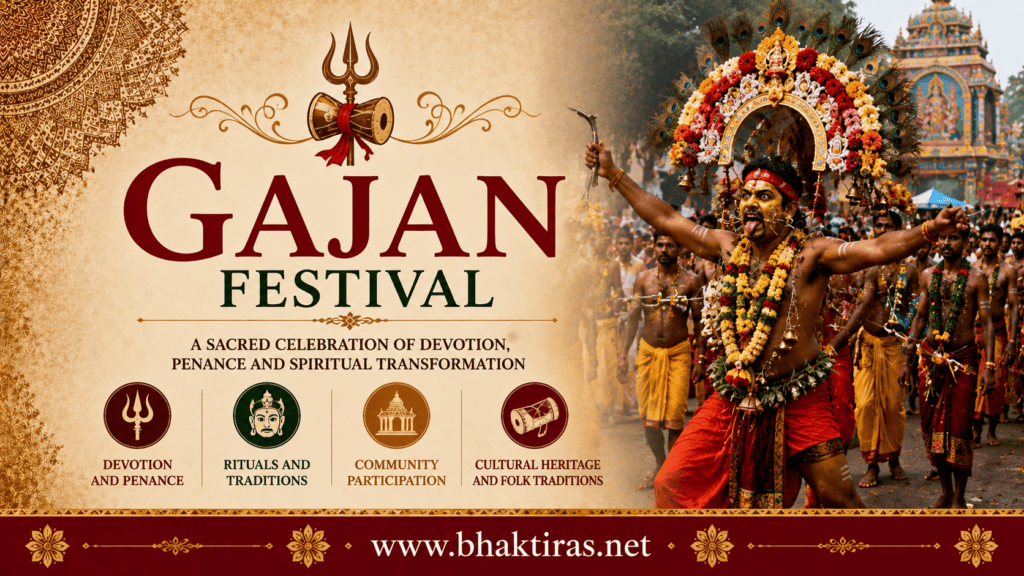
Gajan is one of the rawest, most physical festivals in the Bengali calendar. For about a week at the close of the month of Chaitra, ordinary farmers, labourers and shopkeepers set aside their everyday lives, put on saffron, and become sannyasis – temporary ascetics who fast, keep vows and offer their own bodies as devotion to Lord Shiva. It builds towards Chaitra Sankranti, the last day of the Bengali year (around 14 April), when the fire-walking, body-piercing and the famous Charak hook-swinging take place. Behind the intensity sits a simple village prayer: for rain, a good harvest and the god’s mercy in the year ahead.
Gajan Festival 2026-2028: Dates & Calendar
Gajan closes on Chaitra Sankranti, also called Charak Sankranti, the final day of the Bengali solar year. The next observance falls around 14 April 2027. Because it is fixed to a solar reckoning, the date shifts by only a day between years.
| Year | Charak Sankranti | Day | Notes |
|---|---|---|---|
| 2026 | 14 April | Tuesday | Gajan week ended; Neel Puja on 13 April eve |
| 2027 | around 14 April | Wednesday | Next occurrence – Charak Sankranti (approx.) |
| 2028 | around 14 April | Friday | Chaitra Sankranti; Gajan week precedes it (approx.) |
The seven-odd days of Gajan lead up to this final day. Neel Puja is held on the eve, and Pohela Boishakh, the Bengali New Year, follows the very next morning – so Gajan is literally the old year’s last, most demanding act of faith.
Why Gajan Is Celebrated
Gajan is celebrated to seek Lord Shiva’s grace for fertility, rain and a good harvest as the old Bengali year ends and the farming year begins. Villagers take vows of penance because they believe hardship offered willingly earns the god’s favour.
The name Gajan is often traced to garjan, the deep roar or cry that devotees raise for Shiva during the rites. It is very much a festival of the soil – its heartland is rural Bengal, and its concerns are the concerns of people who live by the land: enough rain, healthy fields, and protection from misfortune in the coming season.
There is also an older layer beneath the Shiva worship. In many districts Gajan is tied to Dharmaraj or Dharmathakur, a folk deity whose cult predates the mainstream Shaiva form, which is why the festival can feel closer to village faith than to temple orthodoxy.
A prayer for the harvest
Falling at the turn of the agricultural year, Gajan is fundamentally about fertility. Devotees ask Shiva, the lord of creation and destruction, to bless the fields with rain and yield. The penances are the price offered for that blessing.
Devotion through the body
In Gajan, faith is enacted physically. Fasting, fire-walking, piercing and hook-swinging are ways of surrendering the body to the deity. Devotees believe the self-inflicted hardship, borne without complaint, purifies them and pleases the god.
The old year's last act
Gajan closes on Chaitra Sankranti, the final day of the Bengali year. Ending the year with intense worship and beginning the next with Pohela Boishakh gives the whole cycle a clear spiritual bookend.
Deities & Figures Worshipped
Gajan centres on Lord Shiva, worshipped locally as Neel or Buro (old) Shiva. In parts of the Rarh region and among certain communities, the folk deity Dharmaraj or Dharmathakur is honoured alongside or instead of him.
Shiva (Neel / Buro Shiva)
The festival’s heart is Shiva, addressed as Neel or Buro Shiva. Neel Puja, held on the eve of Chaitra Sankranti, is dedicated to him, and much of the imagery draws on Shiva’s marriage to Parvati and his role as the great ascetic.
Dharmaraj (Dharmathakur)
In several districts of southern Bengal, Gajan is offered to Dharmaraj, a folk deity often represented by an aniconic stone rather than a human form. This layer reflects an older, non-Brahminical village religion that merged over time with Shiva worship.
The sannyasis (bhoktas)
The temporary ascetics are not deities, but they are the living centre of the festival. During Gajan they are treated as vessels of the god’s presence, and their vows, fasts and ordeals carry the community’s collective prayer.
Key Rituals, Step by Step
Gajan unfolds over roughly a week of vows and austerities, building to a single dramatic day. Here is the usual sequence.
- Taking the vow (sannyas). A week or so before Chaitra Sankranti, devotees called sannyasis or bhoktas take temporary vows of renunciation. They leave home life, wear saffron, and commit to abstinence for the festival’s duration.
- Fasting and clean living. Through the Gajan days the bhoktas fast, eat simply and often only once a day, sleep on bare ground, and keep away from ordinary pleasures. The discipline itself is part of the offering.
- Ritual bathing and worship. Sannyasis bathe in rivers or tanks and carry out daily worship of Shiva or Dharmaraj, moving between homes and shrines while raising cries of devotion for the god.
- Acts of austerity. As the festival intensifies, some undertake severe penances – walking barefoot across burning coals or embers, and piercing the tongue, cheeks or body with iron rods and skewers, borne as proof of faith.
- Neel Puja. On the eve of Chaitra Sankranti, Neel Puja is offered to Neel or Buro Shiva. This worship of Shiva sets the stage for the final day and is one of the festival’s tenderest moments.
- Charak on Charak Sankranti. On the last day the Charak takes place: a devotee is suspended from a rope on a tall wooden pole, sometimes by hooks in the flesh of the back, and swung in wide circles above the gathered crowd as the ultimate act of the festival.
- Release of the vows. After the Charak, the bhoktas end their period of renunciation, return to ordinary life, and the Bengali year turns over into Pohela Boishakh the next day.
Special Foods of Gajan
Food during Gajan reflects the fasting of the devotees and the simple offerings of the village. It is austere for the bhoktas and celebratory for everyone else.
Fruit and sweets offerings
Offerings to Shiva and Dharmaraj lean on seasonal fruit, batasha (sugar drops), and simple sweets. These are shared as prasad among the gathered devotees and villagers.
Sattvik fasting food
The sannyasis keep to plain, sattvik food while under vow – often a single daily meal of rice, fruit or milk, with onion, garlic and non-vegetarian food set aside for the festival’s duration.
Chaitra Sankranti spread
As the Bengali year ends, many Bengali households prepare a bitter-greens dish and light seasonal fare on Chaitra Sankranti, cleansing the palate before the new year’s feasting begins.
Fair food at the mela
The Charak fairs that spring up around the poles bring their own street food and sweets, turning the closing day into a village fair as much as a rite.
Regional Names & Variations
Gajan is a Bengal festival with strong local colour. Its names, deities and intensity change from district to district.
Tarakeswar & Hooghly
The Tarakeswar Shiva temple in Hooghly is among the best-known centres of Gajan, drawing large numbers of bhoktas who worship there before the closing rites.
Rarh Bengal (Bankura, Birbhum, Purulia)
In the Rarh belt of western Bengal the festival is often tied to Dharmaraj as much as to Shiva, and retains its older, folk character with village-level Charak poles.
Charak Puja & Nil Puja
The final rites are variously called Charak Puja, Chadak, Nil Puja or Neel Puja. Nil or Neel Puja names the worship of Neel Shiva on the eve; Charak names the hook-swinging on the last day.
Bangladesh
Bengali Hindu communities across the border in Bangladesh observe Gajan and Charak in much the same form, marking the same close of the Bengali year.
Gajan Do's and Don'ts
If you are attending or observing Gajan, a little sensitivity goes a long way at this intense village festival.
Do
- Watch the Charak and penances respectfully, from a distance the organisers allow
- Dress modestly, especially inside temple grounds like Tarakeswar
- Ask before photographing bhoktas mid-ritual – many are in a fasting, prayerful state
- Support local fairs and offerings if you wish to take part
- Learn a little of the Shiva and Dharmaraj background before you go
Avoid
- Do not treat the penances as a spectacle or entertainment
- Do not attempt any austerity yourself – these are vows taken under guidance
- Do not disturb or crowd the sannyasis while they are fasting or worshipping
- Do not offer onion, garlic or non-vegetarian food to bhoktas under vow
- Do not push into ritual spaces reserved for devotees
Frequently Asked Questions
When is the Gajan festival in 2027?
Gajan culminates around 14 April 2027, on Chaitra Sankranti (Charak Sankranti), the last day of the Bengali year. The festival’s austerities run for roughly a week before that date, and Neel Puja falls on the eve. As it follows the Bengali solar calendar, the date may shift by a day, so check a local panjika near the time.
When is Gajan in 2026 and 2028?
In 2026 Gajan ended on Chaitra Sankranti, around 14 April. In 2028 it is again expected around 14 April, on the final day of the Bengali month of Chaitra. These dates are approximate because they depend on the traditional Bengali solar reckoning.
Why is Gajan celebrated?
Gajan is celebrated to seek Lord Shiva’s blessings for rain, fertility and a good harvest as the old Bengali year ends and the farming year begins. Village devotees take temporary vows of penance, believing that hardship offered willingly earns the god’s grace. It is above all a rural prayer for the coming season.
Which god is worshipped during Gajan?
Gajan chiefly worships Lord Shiva, known locally as Neel or Buro Shiva, to whom Neel Puja is offered on the festival’s eve. In parts of western Bengal the folk deity Dharmaraj, or Dharmathakur, is honoured alongside or instead of Shiva, reflecting an older village tradition.
What is the Charak in Gajan?
Charak is the closing rite of Gajan, held on Charak Sankranti. A devotee is tied to a rope on a tall wooden pole, at times by hooks piercing the skin of the back, and swung in wide circles above the crowd. It is the most dramatic of the festival’s penances and gives Charak Puja its name.
Who are the sannyasis or bhoktas in Gajan?
The sannyasis, also called bhoktas, are ordinary villagers who take temporary vows of renunciation for the days of Gajan. They wear saffron, fast, sleep simply and perform acts of devotion and austerity. At the festival’s end they release their vows and return to normal life.
What is Neel Puja and how is it linked to Gajan?
Neel Puja is the worship of Neel or Buro Shiva held on the eve of Chaitra Sankranti, and it forms the devotional heart of Gajan just before the closing Charak. It marks the transition into the final day of the festival and of the Bengali year.
Where is Gajan mainly celebrated?
Gajan is celebrated mainly in West Bengal, with famous centres at the Tarakeswar Shiva temple in Hooghly and across the villages of the Rarh region such as Bankura, Birbhum and Purulia. Bengali Hindu communities in Bangladesh observe it in much the same form.
As the last of the old year burns down and the fields wait for rain, Gajan carries all of village Bengal’s hope in a single week of devotion. Shubho Noboborsho to all who greet the new year that follows.