
Rishi Vashishtha
वशिष्ठ
Rishi Vashishtha is one of the greatest of the Saptarishi, a Brahmarishi and a mind-born son of Brahma. He served as kulaguru of the Solar dynasty and was the guru of Lord Rama, whose teaching to him survives as the Yoga Vasistha. He is remembered for his forbearance, and for his wife Arundhati, seen as a star beside him.
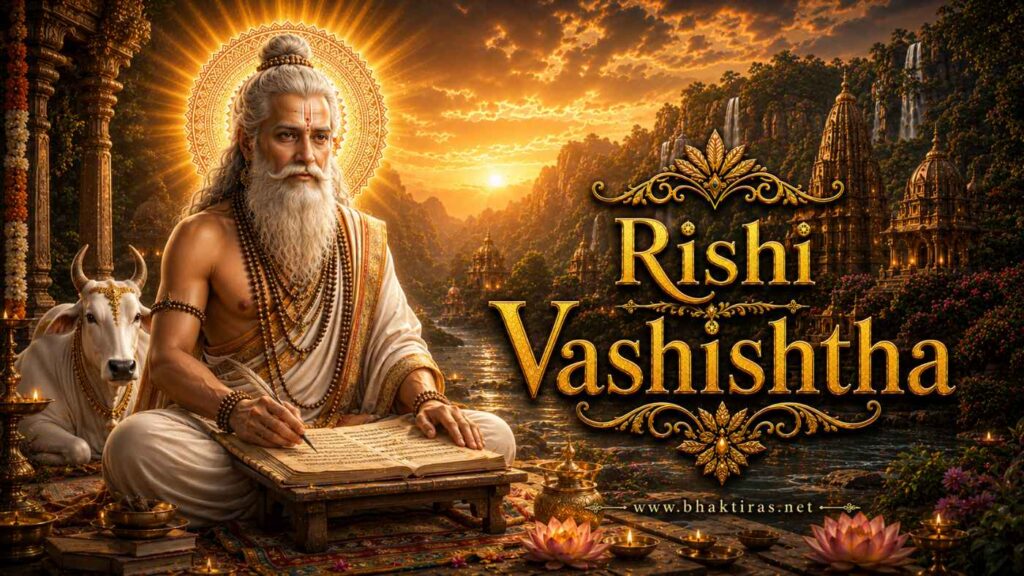
Who Is Rishi Vashishtha
Among the seven great seers whom Hindus place at the very source of the tradition, Vashishtha is spoken of with a particular warmth. He belongs to the Saptarishi, the seven sages whose names recur across the Vedas, the epics and the Puranas as the first teachers of dharma. Of these seven, Vashishtha is a Brahmarishi – a seer who has realised Brahman, the highest of the rishi ranks – and, in the accounts most often told, a manasaputra, a son born directly from the mind of Brahma the creator.What sets Vashishtha apart in memory is not a single dramatic deed but a whole life of steadiness. He is the sage kings turn to when they need counsel, the teacher a despairing prince turns to when nothing else will settle his heart, and the husband whose married life became a model for others. His voice carries authority in the Rig Veda itself, where the seventh mandala – one of the family books – is attributed to him and his line. To speak of Vashishtha is to speak of a man who held knowledge and patience in the same hand. He is also, in the older layers of the tradition, a householder rather than a solitary ascetic. He kept a hermitage, tended sacred fires, raised sons, welcomed guests, and looked after the wish-fulfilling cow entrusted to him. This ordinariness sits beside his greatness rather than contradicting it, which is part of why so many people find him approachable across the centuries.The Royal Preceptor and Guru of Rama
Vashishtha’s most enduring role is that of kulaguru – the hereditary spiritual guide of a royal house. The house he served was the Ikshvaku or Suryavamsha, the Solar dynasty of Ayodhya, from which Lord Rama would be born. As family preceptor he did far more than perform rituals. He advised kings on justice, conducted their great sacrifices, named and educated their children, and kept the moral compass of the throne steady across generations.When Rama was still a boy, it was Vashishtha who taught him the Vedas, statecraft and the conduct of a king. But the teaching for which the sage is best loved came at a different moment. As a young man, before the great events of his life, Rama fell into a deep world-weariness. He looked at birth, ageing, wealth and power and found them hollow; he questioned the point of it all. His father Dasharatha, alarmed, called on Vashishtha, and the sage answered not with comfort but with knowledge. That long dialogue, in which Vashishtha leads the restless prince from despair to clear self-knowledge, is preserved as the Yoga Vasistha. It is one of the great texts of Advaita and of the philosophy of the Self – a work that argues, through story after story, that the world we grasp at is closer to a dream than we suppose, and that liberation is a change in seeing rather than a distant reward. Through this teaching Vashishtha became not only Rama’s family priest but his true guru, the one who settled his mind.Vashishtha and Arundhati – the Ideal Couple in the Stars
No portrait of Vashishtha is complete without Arundhati, his wife. In a tradition that reveres many devoted wives, she holds a special place, spoken of as the model of fidelity and quiet strength. Their marriage is remembered not for grand incident but for its harmony, and that harmony was given a permanent home in the night sky.In the Saptarishi constellation – the seven stars that many cultures know as the Great Bear or the Big Dipper – Vashishtha is identified with one of the bright stars, and beside it sits a faint companion star long identified with Arundhati. Because the two stars appear so close as to be almost one, they became an emblem of a couple whose lives are inseparable. This is why, at a traditional Hindu wedding, the priest steps outside with the bride and groom and points up to the sky, asking them to look at the Arundhati star. Seeing the small, steady star beside the great sage is offered to the newlyweds as a blessing and a wish – that their own union may be as close, as constant and as luminous as that of Vashishtha and Arundhati.Kamadhenu and the Rivalry with Vishwamitra
One of the most consequential episodes in Vashishtha’s life turns on a cow. In his hermitage he kept Kamadhenu, the divine wish-fulfilling cow – in many tellings represented by her calf Nandini – who could grant whatever was desired. Out of her plenty Vashishtha could feed and honour any guest, however large their retinue.The visit of the king
The story goes that King Vishwamitra, then a powerful monarch out hunting with his army, came upon Vashishtha’s ashram. The sage received him graciously and, drawing on Kamadhenu, laid out a feast fit for the whole host without any apparent effort. The king was astonished, and then covetous. Such a cow, he reasoned, belonged in the treasury of a king rather than a forest hermitage. He offered wealth, herds and riches in exchange; when Vashishtha refused, explaining that the cow was not a possession to be traded but a charge entrusted to him, the king tried to seize her by force.
The lesson of the two powers
Kamadhenu, unwilling to be taken, resisted, and in the accounts she produced fierce warriors who scattered the royal army. Vishwamitra found that all his weapons and armies could not overcome the spiritual power of a single sage and his cow. Humbled and burning with a new ambition, he understood that the strength of a Brahmarishi surpassed that of any king. He renounced his throne and turned to austerity, resolving to win by tapas what he could not take by force – to become a Brahmarishi himself. Ages of penance and many trials followed, and in the end it was Vashishtha who acknowledged Vishwamitra’s attainment. Their long rivalry, sparked over one cow, drove Vishwamitra to one of the greatest transformations in all the sacred literature.
The Embodiment of Forbearance
If a single virtue is attached to Vashishtha’s name, it is kshama – forbearance, the patience that forgives. The sages who compiled his stories did not spare him suffering, and it is in the way he met that suffering that his greatness is measured.In the course of the long feud, it is told, Vashishtha lost his sons to the anger that swirled around Vishwamitra’s ascent. A lesser man might have answered loss with a curse; the accounts even describe Vashishtha, in his grief, walking toward the end of his own life, only to be turned back by the rivers and the world itself, which would not let so great a sage perish. What is striking in every version is that his sorrow never hardened into hatred. He forgave the man who had caused him so much pain, and when the time came he confirmed Vishwamitra’s status as a Brahmarishi with an open heart. This is why devotees hold him up as a teacher of equanimity. His wisdom was not the cold detachment of someone untouched by life, but the hard-won calm of someone who had been touched deeply and chose peace anyway. In the Yoga Vasistha he asks the young Rama to see the passing world with the same steadiness he himself had learned – and the fact that Vashishtha could give that teaching from lived experience is what gives it its weight.Iconography and Symbols
In painting and sculpture Vashishtha is shown in the familiar form of an elder rishi, calm rather than fierce, his bearing suggesting the counsellor and the teacher.The elder sage
He appears as an aged seer with a long white beard and matted hair (jata), his face serene. His posture is upright and settled, the picture of a mind at rest. Often he is seated in a teaching pose or in meditation, marking him as one whose work is knowledge rather than combat.
Kamandalu and rudraksha
He commonly carries the kamandalu, the ascetic’s water pot, and wears rudraksha beads or a simple sacred thread. These signal the disciplined life of the tapasvi – one who has renounced excess and lives close to the sacred fire and the daily rites.
Deer-skin and simple robes
A deer-skin or plain ochre cloth is often draped over his shoulder, the traditional seat and garb of a forest sage. The plainness is deliberate: his authority comes from realisation, not from ornament or wealth.
The wish-fulfilling cow
Where the scene allows, Vashishtha is shown near Kamadhenu or her calf Nandini, the gentle cow standing beside the hermitage. Her presence identifies him at once and recalls the generosity of his ashram and the famous test of the two powers.
How Rishi Vashishtha Is Remembered
Vashishtha lives on in Hindu memory in many woven strands – in scripture, in ritual, in the sky and in daily speech. A few of the ways he is honoured:- In the Rig Veda – the seventh mandala, one of the family books of the oldest scripture, is traditionally ascribed to Vashishtha and his descendants, placing him among the earliest voices of the Vedic tradition.
- In the Ramayana – he appears throughout as the family guru of Ayodhya, guiding Dasharatha and Rama and lending the epic its moral steadiness.
- Through the Yoga Vasistha – his long teaching to Rama is studied to this day by seekers of Advaita and self-knowledge, and quoted for its striking stories about the nature of the mind.
- Among the Saptarishi – he is invoked in the daily and seasonal remembrance of the seven seers, whose names are recited in prayers and marked in the night sky.
- At weddings – the pointing out of the Arundhati star to newlyweds keeps his marriage alive as a living blessing at almost every traditional Hindu wedding.
- In the Vashishtha gotra – many families trace their lineage to him, reciting his name in their gotra and honouring him as a founding ancestor.
- At sacred sites – shrines and hermitages associated with Vashishtha, including the well-known Vashishtha ashram near Gangotri and other spots along the Ganga, draw pilgrims who come to sit where the sage is said to have meditated.
Prayers and Mantras
Devotees who wish to honour Vashishtha or invoke his qualities of wisdom, patience and clear seeing may recite his name with a simple mantra. As with all the Saptarishi, the aim is less to ask for favours than to draw the sage’s steadiness into one’s own life.A short and widely used invocation is given below. It may be repeated with a quiet mind, ideally at dawn or before study, as a way of seeking the sage’s guidance: ॐ वशिष्ठाय नमःOm Vashishthaya Namah
Salutations to the sage Vashishtha. Those who study the Yoga Vasistha often begin their reading with this remembrance, offering respect to the teacher before turning to the teaching itself.
Frequently Asked Questions about Rishi Vashishtha
Who is Rishi Vashishtha?
Vashishtha is one of the greatest of the Saptarishi, the seven primordial seers. He is a Brahmarishi and, in most accounts, a mind-born son of Brahma. He is best known as the kulaguru of the Solar dynasty of Ayodhya and as the guru of Lord Rama, revered for his wisdom and his boundless patience.
What is the Yoga Vasistha?
The Yoga Vasistha is the long teaching Vashishtha gave to the young Lord Rama, who had fallen into deep world-weariness. Through many stories it leads him from despair to self-knowledge. It is one of the great texts of Advaita philosophy, arguing that liberation comes from a change in how we see the world rather than from anything we can gain or lose.
Why did Vashishtha and Vishwamitra clash?
The quarrel began over Kamadhenu, the wish-fulfilling cow in Vashishtha's care. King Vishwamitra wanted the cow and tried to take her by force, but the sage's spiritual power proved stronger than the king's army. Humbled, Vishwamitra renounced his throne and undertook ages of penance to become a Brahmarishi himself – a status Vashishtha finally acknowledged.
Who was Arundhati?
Arundhati was the wife of Vashishtha, honoured as a model of devotion and steadfastness. She is identified with the faint companion star beside Vashishtha's star in the Saptarishi constellation. Because the two stars appear almost as one, their union became a symbol of an ideal marriage, shown to couples at Hindu weddings.
Is Vashishtha one of the Saptarishi?
Yes. Vashishtha is counted among the Saptarishi, the seven great seers of the tradition, and is regarded as a Brahmarishi, the highest rank among the sages. The names of the Saptarishi vary a little across texts and cosmic ages, but Vashishtha is present in nearly every list and is one of the most prominent.
Where is Vashishtha mentioned in scripture?
Vashishtha appears across the sacred literature. The seventh mandala of the Rig Veda is traditionally attributed to him and his line. He is a central figure in the Ramayana as Rama's family guru, the teacher of the Yoga Vasistha, and a recurring presence in the Puranas that recount the lives of the seers.
What does Vashishtha teach us today?
Vashishtha is remembered above all for forbearance and forgiveness. He endured great personal loss without letting grief turn to hatred, and he forgave those who wronged him. His example, together with the Yoga Vasistha, encourages a life of steady wisdom, equanimity and clear self-knowledge amid the changes of the world.
May the calm wisdom of Rishi Vashishtha and the steadfast devotion of Arundhati light your path, and may their example of patience and forgiveness settle your heart as it once settled Lord Rama’s.