
Lord Dhanvantari
धन्वन्तरि
Lord Dhanvantari is the physician of the gods and the divine father of Ayurveda, worshipped as an avatar of Lord Vishnu. He rose from the churning of the cosmic ocean carrying the Amrita Kalasha, the pot of the nectar of immortality. Doctors, vaidyas and Ayurvedic healers pray to him for good health, long life and freedom from disease.
Who Is Lord Dhanvantari?
Lord Dhanvantari is the god of medicine and the physician of the heavens – the being the other gods turn to when they need healing. Hindus revere him as an avatar of Lord Vishnu, which places him among the very few deities who are worshipped both as an independent god of health and as a form of the preserver of the universe. His name is spoken with gratitude in clinics, homes and Ayurvedic schools whenever someone hopes to recover their strength.
What sets Dhanvantari apart is that he is not a distant, abstract power. He is a healer with a purpose – the giver of the knowledge that lets ordinary people ease pain, treat illness and live longer. When a vaidya grinds herbs, checks a pulse or prepares a decoction, tradition holds that the wisdom flowing through those hands began with him.
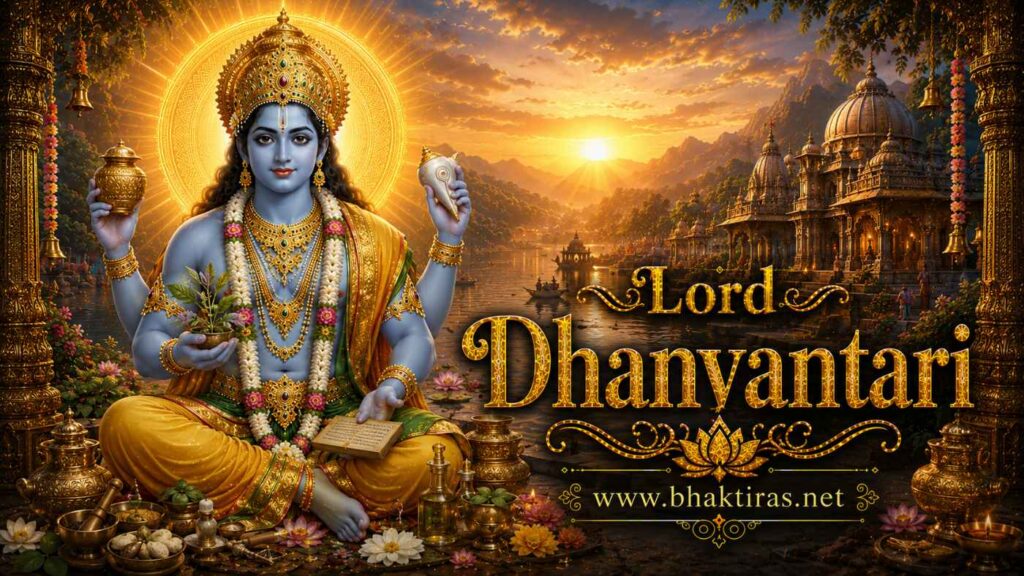
He is described as a radiant figure with four arms, dressed like a king yet carrying the tools of a physician. In one hand he holds the Amrita Kalasha, the pot of the nectar of immortality, and this single image tells his whole story: the god who carries the cure for death itself.
Across the Puranas he appears at a decisive moment in the history of the cosmos, and from that moment onward he becomes the eternal patron of anyone who seeks health, recovery and a long, disease-free life.
Risen from the Ocean with the Nectar
The most beloved account of Dhanvantari comes from the Samudra Manthan, the great churning of the cosmic ocean. The gods and the asuras, weakened and afraid of death, agreed to work together to draw the nectar of immortality from the sea. They used the mountain Mandara as a churning rod and the serpent Vasuki as the rope, and for ages they pulled the ocean back and forth.
The churning of the milk ocean
The sea gave up wonder after wonder as it was churned – the moon, the wish-granting cow, the celestial elephant, the goddess Lakshmi and, at first, a terrible poison that threatened to burn the worlds until Lord Shiva swallowed it. But the true prize came last. From the turning waters rose a shining figure, calm and unhurried, dressed like a prince and holding a vessel that glowed with light.
The pot of immortality
This was Dhanvantari, and cradled in his hands was the Amrita Kalasha, brimming with the nectar of immortality. The whole assembly fell silent. His appearance was the goal of the entire labour, and it marked the arrival of both the cure for death and the god who would forever be linked with healing and the preservation of life.
Why he is a form of Vishnu
Because he emerged bearing the very nectar that sustains life, tradition counts Dhanvantari among the avatars of Vishnu, the preserver. The gods received the amrita and their strength was restored. Yet the deeper gift was Dhanvantari himself – the physician who would carry the science of health from the ocean into the world of humankind.
The Origin of Ayurveda
Dhanvantari is honoured as the source of Ayurveda, the ancient Indian science of life and healing. In the traditional account, the knowledge of medicine did not begin with human experiment alone – it was a divine gift, first held by Dhanvantari and then passed down through a living chain of teachers to the physicians who practise it today.
The Puranas describe how this healing wisdom moved from the heavens into human hands. Sages received it, refined it and taught it to their students, and over generations it grew into the great texts and remedies that shaped Indian medicine. Because that stream is believed to begin with him, every branch of Ayurveda – the study of herbs, surgery, diet, pulse and the balance of the body – looks to Dhanvantari as its patron.
This is why he is dear not only to worshippers seeking a blessing but to practitioners themselves. A vaidya who spends years learning which root cools a fever or which paste closes a wound sees his own craft as a continuation of Dhanvantari’s gift. Medical colleges, Ayurvedic pharmacies and healing centres across India keep his image, and students often begin their studies with a prayer to him.
His role reframes health as something sacred. To seek a cure, in this view, is not only a practical act but a form of devotion – a reaching back toward the god who first brought the science of wellness into the world.
Iconography and Symbols
Dhanvantari is usually shown as a strong, serene figure with four arms, richly dressed and often dark-hued like Vishnu. Each object he carries points to a different part of his character – part king, part god, part physician.
The Amrita Kalasha
In his most important hand he holds the pot of the nectar of immortality. This vessel is his signature. It marks him as the bringer of the cure for death and the giver of long, healthy life, and it is the image most often placed on home altars for his blessing.
The Shankha (conch)
The conch he carries is a mark of his divinity as a form of Vishnu. Its sound is said to clear the air of negativity and disease, and in worship it signals the sacred, protective presence of the preserver working through the healer.
The Chakra (discus)
The spinning discus, another emblem of Vishnu, represents the turning of time and the power to cut away what harms. In Dhanvantari’s hands it suggests that true healing also means removing the root of an illness, not only soothing its surface.
The leech and healing herbs
In his fourth hand he often holds a leech or a bundle of medicinal herbs. The leech recalls the old practice of drawing out impure blood, while the herbs stand for the whole living pharmacy of Ayurveda – the plants, roots and remedies that carry his healing into daily life.
Dhanteras and Dhanvantari Jayanti
Dhanteras, the first day of the five-day Diwali festival, is celebrated as Dhanvantari Jayanti – the appearance day of the god of medicine. On this day devotees remember his rising from the ocean with the pot of nectar, and prayers turn toward the one gift that no amount of wealth can buy: good health.
Homes are cleaned and lamps are lit, and while Dhanteras is widely known for the buying of gold, metal and new utensils, its older heart is the worship of Dhanvantari. Families light a diya for him, offer flowers and sweets, and ask for a year of wellness, recovery for the sick and long life for their loved ones. In Ayurvedic circles the day carries special weight, and healers honour the source of their science.
The Government of India has recognised this deep connection by declaring Dhanvantari Jayanti as National Ayurveda Day. Each year the occasion is used to celebrate India’s traditional system of medicine, to encourage healthy living and to remind people that the pursuit of health is woven into the very fabric of the festival of lights.
So on the day most associated with prosperity, tradition quietly reminds everyone that the truest wealth is a healthy body – and it points them toward the physician of the gods to protect it.
How Lord Dhanvantari Is Worshipped
Worship of Dhanvantari is gentle, hopeful and centred on the wish for health – for oneself, for family and for the sick. It ranges from a quiet daily prayer to formal rituals in Ayurvedic institutions, and it grows especially strong around Dhanteras.
- Lighting a lamp before his image and offering fresh flowers, especially on Dhanteras and Ekadashi days.
- Chanting the Dhanvantari mantra for recovery from illness, mental peace and lasting good health.
- Praying on behalf of someone who is unwell, asking him for their swift healing and strength.
- Ayurvedic doctors and students beginning their practice or studies with a prayer to him as their guiding physician.
- Placing his picture in clinics, pharmacies and healing centres so that treatment is carried out under his blessing.
- Offering herbal preparations, tulsi leaves and simple naivedya as a symbol of the medicine he first brought to the world.
There is no need for elaborate ceremony. A sincere prayer for health, made with a calm heart, is considered the offering he most gladly receives.
Temples and Sacred Sites
While many Vishnu temples honour Dhanvantari, several shrines are devoted to him directly, and these are especially treasured by those seeking healing. The southern states, with their deep Ayurvedic heritage, hold some of his most active places of worship.
- Kerala, the land most closely tied to Ayurveda, is home to several revered Dhanvantari shrines where patients come to pray for recovery.
- Tamil Nadu holds notable Dhanvantari temples, some attached to major Vishnu temples, where the god is worshipped for health and long life.
- Ayurvedic hospitals and colleges across India often keep a dedicated Dhanvantari sanctum or idol at their entrance.
- Many Vishnu temples feature a Dhanvantari image or sub-shrine, allowing devotees to seek his healing blessing during their darshan.
- Special worship on Dhanteras and Dhanvantari Jayanti draws large gatherings at his temples, filled with prayers for a healthy year ahead.
Whether at a grand temple or a small clinic altar, the prayer offered to him is nearly always the same – a wish for health, healing and freedom from suffering.
Prayers and Mantras
The mantras of Dhanvantari are chanted for healing, protection from disease and the blessing of a long, well life. They call on him both as the divine physician and as the great form of Vishnu who holds the nectar of immortality. The most widely recited is the Dhanvantari stotra mantra, offered with faith by those who are ill and by the healers who tend to them.
The great Dhanvantari mantra is:
ॐ नमो भगवते वासुदेवाय धन्वन्तरये अमृतकलश हस्ताय सर्वामय विनाशनाय त्रैलोक्यनाथाय श्री महाविष्णवे नमः
Om Namo Bhagavate Vasudevaya Dhanvantaraye Amritakalasha Hastaya Sarvamaya Vinashanaya Trailokyanathaya Shri Mahavishnave Namah
This prayer salutes the Lord Vasudeva in the form of Dhanvantari, the one who holds the pot of nectar in his hand, the destroyer of all disease, the lord of the three worlds – and bows to him as the great Vishnu. A shorter daily form, Om Dhanvantaraye Namah, is often repeated by those who wish to keep his healing presence close through the day.
Frequently Asked Questions about Lord Dhanvantari
Who is Lord Dhanvantari?
Lord Dhanvantari is the physician of the gods and the divine originator of Ayurveda, worshipped as an avatar of Lord Vishnu. He emerged from the churning of the cosmic ocean holding the pot of the nectar of immortality, and he is prayed to for good health, long life and freedom from disease.
Why is Dhanvantari worshipped on Dhanteras?
Dhanteras, the first day of Diwali, is celebrated as Dhanvantari Jayanti, his appearance day. It marks the moment he rose from the ocean with the pot of nectar. On this day devotees pray to him for wellness and long life, and India also observes it as National Ayurveda Day.
Is Dhanvantari an avatar of Vishnu?
Yes. Because he emerged from the Samudra Manthan carrying the nectar that sustains life, tradition counts Dhanvantari among the avatars of Vishnu, the preserver of the universe. He carries Vishnu's conch and discus alongside the healer's pot of nectar and medicinal herbs.
Why does Dhanvantari hold a pot of amrita?
The Amrita Kalasha, the pot of the nectar of immortality, is his defining symbol. He carried it out of the churned ocean, and it marks him as the giver of health, recovery and long life. It represents the ultimate goal of his healing science – freedom from sickness and death.
How is Lord Dhanvantari connected to Ayurveda?
Dhanvantari is revered as the source of Ayurveda, the ancient science of life and healing. Tradition holds that the knowledge of medicine flowed from him through generations of sages and physicians. Vaidyas, Ayurvedic doctors and students honour him as the patron of their craft.
What is the Dhanvantari mantra used for?
The Dhanvantari mantra is chanted for healing, recovery from illness and protection from disease. Both patients and healers recite it with faith. The full stotra salutes him as the holder of the nectar pot and destroyer of all disease, while the short form Om Dhanvantaraye Namah is used daily.
Where are the famous Dhanvantari temples?
His most active temples are in the southern states, especially Kerala and Tamil Nadu, which have strong Ayurvedic traditions. Many Vishnu temples also house a Dhanvantari image or sub-shrine, and Ayurvedic colleges and hospitals often keep a dedicated shrine for him at their entrance.
May Lord Dhanvantari, the divine physician, keep you and your loved ones in good health, and may his healing light stay with you through every season of life.