
Kanuma 2027 – The Sankranti Day for Cattle and Farm Animals
కనుమ
When is Kanuma in 2027?
Kanuma falls on Saturday, 16 January 2027. It is the third day of the four-day Telugu Sankranti festival, celebrated the day after Makar Sankranti. On Kanuma, farming families in Andhra Pradesh and Telangana honour their cattle, oxen and bulls for a year of work in the fields.
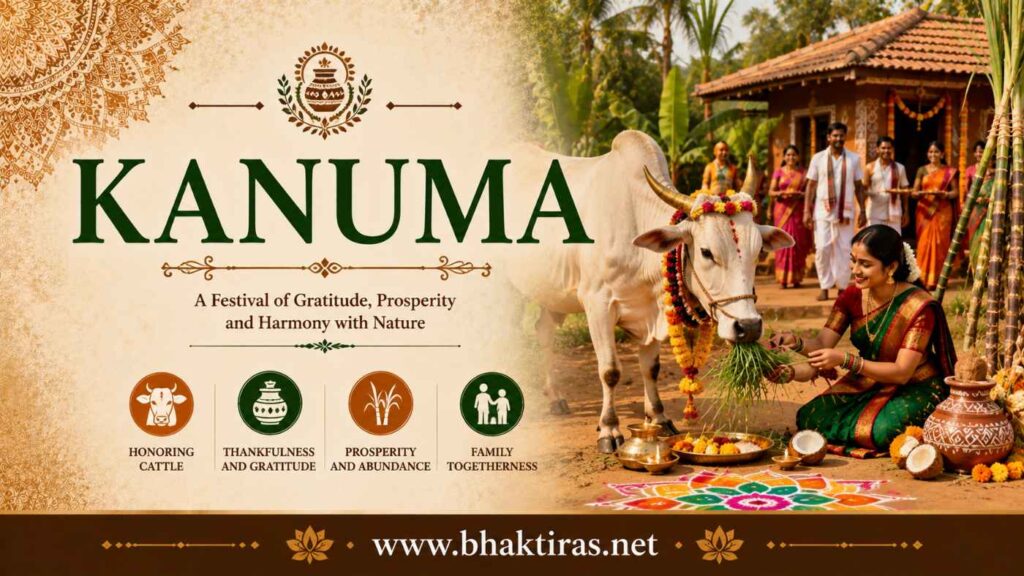
Kanuma is the quiet, heartfelt day of the Telugu Sankranti festival – the one that belongs to the animals. Falling on the third of the four Sankranti days, it is when farming households across Andhra Pradesh and Telangana turn their gratitude toward the cattle, oxen and bulls that pulled ploughs and carts through the year. The animals are bathed, painted, garlanded and fed well, and many families link the day to Lord Krishna lifting Govardhan hill to shelter the cowherds and their herds. For rural Telugu families, no day of Sankranti is dearer.
Kanuma 2026-2028: Dates & Calendar
Kanuma in 2027 falls on Saturday, 16 January. It always lands the day after Makar Sankranti, so its date tracks the sun’s entry into Capricorn rather than the moon.
| Year | Date | Day | Notes |
|---|---|---|---|
| 2026 | 16 January | Friday | Day after Makar Sankranti (14 Jan) |
| 2027 | 16 January | Saturday | Next occurrence |
| 2028 | 16 January | Sunday | Day after Makar Sankranti (15 Jan, leap year) |
The Sankranti days run in a set order: Bhogi on day one, Makar Sankranti on day two, Kanuma on day three and Mukkanuma on day four. Because the whole cycle is anchored to the solar Makar Sankranti, Kanuma sits close to 16 January each year, shifting by a day around leap years.
Why Kanuma Is Celebrated
Kanuma is celebrated to thank farm animals – cattle, oxen and bulls – for a year of labour in the fields, and to honour their place in the harvest that Sankranti marks.
A thank-you to the herd
Kanuma is agriculture’s day of gratitude. The bullocks that dragged the plough, the cows that gave milk and the calves born through the year are treated as members of the household. Feeding, bathing and worshipping them is a way of acknowledging that the filled granary of Sankranti was never the farmer’s work alone.
The Govardhan link
Many Telugu families connect Kanuma to Lord Krishna lifting Govardhan hill on his little finger to shelter the cowherds of Vrindavan and their cattle from Indra’s storm. Worshipping cattle on this day echoes that story of a god who chose to protect the herds, and go-puja (cow worship) is central to the observance.
Rooted in rural life
Kanuma is dearest to farming communities rather than city households, which is part of its character. It grew out of a settled agricultural year in the Telugu countryside, where a family’s wealth and its work both walked on four legs, and the day still carries that earthy, close-to-the-soil feeling.
Deities & Figures Worshipped
Kanuma centres on the worship of cattle themselves, understood as sacred, alongside Lord Krishna as the protector of cows and herds.
Cattle (Go Mata)
The cow, ox and bull are the heart of Kanuma. Cattle are honoured as Go Mata, the giving mother, and go-puja is performed after they are washed and decorated. Feeding them well and worshipping them is treated as an offering in its own right.
Lord Krishna (Govardhana)
Krishna, who lifted Govardhan hill to shield the cowherds and their cattle, is remembered on Kanuma as the guardian of the herds. His bond with cows as the cowherd of Vrindavan makes him the natural presiding figure of the day.
Key Rituals, Step by Step
Kanuma unfolds around the cattle from morning onward, moving from the wash to worship to a shared festive spread.
- Early bath for the cattle. Cows, oxen and bulls are led out at dawn and washed clean, often in a pond or at the well, so they are fresh for the day’s honours.
- Decorating the animals. Their horns are painted, and they are marked with turmeric and vermilion, then dressed with garlands, coloured cloth, small mirrors and bells that jingle as they move.
- Go-puja. The family gathers to worship the cattle with lamps, incense, kumkum and flowers, offering prayers of thanks for the year’s work and asking for the herd’s health.
- Feeding a special meal. The animals are fed generously – fresh fodder along with treats like jaggery, pongal rice and pulses – so they share in the festival’s abundance.
- Rangoli and home worship. Muggu (rangoli) is drawn at doorways and cattle sheds, and families offer prayers to Krishna and to their household deities alongside the go-puja.
- Community displays. In some villages, decorated bulls are paraded, and cattle displays or traditional cockfights are held, drawing neighbours together for the day.
- A festive family meal. Households share Sankranti dishes, and the day closes with the sense that the animals, the harvest and the family have all been thanked together.
Special Foods of Kanuma
Kanuma food carries over the Sankranti spread, with dishes offered to the deities, shared by the family and, in special measure, given to the cattle.
Chakkara Pongali
A sweet pongal of rice and moong dal cooked with jaggery, cardamom, cashews and ghee. It is a signature Sankranti offering and turns up on the Kanuma table as prasadam and family food.
Ariselu
A traditional deep-fried sweet of rice flour and jaggery, chewy and dark, made specially in the Sankranti season. Ariselu is one of the most looked-forward-to festival sweets in Telugu homes.
Pulihora
Tangy tamarind rice, tempered with mustard, curry leaves, peanuts and chillies. A staple offering and a savoury anchor to the festive meal.
Treats for the cattle
The animals get their own festive food on Kanuma – jaggery, a portion of the pongal rice, pulses and fresh green fodder – so the day’s abundance is literally shared with them.
Kanuma Do's and Don'ts
A few simple courtesies keep Kanuma warm, safe and true to its spirit of gratitude toward animals.
Do
- Bathe and decorate the cattle gently, keeping the day comfortable for them
- Perform go-puja with thanks for the year’s work and the harvest
- Feed the animals a good, special meal as part of the celebration
- Draw muggu at the doorway and cattle shed to welcome the day
- Share Sankranti dishes with family, neighbours and helpers
Avoid
- Do not overwork or stress the animals – the day is meant to rest and honour them
- Do not force cattle into frightening situations for display or sport
- Do not treat the puja as a mere formality; the gratitude is the point
- Do not waste the festive food; offer, share and give to the herd
- Do not overlook the labourers and cowherds who care for the animals year round
Frequently Asked Questions
When is Kanuma in 2027?
Kanuma is on Saturday, 16 January 2027. It is the third day of the four-day Telugu Sankranti festival, falling the day after Makar Sankranti. On this day, farming families in Andhra Pradesh and Telangana worship their cattle.
When is Kanuma in 2026 and 2028?
Kanuma falls on Friday, 16 January 2026 and on Sunday, 16 January 2028. In both years it lands the day after Makar Sankranti. Because the festival follows the solar Sankranti reckoning, the date stays close to 16 January each year (approximate).
Why is Kanuma celebrated?
Kanuma is celebrated to thank farm animals – cattle, oxen and bulls – for their year of labour in the fields. It honours the animals whose work makes the harvest possible, and many families link it to Lord Krishna, the protector of cows. It is considered the day of Sankranti most dear to farming households.
Which god is worshipped on Kanuma?
On Kanuma, cattle themselves are worshipped as sacred (Go Mata), and Lord Krishna is honoured as the protector of cows and herds. The day recalls Krishna lifting Govardhan hill to shelter the cowherds and their cattle, so go-puja (cow worship) is at its centre.
What is the difference between Kanuma and Makar Sankranti?
Makar Sankranti is the main harvest day and the second day of the Telugu Sankranti festival, while Kanuma is the third day, dedicated specifically to farm animals. Makar Sankranti thanks the sun and the harvest; Kanuma thanks the cattle that helped bring it in.
How is Kanuma celebrated in Andhra Pradesh and Telangana?
In Andhra Pradesh and Telangana, families bathe their cattle at dawn, paint their horns, and decorate them with turmeric, vermilion, garlands and bells. They perform go-puja, feed the animals a special meal, and share Sankranti dishes; some villages hold cattle displays or cockfights.
What foods are made on Kanuma?
Kanuma food carries over the Sankranti spread – chakkara pongali (sweet jaggery pongal), ariselu, and pulihora (tamarind rice) are typical. A portion of the festive food, along with jaggery and fresh fodder, is also given to the cattle so the day’s abundance is shared with them.
Is Kanuma a public holiday?
Kanuma is observed as a holiday in Andhra Pradesh as part of the Sankranti festival period. As one of the four Sankranti days, it is widely marked across Telugu regions, especially in farming and rural communities.
May your fields be full and your cattle well – a happy Kanuma to you and your family. కనుమ శుభాకాంక్షలు.