
Vamana Jayanti 2026 – The Dwarf Who Measured the Universe
वामन जयंती
When is Vamana Jayanti in 2027?
Vamana Jayanti falls on Sunday, 12 September 2027. It marks the appearance of Vamana, the fifth avatar of Vishnu, who came to earth as a short brahmin boy and outwitted the generous demon-king Bali. It is observed on Bhadrapada Shukla Dwadashi, so the English date shifts each year.
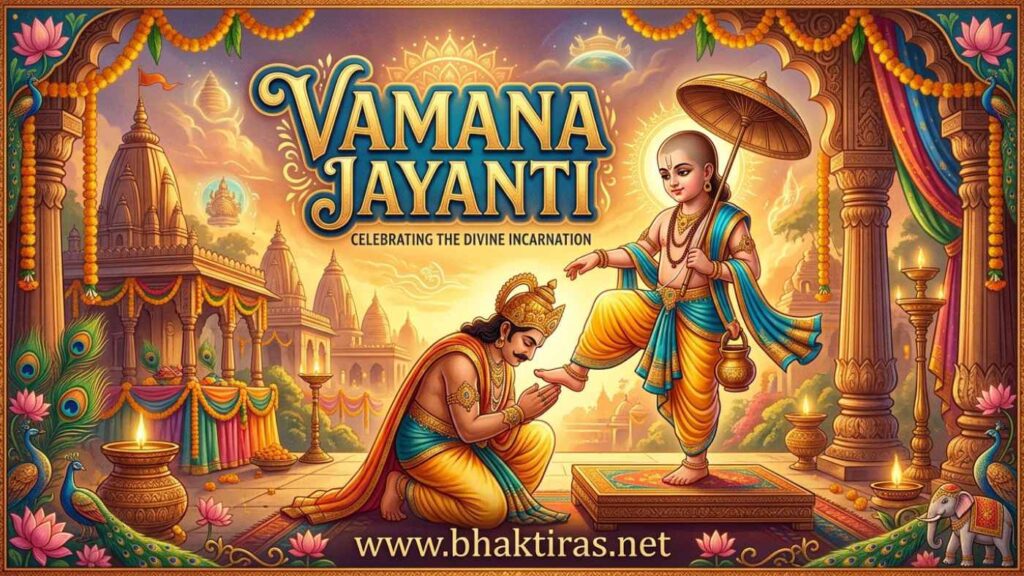
Vamana Jayanti honours the day Vishnu took his fifth avatar, appearing not as a warrior or a beast but as a small brahmin boy carrying a wooden umbrella and begging bowl. The story turns on a single request for three paces of land, made to the powerful and open-handed demon-king Bali. It is a festival about humility outweighing size, the binding force of a promise, and grace given even to a defeated opponent. Vaishnava devotees observe it on Bhadrapada Shukla Dwadashi, usually in September, with fasting, temple worship, and readings from the Bhagavata Purana.
Vamana Jayanti 2026-2028: Dates & Calendar
The next Vamana Jayanti is on Sunday, 12 September 2027. Because it follows the lunar tithi Bhadrapada Shukla Dwadashi rather than a fixed solar date, the English calendar date moves by a week or two each year.
| Year | Date | Day | Tithi |
|---|---|---|---|
| 2026 | 23 September | Wednesday | Bhadrapada Shukla Dwadashi |
| 2027 | 12 September | Sunday | Next occurrence – Bhadrapada Shukla Dwadashi |
| 2028 | 31 August | Thursday | Bhadrapada Shukla Dwadashi |
Vamana Jayanti sits within the busy Bhadrapada month, arriving a few days after Ganesh Chaturthi and close to Parsva Ekadashi and Onam. The observance runs for a single day, with the main worship performed at midday, the hour tradition assigns to Vamana’s appearance.
Why Vamana Jayanti Is Celebrated
Vamana Jayanti celebrates the appearance of Vishnu’s fifth avatar and the lesson at the centre of his story: that true greatness has nothing to do with physical size, and that a promise, once given, must be honoured whatever the cost.
The tale is one of the best loved in the Bhagavata Purana. King Bali, grandson of Prahlada, had grown so mighty through penance and sacrifice that he ruled the earth and the heavens together, unsettling the gods. Bali was no ordinary tyrant. He was famous for never refusing a request, and it was precisely this generosity that Vishnu chose to work with rather than against.
Humility over might
Vishnu could have arrived as a conqueror. Instead he came as Vamana, a small brahmin boy, and asked only for as much ground as he could cover in three steps. The festival holds up smallness and modesty as strengths, not weaknesses.
The weight of a vow
Bali’s teacher Shukracharya saw through the disguise and warned him not to promise. Bali gave his word anyway, because a king who breaks a pledge to a guest is worse than one who loses a kingdom. Honouring that vow, even to his own ruin, is what makes him a hero of the story rather than its villain.
Grace to the defeated
When Vamana grew into the cosmic Trivikrama and reclaimed the worlds in two strides, Bali offered his own head for the third. Vishnu did not destroy him. He sent him to rule the netherworld and gave him a boon to return home once a year, a homecoming Kerala still keeps as Onam.
Deities & Figures Worshipped
Worship on Vamana Jayanti centres on Vishnu in his Vamana form, with the demon-king Bali honoured as the devotee whose generosity the story turns on.
Vamana
The fifth of Vishnu’s ten avatars, shown as a young brahmin scholar with a parasol, a water pot, and a begging bowl. He is the deity of the day, worshipped in his small human form rather than as the towering Trivikrama he becomes.
Vishnu (as Trivikrama)
Trivikrama, meaning he of the three strides, is Vamana grown to fill the universe. Temple images and hymns recall the moment his foot rose past the sun and moon to cover the heavens, a form linked to the ancient Vedic Vishnu who measured the worlds in three steps.
King Bali
The asura ruler remembered less for his defeat than for keeping his word. In Vaishnava thought Bali is counted among the great devotees, a king whose downfall was really an act of surrender that earned him lasting favour.
Key Rituals, Step by Step
The observance is quiet and devotional rather than public and noisy, kept mainly by Vaishnavas and in Vishnu temples.
- Wake and bathe early. Devotees rise before sunrise, bathe, and many take a vow of fasting for the day, some keeping a strict waterless fast and others a light fruit-and-milk diet.
- Set up the worship. A small image or picture of Vamana is placed on a clean altar, often alongside a pot of water representing the sacred vessel he carried.
- Midday puja. The main worship is timed to noon, the hour tradition gives for Vamana’s appearance. Offerings of flowers, tulsi leaves, sandalwood, and incense are made with recitation of Vishnu’s names.
- Read the story. The Vamana episode from the Bhagavata Purana (Canto 8) is read or heard, keeping the tale of Bali and the three steps alive for another year.
- Offer curd, rice and jaggery. Simple sattvic offerings suited to a brahmin boy are prepared and presented, then shared as prasad.
- Give in charity. Because the whole story hinges on a gift of land, giving daan on this day – food, grain, or money to a brahmin or the needy – is considered especially meritorious.
- Break the fast. After the puja and, for some, after sighting the moon or completing the Dwadashi observance, the fast is gently broken with the prasad.
Special Foods of Vamana Jayanti
As a fasting day, the food is sattvic and simple, made without onion, garlic, or grains for those keeping the vrat, then shared as prasad.
Curd rice and jaggery
A plain plate of curd mixed with rice, sweetened with jaggery, echoes the humble meal fit for a young brahmin. It is among the most common offerings placed before Vamana.
Panchamrit
The five-nectar mix of milk, curd, ghee, honey, and sugar is offered to Vishnu and then given out in small spoonfuls to everyone present.
Fruit and milk
Those keeping a phalahar fast take seasonal fruit, milk, and dry fruits through the day, avoiding cereals and salt until the fast is broken.
Sabudana and singhara dishes
Tapioca khichdi and water-chestnut flour preparations, the standard vrat foods across north India, let devotees eat without breaking the grain-free rule of the fast.
Regional Names & Variations
The festival is Vaishnava rather than pan-Hindu, so its scale and name shift from region to region, with its deepest resonance felt in the south.
Kerala
Vamana’s story is the root of Kerala’s biggest festival, Onam, which celebrates King Bali’s yearly return to see his people. The Bhadrapada observance of Vamana Jayanti often falls near the Onam season, tying the two together.
Tamil Nadu & Andhra Pradesh
Called Vamana Dwadashi, it is kept in Vishnu temples with midday puja and readings from the Bhagavata Purana. Trivikrama shrines mark the day with particular care.
North India
Observed more quietly as a vrat day within the crowded Bhadrapada calendar, with fasting, home worship of Vamana, and charitable giving in the demon-king’s spirit of generosity.
Vaishnava communities
For followers of the Bhagavata tradition, including ISKCON temples, the day is Vamana Dwadashi, kept with fasting till noon and celebration of the Lord’s appearance.
Vamana Jayanti Do's and Don'ts
A few simple customs help keep the spirit of a day built around humility and giving.
Do
- Bathe early and keep the fast with a sincere resolve.
- Perform the main puja around midday, the hour of Vamana’s appearance.
- Read or listen to the Vamana story from the Bhagavata Purana.
- Give food, grain, or money in charity, echoing the gift at the heart of the tale.
- Offer tulsi leaves, which are especially dear to Vishnu.
Avoid
- Do not take onion, garlic, or grains if you are keeping the vrat.
- Do not treat King Bali as a mere villain – he is honoured for keeping his word.
- Do not skip the charity – a day about a gift of land is meant to be shared.
- Do not eat non-vegetarian food or drink alcohol on the fasting day.
- Do not perform the puja carelessly or rush the readings.
Frequently Asked Questions
When is Vamana Jayanti in 2027?
Vamana Jayanti in 2027 falls on Sunday, 12 September. It is observed on Bhadrapada Shukla Dwadashi, the twelfth day of the bright fortnight of the Bhadrapada month, with the main worship performed around midday.
When is Vamana Jayanti in 2026 and 2028?
Vamana Jayanti is on Wednesday, 23 September in 2026 and on Thursday, 31 August in 2028. The date moves each year because it follows the lunar tithi Bhadrapada Shukla Dwadashi rather than a fixed date on the English calendar.
Why is Vamana Jayanti celebrated?
Vamana Jayanti is celebrated as the appearance day of Vamana, the fifth avatar of Vishnu. It recalls how he came as a small brahmin boy, asked King Bali for three paces of land, then grew to cosmic size and reclaimed the three worlds – a story about humility, keeping a promise, and divine grace.
Who is Vamana in Hindu mythology?
Vamana is the fifth of Vishnu’s ten avatars and his first fully human form, appearing as a short brahmin boy. When he grew into the giant Trivikrama and covered the earth and heavens in two strides, he restored balance between the gods and the demon-king Bali.
What is the story of King Bali and Vamana?
King Bali was a generous but overmighty demon-king who had won the three worlds. Vishnu came as the dwarf Vamana and asked for three paces of land, which Bali granted. Vamana then expanded to cosmic size, covering earth and sky in two steps, and for the third Bali offered his own head. Vishnu sent him to rule the netherworld and blessed him to return home each year.
How is Vamana Jayanti connected to Onam?
Vamana Jayanti is directly connected to Kerala’s Onam festival. After Bali surrendered, Vishnu granted him a boon to return to visit his subjects once a year, and Onam celebrates that annual homecoming of the beloved king. The two festivals share the same story from opposite points of view.
How is Vamana Jayanti observed?
Vamana Jayanti is observed mainly by Vaishnavas with an early bath, a day-long fast, and midday worship of Vamana. Devotees read the story from the Bhagavata Purana, offer curd rice and panchamrit, and give food or money in charity, reflecting the gift of land at the centre of the legend.
Which god is worshipped on Vamana Jayanti?
Vishnu is worshipped on Vamana Jayanti, specifically in his Vamana or dwarf-avatar form, and in the cosmic Trivikrama form he takes when measuring the worlds. King Bali is also honoured as the devotee whose generosity and honesty drive the story.
May the small feet that measured the universe remind us that humility and a kept promise outweigh any amount of power. A blessed Vamana Jayanti to you and yours.