
Kurma Jayanti 2026 – The Day Vishnu Became the Tortoise
कूर्म जयंती
When is Kurma Jayanti in 2027?
Kurma Jayanti falls on Thursday, 20 May 2027. It is the appearance day of Kurma, the tortoise form and second avatar of Vishnu, and is always observed on Vaishakha Purnima, the full moon of the month of Vaishakha – the same full moon celebrated as Buddha Purnima.
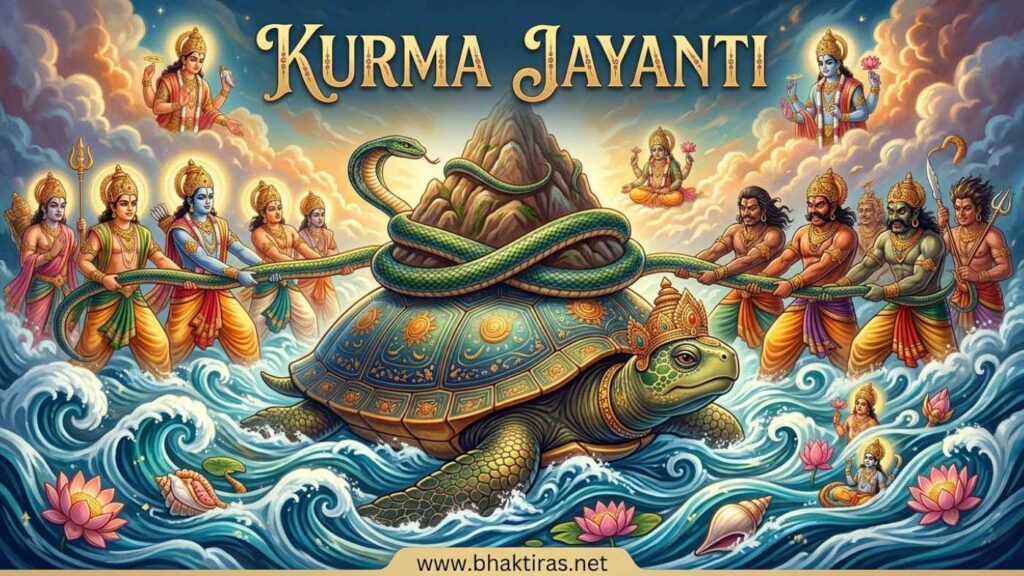
Kurma Jayanti honours the second of Vishnu’s ten avatars: Kurma, the giant tortoise. The day recalls a single decisive moment in the churning of the ocean of milk, when the churning-mountain began to sink and Vishnu slipped beneath it as a tortoise to hold it steady. It is observed on Vaishakha Purnima, the bright full moon of Vaishakha (April to May), and many treat it as one of the most settled, dependable days of the year – a good time to lay a foundation, literally or otherwise.
Kurma Jayanti 2026-2028: Dates & Calendar
The next Kurma Jayanti is on Thursday, 20 May 2027. The date shifts each year because it tracks the lunar Vaishakha Purnima rather than a fixed calendar day.
| Year | Date | Day | Notes |
|---|---|---|---|
| 2026 | 1 May | Friday | Vaishakha Purnima; shared with Buddha Purnima |
| 2027 | 20 May | Thursday | Next occurrence |
| 2028 | 8 May | Monday | Vaishakha Purnima |
Kurma Jayanti always coincides with Vaishakha Purnima, which is why it lands on the same full moon as Buddha Purnima and just after Narasimha Jayanti in the festival calendar.
Why Kurma Jayanti Is Celebrated
Kurma Jayanti marks the appearance of Vishnu as a tortoise during the Samudra Manthan, the churning of the ocean of milk that produced amrit, the nectar of immortality.
The gods and demons had agreed to churn the cosmic ocean together, using Mount Mandara as the churning rod and the serpent Vasuki as the rope. But the mountain had no footing and began to slide down into the depths, threatening to end the whole effort. Vishnu answered by taking the form of an enormous tortoise, diving beneath the waters, and letting the mountain rest on his broad back so the churning could go on and the treasures – Lakshmi, the divine physician Dhanvantari, and finally the amrit – could rise.
The steady base
Kurma is remembered above all as the one who held firm. With the mountain pivoting on his shell, he neither shifted nor tired for the length of the churning. The image of a still, load-bearing centre is the heart of what the day celebrates.
An auspicious day to build
Because Kurma upholds the world from below, the tithi is traditionally favoured for starting construction and laying foundations. In Vastu practice the tortoise is a symbol of stability, and beginning work on this day is thought to give it a firm base.
One avatar in a sequence
Kurma is the second of the Dashavatara, coming after Matsya the fish and before Varaha the boar. Read in order, the avatars trace a movement from water to land, and Kurma – amphibious, patient, supporting – sits right at that threshold.
Deities & Figures Worshipped
The day centres on Vishnu in his Kurma form, with the wider cast of the Samudra Manthan often remembered alongside him.
Vishnu as Kurma
Kurma is Vishnu in the shape of a tortoise, the second avatar. Devotees picture him half-submerged, the churning-mountain balanced on his shell, and worship him as the calm, unmoving support beneath a world in motion.
Lakshmi
Lakshmi, the goddess of fortune, rose from the churned ocean and chose Vishnu as her consort. On Vaishakha Purnima she is often honoured together with Kurma as the good that the churning finally brought forth.
Dhanvantari
Dhanvantari, the physician of the gods, emerged from the same churning holding the pot of amrit. He is remembered on this day as one of the treasures the tortoise’s steadiness made possible.
Key Rituals, Step by Step
Observance is quiet and devotional rather than public, usually kept by Vaishnavas at home or at Vishnu temples.
- Rise early and bathe. Devotees wake before dawn and bathe, ideally in a river or sacred tank; a holy dip on Vaishakha Purnima is considered especially cleansing.
- Take a vow of fast. Many keep a full or partial fast for the day, resolving to hold to it as steadily as Kurma held the mountain.
- Set up the worship. An image or picture of Kurma or Vishnu is placed on a clean altar, sometimes with a small tortoise figure to represent the avatar.
- Offer the puja. Flowers, tulsi leaves, incense, a lamp and sweets are offered while the names of Vishnu are recited.
- Read or hear the story. The account of the Samudra Manthan from the Puranas is read or listened to, keeping the meaning of the day in view.
- Chant and meditate. Devotees repeat Vishnu mantras and the Vishnu Sahasranama, sitting quietly to reflect on patience and steadiness.
- Give in charity. Food, water and alms are given to the needy on the full moon, and the day’s fast is broken after moonrise.
Where It Is Observed
Kurma Jayanti is a pan-Indian Vaishnava observance rather than a regional festival, with a special focus at temples devoted to the tortoise avatar.
Srikurmam, Andhra Pradesh
The Srikurmam temple near Srikakulam is one of the very few dedicated to Kurma anywhere, and it draws particular attention on this day. The deity here is worshipped in the tortoise form, and the town’s name itself carries the avatar.
Vaishnava homes and temples
Across India, followers of Vishnu mark the day with fasting and puja at home or at their local Vishnu temple, without large public processions.
Alongside Buddha Purnima
Because it shares the Vaishakha full moon with Buddha Purnima, the day sees busy temples and river ghats in many regions, with the two observances running side by side.
Kurma Jayanti Do's and Don'ts
A few simple customs keep the spirit of the day, which is one of steadiness and clean intention.
Do
- Wake early and take a bath, in a river if you can
- Keep the fast you resolve on with a settled mind
- Offer tulsi, flowers and a lamp to Vishnu
- Read or listen to the Samudra Manthan story
- Give food, water or alms to those in need
Avoid
- Do not break a fast you have vowed on a whim
- Do not eat grains or pulses if keeping a strict Purnima fast
- Avoid anger and quarrels, which cut against the day’s calm
- Do not skip the moonrise before ending the fast
- Avoid onion, garlic and tamasic food during the observance
Frequently Asked Questions
When is Kurma Jayanti in 2027?
Kurma Jayanti is on Thursday, 20 May 2027. It is always kept on Vaishakha Purnima, the full moon of the Hindu month of Vaishakha, so the date moves a little each year.
When is Kurma Jayanti in 2026 and 2028?
Kurma Jayanti falls on Friday, 1 May 2026 and on Monday, 8 May 2028. Both dates are the Vaishakha Purnima full moon, which is why they shift from year to year.
Why is Kurma Jayanti celebrated?
Kurma Jayanti celebrates the day Vishnu took the form of Kurma, a giant tortoise, during the churning of the ocean of milk. When Mount Mandara began to sink, he bore it on his back so the churning could continue and the nectar of immortality could rise.
Which avatar of Vishnu is Kurma?
Kurma is the second avatar of Vishnu in the Dashavatara, the ten principal incarnations. He appears as a tortoise, coming after Matsya the fish and before Varaha the boar.
Why is Kurma Jayanti considered auspicious for construction?
Kurma Jayanti is thought to be auspicious for beginning construction because Kurma is the steady tortoise who upholds the world from below. Starting a building or foundation on the day is believed to give the work a firm and stable base.
Is Kurma Jayanti the same day as Buddha Purnima?
Yes, Kurma Jayanti and Buddha Purnima fall on the same day. Both are observed on Vaishakha Purnima, the full moon of the month of Vaishakha, so they share the calendar date each year.
Where is Kurma worshipped as a temple deity?
Kurma is worshipped chiefly at the Srikurmam temple near Srikakulam in Andhra Pradesh, one of the rare temples dedicated to the tortoise avatar. Elsewhere he is honoured within Vishnu temples and in Vaishnava homes rather than at dedicated shrines.
How is Kurma Jayanti observed?
Kurma Jayanti is observed with an early bath, a day-long fast, and a home or temple puja to Vishnu with flowers, tulsi and a lamp. Devotees read the Samudra Manthan story, chant Vishnu’s names, give in charity, and break the fast after moonrise.
May the steady one who held the mountain bring some of that stillness to your own foundations. Kurma Jayanti ki shubhkamnayein.