
Adi Parashakti
आदि पराशक्ति
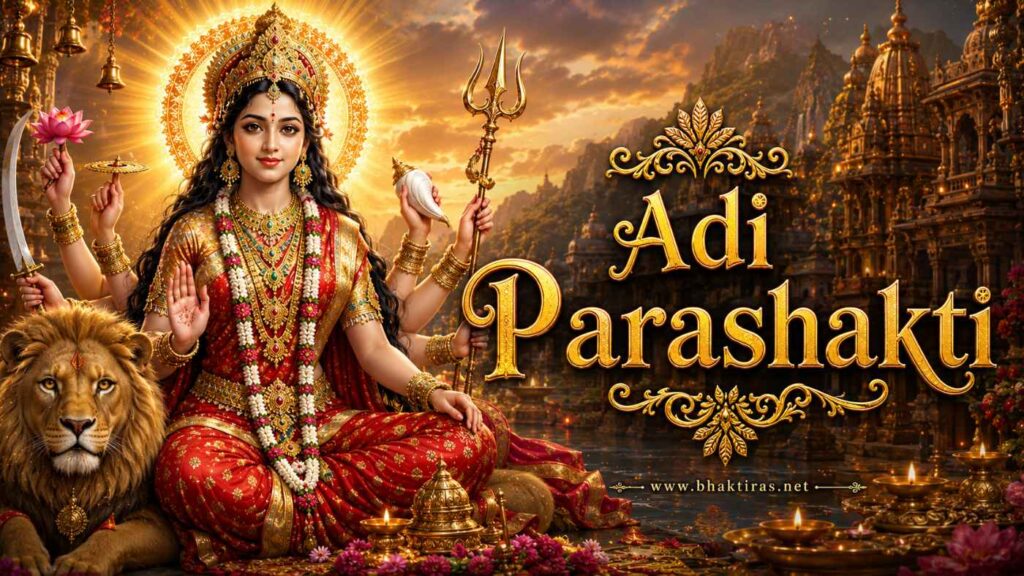
Adi Parashakti is the Supreme primordial Goddess of Shaktism, the formless power from whom the whole universe arises. Even Brahma, Vishnu and Shiva draw their strength from her. Every goddess is her form, and she is worshipped as the Divine Mother, both beyond attributes and present with a loving face.
Who Is Adi Parashakti?
Adi Parashakti is the highest reality worshipped in Shaktism, the tradition that places the Goddess at the very centre of the cosmos. Her name says almost everything: Adi means the first or the primordial, Para means the supreme or the beyond, and Shakti means power or energy. Put together, she is the original supreme power – the force that was there before anything else, and from which everything else has come.The Mother before creation
In the Shakta view, before the sky, the earth, the gods and the sages, there was pure conscious energy. That energy is Adi Parashakti. She is not a goddess who was born inside creation; she is the one who gives birth to creation itself. This is why devotees address her simply as Ma, the Mother, and mean by that word the source of all that lives.
Many names, one presence
She is called Mahadevi, the Great Goddess; Adi Shakti, the primal energy; Parashakti, the supreme power; and Mahamaya, the great weaver of appearances. These are not rival goddesses but different ways of pointing at the same infinite presence, each name lifting up one side of her nature.
Known through her forms
Because Adi Parashakti is boundless, she is often approached through her forms rather than in the abstract. When a devotee bows to Durga slaying the buffalo demon, or to gentle Parvati beside Shiva, or to Lakshmi and Saraswati, the Shakta teaching holds that all of them are her – the one Goddess shining through many faces.
The Power Behind All – Shakti and Shiva
At the heart of Shakta thought is a single, striking idea that reshapes how one sees the divine.Shiva without Shakti is inert
There is an old teaching often placed at the opening of the Saundarya Lahari: without Shakti, even Shiva cannot stir. The image is that Shiva is pure, still consciousness – awake, but motionless on his own. Shakti is the movement, the will, the living current that lets anything happen at all. She is the difference between a lamp that could give light and a lamp that is actually burning.
Consciousness and energy, never apart
Shakta philosophy does not set the two against each other. Shiva and Shakti are like fire and its heat, or the sun and its shining – you cannot pull them apart and still have either. Adi Parashakti is that heat, that shining, that active side of the Absolute. Every act of thinking, growing, loving and creating is her energy at work, carried through the whole of existence.
Why she is called supreme
If nothing can move, grow or become without her, then in a real sense she is the deciding power of the universe. This is why Shaktas do not treat her as a helper of the gods but as the ground the gods themselves rest on. To say Shakti is the power of Shiva is to say that the calm depth of reality and its ceaseless creativity are two faces of one Mother.
Source of the Trimurti
The three great gods – Brahma the creator, Vishnu the preserver and Shiva the destroyer – are usually seen as the highest powers in the cosmos. Shakta texts take a further step and ask where their power comes from.The gods receive their work from her
In the Devi Bhagavata Purana, it is Adi Parashakti who brings forth the three gods and hands each of them a task. Creation, preservation and dissolution are not their own inventions; they are duties given by the Mother, carried out by her grace. Brahma shapes the worlds, Vishnu sustains them, Shiva folds them back – but the energy running through all three is hers.
A famous vision of her supremacy
One well-loved episode describes Brahma, Vishnu and Shiva being lifted to the Goddess’s own realm, where they behold her seated in radiant majesty. There they realise that their masculine forms and even their consorts are drawn from a single supreme feminine source. The message is gentle but firm: the three pillars of the cosmos themselves lean on her.
She delegates, she does not depend
It is worth being careful here. The point is not that the gods are weak, but that their strength is borrowed. Adi Parashakti freely gives out portions of her endless power so that the machinery of the universe can run. The Trimurti govern; she is why there is anything to govern at all.
The One Who Becomes All Goddesses
Because Adi Parashakti contains all feminine divinity, the many goddesses of the tradition are understood as her expressions. Three great groupings show how she unfolds:- The Tridevi – Saraswati (wisdom and speech), Lakshmi (abundance and grace) and Parvati (love and inner strength). As the consorts of Brahma, Vishnu and Shiva, they carry the Mother’s creative, sustaining and transforming energy into the daily life of the world.
- The Navadurga – the nine forms of Durga honoured across the nine nights of Navaratri, from Shailaputri, daughter of the mountain, to Siddhidatri, giver of perfection. Each night draws out one mood of the Goddess, so that the whole festival becomes a slow unveiling of her.
- The Ten Mahavidyas – a circle of great wisdom-goddesses including Kali, Tara, Tripura Sundari, Bhuvaneshwari and Chinnamasta. Some are fierce and some are serene, and together they teach that liberation can be reached through beauty and through terror alike, since both are the Mother.
- Every village and household goddess – the countless gramadevatas and kuladevatas worshipped in India’s towns and homes are, in the Shakta view, local faces of the same universal Mother, near and personal to those who love them.
Nirguna and Saguna – Beyond Form and With Form
One of the most beautiful aspects of Adi Parashakti is that she is described in two ways at once, and the tradition holds both together without contradiction.Nirguna – beyond all attributes
In her Nirguna aspect, Adi Parashakti is formless, without qualities, beyond name and image. She cannot be pictured or fully described, because she is the pure ground of being from which all descriptions arise. Philosophers speak of her here almost the way the Upanishads speak of Brahman – infinite, changeless, silent.
Saguna – the Mother with a face
Yet the same Goddess, out of love, takes on qualities, colour, form and a face that a child can turn to. This is her Saguna aspect: Durga with her weapons, Parvati with her tenderness, the smiling Mother of a home shrine. She becomes approachable so that ordinary hearts can reach her.
Why both matter
A seeker who wants to meditate on the infinite can rest in her formless nature. A devotee who wants to weep, sing and ask for help can hold her hand in her form. Shaktism gently says: you do not have to choose. The formless and the form are the same Mother, meeting each soul at the level it can receive her.
Adi Parashakti in the Devi Mahatmya
The Devi Mahatmya, also called the Durga Saptashati or Chandi Path, is the single most important scripture for the worship of the Supreme Goddess. In its verses her cosmic role comes fully into view.The sleep that holds the world
The text opens with the whole universe dissolved and Vishnu asleep on the cosmic ocean. It is the Goddess, here called Yoganidra and Mahamaya, who holds him in that sleep and then withdraws so creation can begin again. From the first lines, she is shown as the power that governs even the great god’s rest and waking.
The Mother who defeats what the gods cannot
When the buffalo demon Mahishasura conquers heaven and no single god can stop him, the gods pour their energies together, and from that combined light the Goddess appears. Riding her lion, she meets the demon armies and cuts them down. The story makes a plain point: when creation is truly threatened, it is the Mother who saves it.
Praised as the essence of all
Between the battles, the gods sing hymns that name her as the intelligence in every mind, the mercy in every heart and the strength in every hand. She is called the one who dwells in all beings as consciousness, as forgiveness, as beauty. In these praises the Devi Mahatmya stops being only a war story and becomes a direct declaration that she is the Absolute.
How Adi Parashakti Is Worshipped
Devotion to the Supreme Goddess runs through festivals, daily prayer and lifelong practice. A few forms of worship are especially close to her:- Navaratri – the nine nights held twice a year, in spring and autumn, are the great season of the Goddess. Homes and temples honour her nine forms one by one, with lamps, flowers, fasting and song, and the tenth day celebrates her victory.
- Recitation of the Devi Mahatmya – chanting the Chandi Path, in whole or in part, is treated as a direct way of invoking her presence, especially during Navaratri and on Ashtami and Navami.
- Durga Puja – in Bengal and beyond, grand images of the Mother are made, worshipped for several days and then carried to the water, a moving picture of the Goddess arriving among her children and returning to her formless home.
- Daily devotion at the home shrine – a lamp, a red flower, kumkum and a whispered mantra are enough. Many families keep her as their kuladevi, the household Goddess, and turn to her in every joy and sorrow.
- Mantra and meditation – repeating her seed syllables and sitting quietly with her name is a path favoured in the Shakta Tantras, where the Goddess is realised within, as the very energy of one’s own awareness.
Prayers & Mantras
The prayers to Adi Parashakti range from single seed syllables to soaring hymns. One line from the Devi Mahatmya is loved above almost all others, because it finds the Goddess not far away but inside every living thing.Ya Devi Sarvabhuteshu
The famous refrain runs: Ya Devi sarvabhuteshu … rupena samsthita; namas tasyai namas tasyai namas tasyai namo namah – ‘To the Goddess who abides in all beings in the form of consciousness (and mercy, and power, and peace), we bow, again and again and again.’ Each verse changes only the quality named, teaching that whatever is good and strong in us is already her.
The seed of the Mother
The mantra ॐ ऐं ह्रीं क्लीं (Om Aim Hreem Kleem) gathers the seed sounds of Saraswati, of Mahamaya and of desire fulfilled. Spoken with the Mother’s name, it is used to call her supreme presence into the heart of the one who prays.
A simple way to begin
One need not master long recitations. Lighting a lamp, folding the hands and saying ‘Jai Mata Di’ – victory to the Mother – with a quiet, trusting heart is itself a complete prayer, and the tradition promises that the Mother hears the smallest call.
Frequently Asked Questions about Adi Parashakti
Who is Adi Parashakti?
Adi Parashakti is the Supreme primordial Goddess of Shaktism – the formless power from whom the entire cosmos arises. She is the source of even Brahma, Vishnu and Shiva, and every goddess is understood as one of her forms. She is worshipped as the Divine Mother, the ultimate reality with both a formless and a loving personal nature.
Is Adi Parashakti the same as Durga?
Yes and no. Durga is regarded as the chief form of Adi Parashakti in her supreme, protecting aspect, so worshipping Durga is worshipping the Supreme Goddess. But Adi Parashakti is larger than any single form; Durga, Parvati, Kali, Lakshmi and Saraswati are all expressions of the one Mother, who is beyond them all.
What does 'Shakti is the power of Shiva' mean?
It means that Shiva, as pure consciousness, is still and inactive on his own, while Shakti is the living energy that lets anything happen. The two are inseparable, like fire and its heat. Adi Parashakti is that active power, so the phrase teaches that the creative force of the whole universe is the Goddess.
Why is Adi Parashakti called both Nirguna and Saguna?
Nirguna means she is formless and beyond all qualities, the infinite ground of being. Saguna means she also takes on form, colour and a face out of love, so devotees can reach her. Shaktism holds both together: the formless Absolute and the personal Mother are the same Goddess, meeting each soul as it needs.
Which scriptures describe Adi Parashakti?
The central text is the Devi Mahatmya (Durga Saptashati), which tells of her cosmic role and victories. The Devi Bhagavata Purana presents her as the source of the Trimurti and the supreme reality, and the Shakta Tantras give her mantras and meditations. Hymns like the Saundarya Lahari also celebrate her supremacy.
How is Adi Parashakti worshipped today?
She is worshipped especially during Navaratri, when her nine forms are honoured over nine nights, and at Durga Puja. Devotees recite the Devi Mahatmya, offer lamps and red flowers at home shrines, and repeat her mantras. Many families keep her as their kuladevi, the household Goddess, and turn to her in daily life.
Is Adi Parashakti mentioned in the Vedas?
The Vedas praise the Divine Feminine in hymns such as the Devi Sukta, where the Goddess declares herself the sustainer of all beings. The full picture of Adi Parashakti as the Supreme Mother is developed later, in the Puranas and Tantras, but Shaktas see these as unfolding a truth already present in the Vedic vision.
However you call her – Ma, Durga, Adi Shakti or simply the Mother – Adi Parashakti is the loving power that holds your life. May her grace stay close to you. Jai Mata Di.