
Tulja Bhavani
तुळजा भवानी
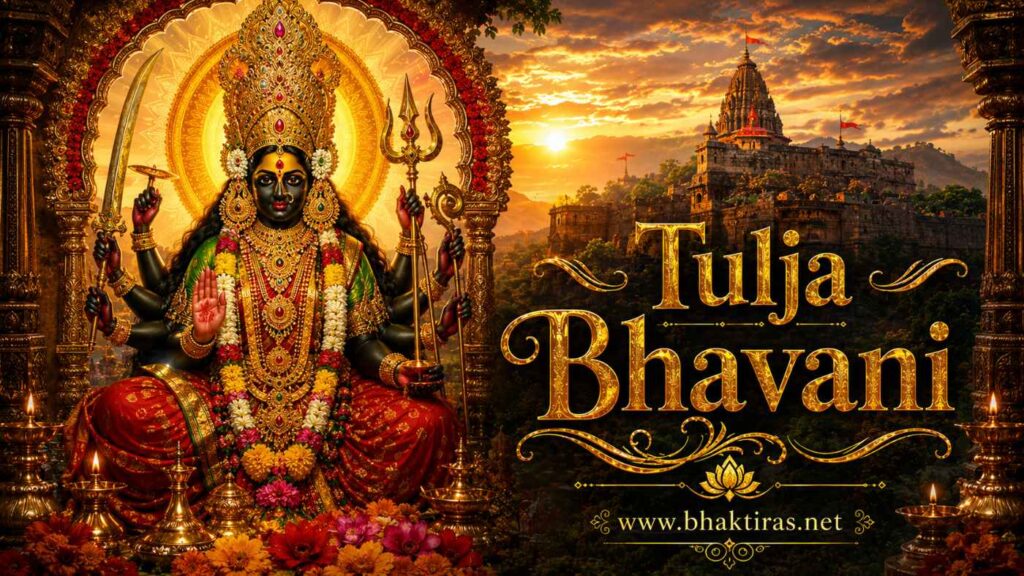
Tulja Bhavani is a fierce yet loving form of the Mother Goddess Durga, worshipped at Tuljapur in Maharashtra. She rides a lion, carries the trishula, and is famous as the family goddess of Chhatrapati Shivaji Maharaj, who is said to have received her sword and blessing before founding the Maratha Swaraj.
Who Is Tulja Bhavani
Tulja Bhavani is the Mother Goddess in her warrior aspect, a living presence for millions of families across Maharashtra and the wider Deccan. She is understood as a form of Durga, the same Adi Shakti who takes shape whenever the balance between good and evil tips too far. Her home is the hill town of Tuljapur in the Osmanabad district, where her granite murti has drawn pilgrims for well over seven centuries.The name Bhavani carries a double meaning that devotees hold close. She is Bhavani, the one who gives life and sustains the world as a caring mother, and she is also Tvarita or Turaja, the swift one who answers quickly when her children call. This blend of tenderness and speed defines her. People come to her not only for comfort but for the courage to act, to stand firm, and to face what frightens them. Farmers, soldiers, traders, and grandmothers all speak of her in the same breath, as though she were a member of the household rather than a distant deity. Her worship crosses caste and language lines, and her festivals fill Tuljapur with a devotion that feels both fierce and warm at once.The Slaying of the Demon Matanga
The oldest stories tie Tulja Bhavani to the timeless duty of the Goddess: to appear when a demon grows too proud to be contained.The prayer of a wronged wife
In the traditional account, a sage named Kardama passed away, leaving behind his devoted wife Anubuti, who sat by a riverbank deep in penance for her family. A demon called Matanga, drunk on his own power, began to trouble the gods and sages and set his eyes on her. Unable to defend herself, Anubuti poured her whole heart into a plea to the Mother of the universe. Her cry did not go unheard.
The swift descent of the Devi
The Goddess came in an instant, so quickly that she earned the name Tvarita, the swift one, which softened over time into Turaja and then Tulja. She met Matanga in battle. When he changed shape and charged as a buffalo, echoing the older war against Mahishasura, she pinned the beast down and struck the killing blow with her trishula. The demon fell, the sages were freed, and Anubuti’s penance was protected.
Why she stayed at the hill
Grateful devotees begged the Goddess to remain among them rather than return to the heavens. She agreed to settle on the Balaghat hills at Tuljapur, taking her place there as a permanent shelter for anyone who calls on her. It is this promise of nearness, of a mother who chose to stay, that gives Tuljapur its particular pull.
Kuldevi of Shivaji Maharaj and the Bhavani Sword
No story binds Tulja Bhavani to history more tightly than her link with Chhatrapati Shivaji Maharaj, the founder of the Maratha kingdom.Tulja Bhavani was the Kuldevi, the family goddess, of the Bhosale clan into which Shivaji was born. From childhood he is said to have turned to her, and the tradition tells that in a moment of deep prayer the Goddess blessed him and granted the sword remembered as the Bhavani Talwar. Whether one reads the sword as a literal gift or as a symbol of divine sanction, its meaning was clear to the people of his time: the Devi stood behind his cause. That cause was Hindavi Swaraj, self-rule for his land, built against far larger powers. Shivaji carried her name into battle as a rallying cry, and his soldiers fought believing the Mother went with them. Even now the war-cry heard across Maharashtra invokes Bhavani alongside Shivaji’s name. For countless families her worship is inseparable from a memory of dignity and self-respect, a reminder that faith and freedom once marched together. Pilgrims who climb to Tuljapur often feel they are walking a path their heroes walked before them.The Temple at Tuljapur
The temple of Tulja Bhavani sits on the slopes of the Balaghat range, reached by a long flight of steps that descend to the sanctum rather than climb to it, an unusual layout that pilgrims remember.At the heart of the shrine is the murti of the Goddess, carved in black granite, roughly three feet tall, shown with eight arms holding weapons and pressing down on the demon beneath her foot. Devotees hold the idol to be swayambhu, self-manifested rather than made by human hands. One of the most striking traditions of Tuljapur is that the Devi is movable. The murti is said to travel, and it is ceremonially placed in different resting states through the year, including periods when she is believed to go into slumber and then awaken. The temple keeps ancient customs alive: the Simhasan or lion-throne on which she is seated, the palkhi processions that carry her in celebration, and the ritual sleep-and-wake cycle tied to the seasons and to Navaratri. Kings, saints, and ordinary pilgrims have added to the complex over the centuries, and the town around it lives to the rhythm of her worship. The district was long known as Osmanabad and has been renamed Dharashiv, but for the faithful the address that matters has always been simply Tuljapur, the seat of the Mother.Iconography and Symbols
Every feature of Tulja Bhavani’s form carries meaning that devotees read like a familiar language.The lion
Her mount is the lion, the same vahana as Durga. It stands for raw, fearless power brought under the control of divine will. That the fiercest of beasts carries her calmly tells devotees that even wild strength bows before the Mother.
The trishula and the many arms
She is shown with eight arms, each holding a weapon, and the trishula is central among them. The three prongs are read as the three qualities of nature and the three forces of creation, preservation, and dissolution, all held in one steady hand.
The slaying pose
Unlike calm, seated deities, Bhavani is caught in motion, mid-strike over the buffalo-demon. The pose is a promise rather than a threat: it shows the exact instant when cruelty is overcome and the frightened are set free.
The black granite form
The dark stone of her murti gives her a grave, ancient presence. Devotees dress and adorn her richly, but the underlying form remains austere and powerful, the swayambhu Devi who chose to appear in stone.
Navaratri and the Festivals of Tuljapur
Tuljapur is at its most alive during the festival seasons, when the quiet hill town swells with pilgrims and song.The greatest of these is Sharadiya Navaratri in the autumn month of Ashwin, nine nights that build toward Vijayadashami. Through these days the Goddess is honoured with special worship, the lighting of lamps, recitation of her praises, and grand processions in which her palkhi moves through the streets. Devotees observe fasts, keep vigils, and offer the sari, bangles, and turmeric-kumkum that a mother is given. A distinctive feature of Tuljapur is the cycle tied to the Devi’s ritual sleep: at set points she is believed to rest and then wake, and her awakening is met with joy. Shakambhari Navaratri, in the winter, celebrates her as the goddess who nourishes the earth with food and greenery. Gudi Padwa, the Marathi new year, and other regional festivals also draw crowds to her door. Beyond the calendar, families arrive year-round to complete vows, to seek her blessing before weddings, and to bring newborn children for her protection. In every case the mood is the same: a homecoming to the family mother who has watched over generations.How Tulja Bhavani Is Worshipped
Devotion to Tulja Bhavani is warm and practical, woven into the ordinary life of Maharashtrian families as much as into grand temple ritual.- Reciting the Bhavani mantra and her names during morning and evening prayer, often with a simple lamp lit before her image.
- Chanting the Devi Mahatmya (Durga Saptashati) and singing Marathi aartis and bhajans dedicated to Ambabai and Bhavani.
- Offering sari, bangles, kumkum and turmeric, the gifts due to a mother, especially during Navaratri.
- Undertaking a pilgrimage to Tuljapur to fulfil family vows and to seek her blessing before major life events.
- Keeping her as the household Kuldevi, with weddings and naming ceremonies performed only after her permission is sought.
- Observing fasts and vigils through the nine nights of Navaratri in her honour.
Temples and Sacred Sites
Her presence radiates outward from Tuljapur to shrines that keep her worship alive across the region.- Shri Tulja Bhavani Temple, Tuljapur – the principal seat of the Goddess in Osmanabad (Dharashiv) district, Maharashtra, and the destination for her devotees.
- The Balaghat hill shrines and subsidiary temples around Tuljapur that pilgrims visit as part of the darshan.
- Numerous Bhavani and Ambabai temples throughout Maharashtra where families worship her as their Kuldevi.
- Her worship is often held alongside that of Mahalakshmi of Kolhapur, Renuka of Mahur and Saptashrungi of Vani, the Shakti seats traditionally counted together in Maharashtra.
Prayers and Mantras
A simple, sincere invocation is the heart of her worship. The following mantra is chanted to call on Bhavani for protection, courage, and grace.ॐ ऐं ह्रीं क्लीं भवान्यै नमः (Om Aim Hreem Kleem Bhavanyai Namah) – ‘I bow to Bhavani.’ The seed-sounds Aim, Hreem and Kleem invoke wisdom, the great cosmic Shakti, and the power of loving grace, gathered together in salutation to the Mother. Devotees repeat it with a steady mind, trusting that the swift Goddess who once came at a single cry still answers those who call her by name.Frequently Asked Questions about Tulja Bhavani
Who is Tulja Bhavani?
Tulja Bhavani is a fierce and loving form of the Mother Goddess Durga, worshipped at Tuljapur in Maharashtra. She rides a lion, carries the trishula, and is honoured as a protector who slays demons and gives courage. For many Maharashtrian families she is the Kuldevi, the family goddess whose blessing is sought at every important moment of life.
What is the connection between Tulja Bhavani and Shivaji Maharaj?
Tulja Bhavani was the Kuldevi, or family goddess, of Chhatrapati Shivaji Maharaj's clan. Tradition holds that in a moment of deep prayer she blessed him and granted the famous Bhavani sword, marking divine support for his mission. Inspired by her, he founded the Maratha Swaraj, and her name became a battle-cry heard across Maharashtra to this day.
Where is the Tulja Bhavani temple?
The main temple stands at Tuljapur, in the Osmanabad district, now called Dharashiv, in Maharashtra. Built on the slopes of the Balaghat hills, it is reached by descending a long flight of steps to the sanctum. It is one of the most visited Shakti shrines in the state and draws pilgrims throughout the year.
Why is Tulja Bhavani called the swift goddess?
In the story of the demon Matanga, the Goddess is said to have come so quickly to protect the sage Kardama's wife Anubuti that she was named Tvarita, meaning the swift one. Over time this softened into Turaja and then Tulja. The name reminds devotees that she answers without delay when her children call on her in need.
Is the Tulja Bhavani idol really movable?
By tradition, yes. The swayambhu, or self-manifested, granite murti of Tuljapur is described as movable and is said to travel. Through the year it is placed in different ritual states, including periods of ceremonial sleep followed by an awakening. This 'travelling Devi' custom is one of the temple's most distinctive and beloved features.
Which festivals are celebrated at Tuljapur?
The grandest is Sharadiya Navaratri in autumn, nine nights of worship, lamps, and palkhi processions leading to Vijayadashami. Shakambhari Navaratri in winter honours her as the nourisher of the earth, and Gudi Padwa marks the Marathi new year. Around these, pilgrims arrive all year to complete family vows and seek her blessing.
Is Tulja Bhavani the same as Durga?
She is understood as a form of Durga, the one Adi Shakti who appears in many aspects. Just as Durga takes shape to destroy evil, Bhavani manifests to protect the good and slay demons. Devotees also link her with the Shakti seats of Maharashtra and worship her alongside forms such as Mahalakshmi, Renuka, and Saptashrungi.
Whether you seek courage before a hard task or comfort in a quiet moment, Tulja Bhavani waits at Tuljapur as she has for centuries – the swift mother who chose to stay near her children.