
Vaishno Devi
वैष्णो देवी
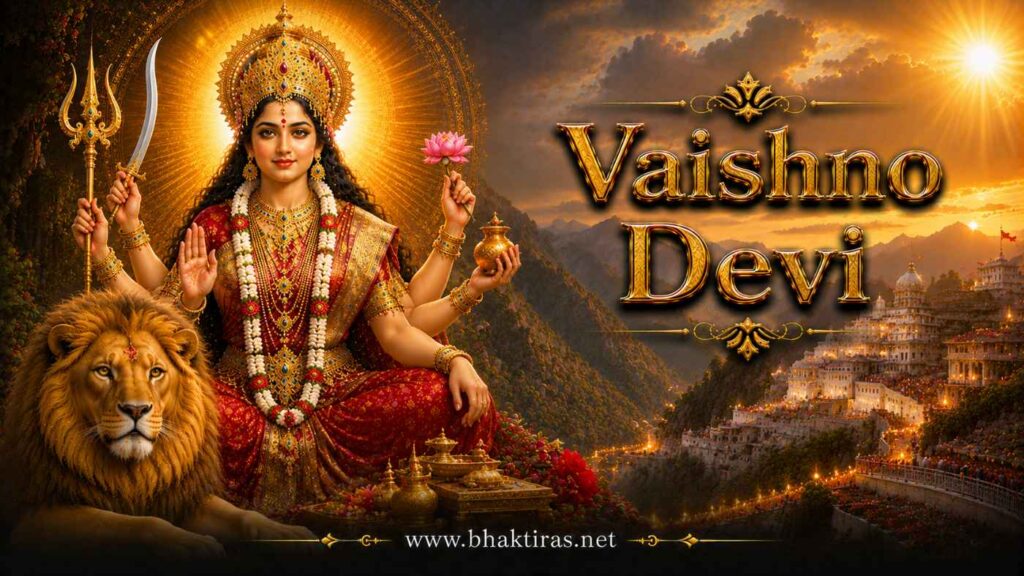
Vaishno Devi, lovingly called Mata Rani, is worshipped as the unified form of Adi Shakti in a holy cave on the Trikuta hills near Katra, Jammu and Kashmir. Devotees see her as three natural rock pindis – Maha Kali, Maha Lakshmi and Maha Saraswati – and climb roughly thirteen kilometres to reach her, chanting Jai Mata Di.
Who Is Vaishno Devi
Ask any pilgrim on the path above Katra who they are climbing to meet, and the answer comes back the same way – Mata Rani, the Mother who reigns. Vaishno Devi is not a single carved deity in the usual sense. She is worshipped as Adi Shakti, the first and original power behind all creation, who chose to make her home inside a narrow cave high on the Trikuta hills of Jammu and Kashmir. Devotees hold that the same divine energy that becomes Durga, Lakshmi and Saraswati is present here as one, quietly waiting for whoever has the will to reach her.
The Mother who reigns
The name Mata Rani carries both tenderness and majesty. Pilgrims speak to her as a mother who knows their worries, yet approach the cave with the awe due a queen. That double feeling – being held and being humbled at once – is what most people remember from the yatra.
Refuge, not spectacle
There is no grand idol at the heart of the shrine. What waits inside the Holy Cave are three natural rock forms lit by lamps. The plainness is the point: Vaishno Devi is met through faith and effort, not through display.
Because she is understood as the united Shakti, prayers here range across every human need – a child, a cure, a job, a safe return, forgiveness. People do not come to Vaishno Devi for one narrow blessing. They come, in the old phrase, to place their whole life at her feet and trust that the Mother will sort what is worth granting.
The Three Pindis – Kali, Lakshmi and Saraswati as One
At the deepest point of the cave, in a chamber the pilgrims call the sanctum, sit three rounded rock formations known as the pindis. They are not statues and were never sculpted. To the devotee they are the Mother showing herself in stone, and each one carries a name and a colour of grace.
Maha Kali
The pindi on the right is honoured as Maha Kali, the fierce protective power that destroys fear and evil. She is the courage a tired pilgrim finds on the last steep stretch of the climb.
Maha Lakshmi
The central pindi is Maha Lakshmi, the giver of abundance, health and well-being. Much of the everyday prayer at the cave – for a home, a livelihood, a healthy family – is placed before this form.
Maha Saraswati
The pindi on the left is Maha Saraswati, wisdom, learning and clear speech. Students and seekers of knowledge feel a special pull toward her presence.
The heart of the teaching here is that these three are not three separate goddesses lined up in a row. They are one Mother seen in three moods. In most of India a devotee visits Kali at one temple, Lakshmi at another and Saraswati at a third. On the Trikuta hills all three are received in a single breath, in a single cave, which is exactly why the shrine is treasured as a meeting of the whole of Adi Shakti.
The Legend of Mata Rani and Bhairon Nath
The story that gives the yatra its shape is told from mother to child across generations of pilgrims. It explains every stop on the path and why the journey does not truly end at the cave.
A girl born of the Devi's light
Long ago, the goddess took birth as a young girl in a devout Vaishnava household in the south, promising to grow up serving the Mother and living a life of purity. Even as a child she kept fasts, avoided worldly comforts and turned her heart entirely toward the divine. She made her way north to the Trikuta hills to deepen her tapasya.
The feast and the pursuit
During her worship she held a bhandara, a feast open to all. Among the guests was a tantric named Bhairon Nath, who saw her radiance and, mistaking spiritual power for something to possess, demanded she marry him. The girl-goddess refused and fled, and Bhairon gave chase across the hills – a pursuit that traced the very route pilgrims walk today.
Ardhkuwari and the womb-cave
To gather her strength she took shelter in a tiny cave and remained hidden there for nine months, the way a child rests in the womb. This spot is Ardhkuwari, and the narrow passage devotees squeeze through is called Garbhjoon, the womb-cave. Emerging renewed, she pressed on toward the Holy Cave.
The beheading and the boon
When Bhairon finally cornered her at the cave, the girl revealed her true form as the Devi and, with a single stroke, struck off his head. His head is said to have flown to the ridge where the Bhairon temple now stands. In his last moment Bhairon repented, and the Mother, forgiving him, granted him moksha and a lasting boon – that no pilgrim’s yatra to her cave would be counted complete until they had also climbed to him.
This is why devotees say the Mother is karuna itself. Even the one who hunted her is not condemned but freed. The legend turns a chase into a lesson: sincere surrender is always welcomed back, and mercy, in the end, outweighs revenge.
The Holy Cave and the Yatra from Katra
The pilgrimage begins in the town of Katra, the base at the foot of the Trikuta hills, and climbs roughly thirteen kilometres to Bhawan, where the Holy Cave rests. People walk it, ride ponies, take a palki, or hire a battery car and helicopter for parts of the route, but the spirit is the same – a steady upward journey with the chant of Jai Mata Di passing from group to group. These are the stations most pilgrims pause at along the way:
- Banganga – the stream where the girl-goddess is said to have quenched her thirst by shooting an arrow into the earth; pilgrims bathe or sip here to begin purified.
- Charan Paduka – a rock bearing what devotees revere as the Mother’s footprints, marking where she paused and looked back during her flight.
- Ardhkuwari – the womb-cave where she hid for nine months; the narrow Garbhjoon passage is crawled through as a symbolic rebirth.
- Sanjichhat – a high ridge and resting point with cool air and wide views, roughly the halfway rise toward Bhawan.
- Bhawan – the shrine complex around the Holy Cave, where devotees finally have darshan of the three pindis.
- Bhairon temple – the last climb above Bhawan to the shrine of Bhairon Nath, without which the yatra is held to be unfinished.
The old natural cave through which pilgrims once waded past cold water is now largely reserved for special occasions, with wider tunnels handling the daily flow of the crowds. However you reach it, the last moments before the pindis are quiet in a way that stays with people long after they have walked back down to Katra.
Why the Pilgrimage Ends at Bhairon
Many first-time pilgrims are surprised to learn that having darshan of Mata Rani is not, by tradition, the final step. Above the cave, a further climb leads to the temple of Bhairon Nath – the very being who once pursued the goddess.
The boon he was given
In forgiving Bhairon at the moment of his death, the Mother promised that pilgrims who visited her would also come to him. Skipping the Bhairon temple is therefore felt to leave the yatra incomplete, a promise half-kept.
Mercy made into a route
The climb to Bhairon is a walking reminder that the goddess redeemed her enemy. Every pilgrim who makes the extra effort re-enacts her compassion, honouring the one she chose to save rather than punish.
So the yatra closes not on triumph but on grace. Devotees descend having witnessed both the Mother’s power in the cave and her mercy on the ridge, carrying home the sense that the door of forgiveness is never fully shut.
Navaratri at the Shrine
If there is one season when the Trikuta hills breathe as a single living crowd, it is Navaratri. Twice a year – in spring at Chaitra and in autumn at Sharad – the nine nights of the Mother fill Katra and the whole path to Bhawan.
Nine nights of the Mother
Since Vaishno Devi is worshipped as the united Shakti, Navaratri is her festival above all. The shrine is decorated, special aartis are held morning and evening, and the recitation of the Durga Saptashati fills the complex.
A river of pilgrims
During these days the yatra count swells enormously. Families plan the trek months ahead, fast through the nine days, and time their climb so that darshan falls within the festival, joining a stream of red chunris moving up the hill.
The autumn Navaratri, ending in Dussehra, and the spring Navaratri, ending near Ram Navami, both turn the ordinary climb into something closer to a celebration. The chant of Jai Mata Di barely stops, echoing off the rock late into the night as fresh groups keep arriving.
How Vaishno Devi Is Worshipped
Worship of Mata Rani mixes the simple devotion of the household with the effort of the road. Some of it happens at home before setting out, much of it on the path itself, and the rest at the cave. Common practices include:
- Chanting Jai Mata Di aloud throughout the climb, so that strangers keep encouraging one another up the hill.
- Carrying the atka-bhent, a small bundle of offerings – a coconut, chunri, sweets and a token amount – presented at the cave.
- Offering a red chunri and, for those who vow it, a full chola of cloth and ornaments dressed onto the Mother’s form.
- Keeping a vrat or fast during the yatra, often taking only fruit and water until darshan is complete.
- Walking barefoot for part of the route as a mark of humility and a fulfilled promise.
- Reciting the Vaishno Devi aarti and the Durga stuti, and lighting a lamp of mannat when a wish is granted.
A gentle rule of the pilgrimage is that Mata Rani calls those she wishes to call – the old saying is that no one reaches the cave until she sends the bulawa, the invitation. Devotees therefore treat a completed yatra not as their own achievement but as the Mother’s own grace answered.
Temples and the Bhawan
While the Holy Cave is the destination, the sacred landscape of Vaishno Devi is spread across the whole hill and beyond. A few places are especially bound to her worship:
- The Holy Cave at Bhawan – the sanctum of the three pindis and the heart of the entire pilgrimage.
- Bhairon Nath temple – above Bhawan, the ridge shrine that completes the yatra.
- Ardhkuwari shrine – built around the womb-cave where the goddess sheltered, a major halt on the way up.
- Charan Paduka and Banganga shrines – the lower stations honouring her footprints and the sacred stream.
- Katra town temples – the base-camp shrines where pilgrims take blessings before beginning the climb.
The shrine is cared for by a dedicated board that has widened the tracks, added rest points and shelters, and managed the vast daily crowds, so that the ancient cave remains reachable for the very young, the old and the frail alongside the fittest trekkers.
Prayers and Mantras
The most-loved call at the shrine needs no priest – it is the two-word chant Jai Mata Di, victory to the Mother, repeated on every step. Alongside it, devotees offer the beeja mantra of the goddess, a compact prayer that gathers her three forms into a single line:
The Mool Mantra
ॐ ऐं ह्रीं क्लीं वैष्णो देव्यै नमः – Om Aim Hreem Kleem Vaishno Devyai Namah. The three seed-sounds Aim, Hreem and Kleem invoke Saraswati’s wisdom, Adi Shakti’s power and Lakshmi’s grace, ending in a bow to Vaishno Devi as the one who holds them together.
Many pilgrims also recite the Durga Chalisa and the Vaishno Devi aarti at the cave and back at home, keeping the connection alive long after the descent. The prayers are less about exact words than about turning the whole heart toward the Mother, which is what the yatra teaches from the first step out of Katra.
Frequently Asked Questions about Vaishno Devi
Who is Vaishno Devi?
Vaishno Devi, adored as Mata Rani, is worshipped as Adi Shakti, the original divine power, enshrined in a holy cave on the Trikuta hills near Katra in Jammu and Kashmir. She is seen as the united form of Maha Kali, Maha Lakshmi and Maha Saraswati and is one of the most visited goddesses in India.
What are the three pindis?
The three pindis are three natural rock formations inside the Holy Cave, revered as the Mother herself. The right is Maha Kali (protective power), the centre is Maha Lakshmi (abundance), and the left is Maha Saraswati (wisdom). Together they show that a single Adi Shakti contains all three goddesses.
How long is the Vaishno Devi trek?
The main trek runs about thirteen kilometres from Katra up to Bhawan, where the Holy Cave lies. Pilgrims can walk, ride a pony, take a palki or a battery car, and a helicopter service covers part of the route. Most walkers complete the climb in several hours depending on pace and crowds.
Why do pilgrims also visit the Bhairon temple?
According to the legend, the goddess beheaded the tantric Bhairon Nath at the cave but forgave him and granted him moksha, promising that pilgrims to her shrine would also visit him. The Bhairon temple sits on a ridge above the cave, and the yatra is traditionally considered incomplete without that final climb.
What is the significance of Ardhkuwari?
Ardhkuwari is the small womb-cave where the girl-goddess is said to have hidden for nine months while fleeing Bhairon Nath. Pilgrims pass through its narrow Garbhjoon passage as a symbolic rebirth. It stands roughly midway on the climb and is one of the most cherished halts of the yatra.
When is the best time to visit Vaishno Devi?
The shrine welcomes pilgrims all year, but the twice-yearly Navaratri seasons in spring and autumn are the most sacred and the most crowded. Summer offers pleasant walking weather, while winter can bring snow and cold on the higher stretches. Many prefer the cooler months of the year for the climb.
What offerings do devotees bring to Mata Rani?
Common offerings include the atka-bhent bundle of a coconut, sweets and a red chunri, along with dry fruits and a token amount. Those who make a special vow may offer a full chola of cloth and ornaments. Above all, pilgrims bring their prayers, keep fasts, and chant Jai Mata Di.
What does Jai Mata Di mean?
Jai Mata Di means victory to the Mother goddess. It is the constant chant of the Vaishno Devi yatra, called out on every step of the climb. Pilgrims use it to greet one another, to encourage tired walkers, and to keep their hearts fixed on Mata Rani all the way to the cave.
Is Vaishno Devi the same as Durga?
They are closely linked. Vaishno Devi is worshipped as a form of Adi Shakti, the same supreme power that manifests as Durga. The three pindis include Maha Kali, a fierce aspect of the Mother much like Durga. So while the shrine has its own legend and identity, devotees experience her as the one Mother behind Durga and all the goddesses.
May Mata Rani send you her bulawa, and may your every step up the Trikuta hills be light – Jai Mata Di.