
Vindhyavasini Devi
विंध्यवासिनी
Vindhyavasini Devi is a fierce, self-manifested form of Durga and the Adi Shakti who lives in the Vindhya mountains at Vindhyachal near Mirzapur, Uttar Pradesh, on the banks of the Ganga. Worshipped as Yogamaya, she grants power, protection and the fulfilment of heartfelt wishes. Her shrine is one of the great Shakti Peethas.
Who Is Vindhyavasini Devi
Vindhyavasini Devi is the Goddess who made the Vindhya mountains her home. Her name says it plainly – Vindhya-vasini, the one who resides in the Vindhyas. Pilgrims know her as a fierce and giving form of Durga, the Adi Shakti herself, seated on a lion above the wide bend of the Ganga at Vindhyachal in Uttar Pradesh.A form of the Adi Shakti
She is counted among the great forms of Durga and is often identified with Mahalakshmi and Mahakali as the primordial power that holds up creation. Devotees do not treat her as a lesser or regional deity – to them she is the same Shakti praised across the Puranas, choosing to be present in one particular place.
Yogamaya, the divine illusion
In her deepest identity she is Yogamaya, the veiling power of Vishnu himself. It was Yogamaya who arranged the events around Krishna’s birth, and it is she who dwells at Vindhyachal. This ties the Goddess of the Vindhyas directly to the great story of Krishna and Kansa.
Fierce yet approachable
Her form is that of a warrior – red garments, weapons in many hands, a lion beneath her. Yet those who come to her speak of her as a mother who answers. She is asked for children, for courage, for release from fear, and for the strength to face what a life demands.
The Girl Who Slipped from Kansa's Hands
The exchange in the prison
The story begins in the dungeon of Mathura, where the tyrant Kansa had locked away his sister Devaki and her husband Vasudeva. A prophecy had told Kansa that Devaki’s eighth child would kill him, so he waited to destroy each newborn. On the night Krishna was born, a strange sleep fell over the prison. At the same hour, in Gokul, Yashoda gave birth to a daughter – and that daughter was Yogamaya, the Goddess taking human form. Vasudeva carried the infant Krishna across the flooded Yamuna and quietly exchanged the two children. Krishna slept safe in Gokul, and the divine girl lay in Devaki’s place.
The child who rose into the sky
When Kansa heard the cry of a newborn, he rushed in and seized the child, meaning to smash her against a stone as he had the others. But she slipped from his grip. She rose out of his hands into the air, taking the eight-armed form of the Goddess, and her voice filled the prison – your slayer is already born and growing elsewhere, and no wall of yours can reach him. Then she vanished. Kansa was left shaken, his cruelty spent on empty air.
Why she went to the Vindhyas
Having delivered her warning, the Goddess did not return to any heaven. She chose the earth, and specifically the forested ridges of the Vindhya mountains, and settled there as Vindhyavasini. So the same divine girl who protected Krishna became the presence enshrined at Vindhyachal – which is why her devotees feel her tied forever to the Krishna story, even as they worship her as Durga.
She Who Dwells in the Vindhyas
The Vindhya range runs like a long spine across central India, an old and wild country in the memory of the Puranas. That the Goddess chose these hills rather than a golden palace tells you something about how she is understood.A wild and ancient land
The Vindhyas were spoken of as a border between the north and the south, thick with forest and touched with a sense of the untamed. A Goddess who is power in its raw form belongs to such a place. Her presence here reads less like a visitor and more like the land itself waking up as a deity.
Where the mountains meet the Ganga
Vindhyachal sits where the hills come down to the Ganga. Pilgrims bathe in the river below and then climb to the Devi, so the journey joins the two great sacred forces of the region – the mountain and the water. This meeting of hill and river gives the pilgrimage much of its feeling.
The Vindhyachal Shakti Peetha
Vindhyachal is honoured as one of the important Shakti Peethas and as a Siddha Peetha – a place where prayer is believed to bear fruit quickly. For countless families across Uttar Pradesh, Bihar and beyond, a visit here is a duty carried out at least once, and often again and again.The main temple
The central shrine holds the Devi in a compact sanctum that stays crowded through the day. Pilgrims move in a slow, pressing line to catch her darshan, offer red cloth, coconut, sindoor and sweets, and whisper what they have carried in their hearts. The scale of devotion in that small space is part of what people remember.
A living pilgrimage town
Around the temple, Vindhyachal has grown into a full pilgrimage town of lodges, priests, shops of offering goods, and boats on the Ganga. During Navaratri the roads fill for kilometres and the town runs day and night to receive the flood of visitors.
The Sacred Triangle – Vindhyavasini, Kali and Ashtabhuja
Vindhyachal is not one shrine but three, arranged in a sacred triangle known as the Trikon. Serious pilgrims complete a circuit of all three, walking the Trikon Parikrama that binds the Goddess in her three great aspects.- Vindhyavasini Devi – the central Goddess of the town, the giving mother who fulfils wishes and offers protection, worshipped in the main temple by the Ganga.
- Kali Khoh – a cave-like shrine on the hillside sacred to Mahakali, the dark and fierce power that destroys evil and fear. Her presence gives the triangle its edge of raw strength.
- Ashtabhuja Devi – the eight-armed Goddess, worshipped as the aspect of knowledge and creative power, set higher in the hills with wide views over the region.
- Together the three are read as the fullness of Shakti – Lakshmi in Vindhyavasini, Kali in Kali Khoh, and Saraswati in Ashtabhuja – so that completing the Trikon is to honour the whole Goddess in a single journey.
Iconography & Symbols
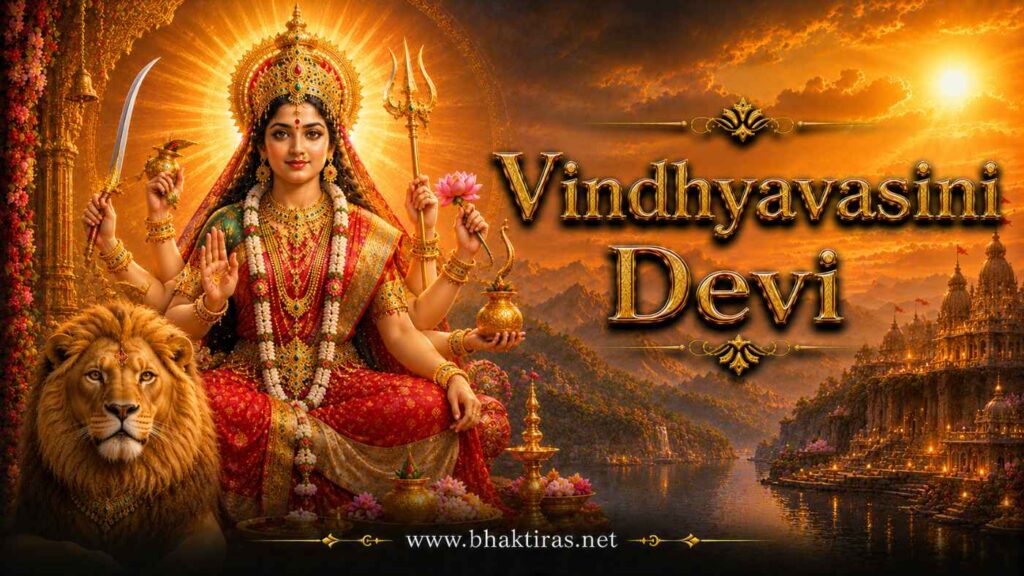
Vindhyavasini is shown as a warrior mother, calm in face but armed for battle, every object in her hands carrying a meaning.The lion
She rides or is seated beside a lion, her vahana. The lion is fearlessness and sovereign power, the wild made obedient to the divine will. It marks her as Durga, the one who tames what others flee from.
The trishula and chakra
The trident in her hand pierces ignorance, ego and evil in their three forms. The chakra, the spinning discus, is the turning of time and the swift cutting of danger. Together they show a Goddess ready to act.
Red robes and sindoor
She is dressed and adorned in deep red, the colour of Shakti, of life-force and of victory. Devotees offer sindoor and red cloth to her, and her sanctum glows with the same shade – a reminder that she is power in its most vivid form.
The many arms
In her fuller forms she carries several weapons and a lotus at once. The many arms say that she can guard from every side, meet many troubles together, and still hold out the open lotus of blessing to those who ask.
How Vindhyavasini Devi Is Worshipped
Worship of Vindhyavasini runs from a quiet daily lamp at home to the great surge of the Navaratri pilgrimage. These are the ways devotees turn to her.- Navaratri pilgrimage – the two Navaratris, in spring (Chaitra) and autumn (Sharad), draw the largest crowds, when lakhs of pilgrims arrive at Vindhyachal to seek her darshan.
- The Trikon Parikrama – the circuit of Vindhyavasini, Kali Khoh and Ashtabhuja on foot, walked especially during Navaratri, is the signature act of devotion here.
- Bath in the Ganga – pilgrims first bathe in the river below the temple, then climb to offer their prayers with a purified body.
- Offerings – red cloth (chunari), coconut, sindoor, flowers, sweets and a lamp are given at her feet, along with the recitation of her mantra.
- Durga Saptashati path – reading or hearing the Devi Mahatmya, in which she is praised, is a common way to honour her, at the temple or at home.
- Kajali festival – the monsoon Kajali celebration, tied to the region and to the Devi, brings folk song and fairs to Vindhyachal.
- Vows for wishes – many come to make a vow (mannat) for a child, a marriage, health or success, returning to give thanks when the wish is granted.
Temples & Sacred Sites
The heart of her worship is fixed at Vindhyachal, though her name is honoured wherever Durga is loved.- Vindhyavasini Temple, Vindhyachal – the principal shrine, near Mirzapur in Uttar Pradesh, on the banks of the Ganga, and one of the most visited Devi temples in the north.
- Kali Khoh, Vindhyachal – the hillside cave shrine of Mahakali, the second point of the sacred triangle.
- Ashtabhuja Temple, Vindhyachal – the eight-armed Goddess set in the hills above the town, the third point of the Trikon.
- Sita Kund and other tirthas – the sacred bathing spots and smaller shrines scattered around Vindhyachal that pilgrims touch on their way through.
- Local Vindhyavasini shrines – across Uttar Pradesh, Bihar and neighbouring regions, many communities keep smaller temples to her, often modelled on the mother shrine.
Prayers & Mantras
Her mantras are short, direct calls to the Goddess of the Vindhyas, used at the temple and in daily prayer at home.Mool Mantra
ॐ विंध्यवासिन्यै नमः
Om Vindhyavasinyai Namah
I bow to Vindhyavasini, the Goddess who dwells in the Vindhyas. Repeated with a steady mind, this simple line is the most common way devotees keep her near.
Invocation of the Devi
या देवी सर्वभूतेषु शक्तिरूपेण संस्थिता।
Ya Devi sarva-bhuteshu Shakti-rupena samsthita
To the Goddess who abides in all beings as power itself, I bow again and again. Drawn from the Durga Saptashati, this verse is often sung to Vindhyavasini as a form of that same Shakti.
Frequently Asked Questions about Vindhyavasini Devi
Who is Vindhyavasini Devi?
Vindhyavasini Devi is a fierce and giving form of Durga, the Adi Shakti, who dwells in the Vindhya mountains at Vindhyachal in Uttar Pradesh, on the banks of the Ganga. She is worshipped as Yogamaya and grants power, protection and the fulfilment of wishes, and her shrine is a great Shakti Peetha.
Is she connected to Krishna?
Yes, closely. In her deepest identity she is Yogamaya, the divine girl born to Yashoda and exchanged for the infant Krishna. When Kansa tried to kill her, she slipped from his hands, rose into the sky, foretold his death by the child already born, and then went to dwell in the Vindhya mountains as Vindhyavasini.
Where is the Vindhyavasini temple?
The main temple is at Vindhyachal, near Mirzapur in Uttar Pradesh, standing close to the Ganga. It is one of the most visited Devi temples in northern India and part of a sacred triangle with the shrines of Kali Khoh and Ashtabhuja Devi in the surrounding hills.
What is the sacred triangle at Vindhyachal?
The Trikon, or sacred triangle, joins three shrines – Vindhyavasini in the town, Kali Khoh (Mahakali) on the hillside, and Ashtabhuja Devi higher in the hills. Devotees walk the Trikon Parikrama, a circuit of all three, especially during Navaratri, to honour the whole Goddess in one journey.
Which texts speak of Vindhyavasini?
She appears in the Devi Bhagavata Purana and the Markandeya Purana, and she is praised within the Durga Saptashati, the Devi Mahatmya, where the Goddess is described as dwelling in the Vindhya mountains. These texts identify her with Durga, Yogamaya and the primordial Shakti.
When is the best time to visit her?
The two Navaratri seasons, in spring (Chaitra) and autumn (Sharad), are the most auspicious and the busiest, when huge crowds gather at Vindhyachal. Many also visit during the monsoon Kajali festival. Any day is welcome, but Navaratri carries the strongest devotional atmosphere.
What do devotees pray to her for?
People turn to Vindhyavasini for power, protection and courage, and above all for the fulfilment of heartfelt wishes – a child, a marriage, recovery from illness, or success in a hard undertaking. Many make a vow and return to give thanks once the wish is granted.
May Vindhyavasini Devi, seated on her lion above the Ganga, guard you, strengthen you, and grant the wish you carry to her feet.