
Goddess Jagaddhatri
जगद्धात्री
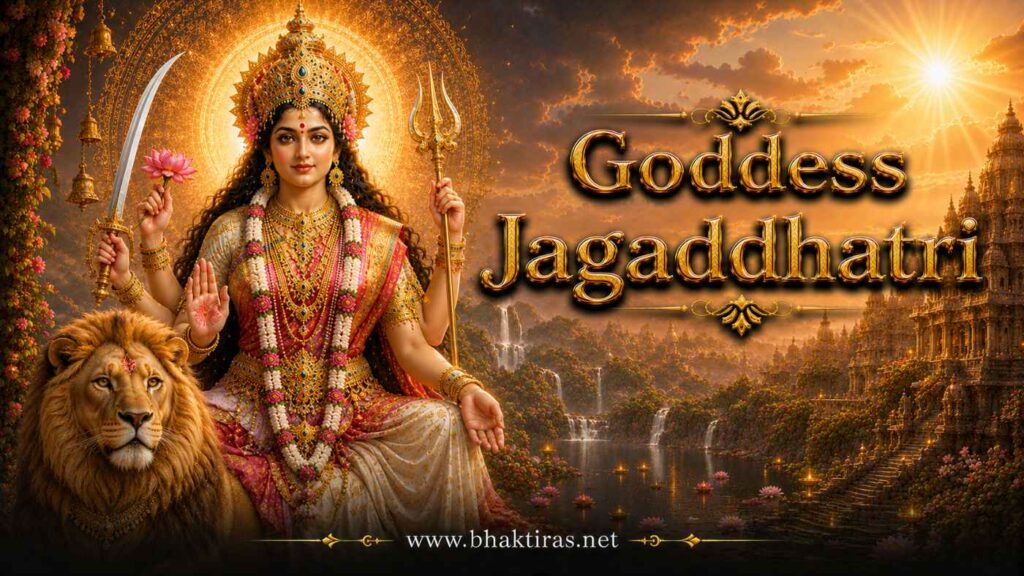
Jagaddhatri is a serene, golden form of Durga whose name means the Bearer of the World. Three-eyed and four-armed, she rides a lion that stands over Karindrasura, the elephant-demon of pride. She carries the conch, chakra, bow and arrow, wears a snake as a sacred thread, and is worshipped grandly across Bengal.
Who Is Goddess Jagaddhatri
Jagaddhatri is one of the gentler, more regal faces of the Great Goddess. Where Durga rides into battle and Kali dances in fury, Jagaddhatri sits with a calm, sovereign grace, holding creation steady the way a mother holds a sleeping child. Her name says it plainly: jagat, the world; dhatri, the one who bears and nourishes it. She is the Bearer of the World.In her form we meet a golden, three-eyed, four-armed goddess seated upon a lion, with a defeated elephant-demon crushed beneath the lion’s paws. She wears red, carries the weapons of Durga, and drapes a living serpent across her shoulder as a sacred thread. Every part of this image is a lesson, and worshippers across Bengal have read those lessons for centuries. To her devotees she is not a distant power but the warm, watchful mother who keeps the world from falling apart, and who quietly asks each of us to conquer the one enemy we rarely name – our own pride.The Bearer of the World
The heart of Jagaddhatri lies in her name. Dhatri is a word rich with tenderness – it means the nurse, the foster-mother, the one who carries a child and feeds it. To call the Goddess Jagaddhatri is to say that the whole cosmos is her infant, resting in her arms, drawing its life from her.This is a different kind of divine strength from the one we usually celebrate. It is not the power that destroys, but the power that holds. Sages describe her as the sattvic energy of the Devi – the balanced, luminous force that sustains what has already been created. The sun stays lit, the seasons turn, the rivers keep their course, and a mother’s love keeps a family whole; behind all of it, the tradition says, is Jagaddhatri quietly bearing the weight. Her serenity is not weakness. It is the composure of someone strong enough that she need never raise her voice. Holding up the world, after all, is harder than tearing it down.The Lion, the Elephant-Demon and the Ego
Look closely at Jagaddhatri’s mount and you find a striking, layered image. She rides a lion, and the lion in turn stands upon a fallen elephant. That elephant is Karindrasura, the elephant-demon – karin means elephant – and his defeat is the secret meaning of her whole form.In the older stories the elephant is a symbol of the ego and of unruly pride. An elephant is enormous, powerful, hard to control, and when it goes mad it tramples everything in its path – much like a mind swollen with arrogance. The lion, the vehicle of the Goddess, subdues it. So Jagaddhatri seated above both is the higher awareness that masters the wild ego and the pride that runs wild inside us. She does not merely kill the demon; she stands upon it, keeping it forever beneath her feet. The message is quiet but firm: the world is upheld not only by force against outer enemies, but by the steady conquest of the pride within. That is why she is called Karindrasuranisudini, the one who slays the elephant-demon.Iconography & Symbols
Every detail of Jagaddhatri’s image carries meaning. Artists in Bengal follow this description carefully, and devotees learn to read it like a sacred text.Three Eyes
Like Shiva and Durga, she gazes with three eyes, said to be the sun, the moon and fire. They let her see the past, the present and the future at once, so that nothing in the world she bears escapes her care.
Four Arms
Her four arms show her completeness and her reach across the four directions. In them she holds the weapons that mark her as a form of Durga, ready to protect what she sustains.
Conch, Chakra, Bow & Arrow
The conch (shankha) sounds the primal note of creation; the discus (chakra) is the wheel of time and cosmic order; the bow and arrow show her aim and resolve. These are Durga’s own arms, borne with calm rather than rage.
The Serpent Thread
Across her body she wears a snake as a sacred thread (yajnopavita). The serpent, usually a sign of danger, becomes an ornament of the wise – showing that she has tamed even the most fearsome energies and turned them to sacred use.
Golden Form
Her complexion glows like the newly risen sun, warm and golden. This radiance marks her sattvic, luminous nature – the light that nourishes rather than scorches.
Lion Upon the Elephant
She sits on a lion whose paws press down the elephant-demon Karindrasura. The tiered image places pure awareness above courage, and courage above the conquered ego.
The Teaching of Humility
One of the deepest tales linked with Jagaddhatri reaches back to an old Upanishadic teaching about pride, retold in the light of the Devi. After a great victory the gods began to boast, each believing his own strength had won the day – and the Goddess set out to humble them.The Yaksha in the Field
In the Kena Upanishad, the gods triumph over the forces of darkness and grow swollen with pride, each taking the credit for himself. A mysterious being, a Yaksha, appears before them. Puzzled, the gods send Agni, lord of fire, to learn who it is. The Yaksha lays a single blade of grass on the ground and asks Agni to burn it. Fire itself, for all its might, cannot scorch that one blade. Vayu, the wind, is sent next and cannot stir it. The proud gods are quietly stripped of their certainty.
The Appearance of Uma
Then Indra, king of the gods, comes forward, and the Yaksha vanishes. In its place appears Uma, radiant as gold – the Goddess herself – who reveals that the strength the gods claimed was never their own. It was her power moving through them. The devotional tradition reads this shining, golden Uma as none other than the Devi in her Jagaddhatri aspect, the one who bears the world and gently teaches the mighty that their pride is borrowed light.
Jagaddhatri Puja in Bengal
Nowhere is Jagaddhatri loved as warmly as in Bengal. Her great festival, Jagaddhatri Puja, falls in the month of Kartik, only a few days after Kali Puja, and for the towns that keep it, these are the brightest nights of the year.Two places above all are famous for it. In Chandannagar, the old French settlement on the Hooghly, the puja is known across India for its extraordinary lighting – streets and pandals lined with thousands of tiny bulbs arranged into moving pictures, so that whole avenues seem to breathe with light. In nearby Krishnanagar, in Nadia district, the festival is said to have taken its historic form under the local rulers, and the immense clay images of the golden goddess draw crowds through the night. Families gather, drums roll, and on the final day long illuminated processions carry the images to the river, the crowds singing as the golden mother is given back to the water. For a few nights the ordinary streets become a moving temple, and the Bearer of the World is carried through them by the hands of her children.Jagaddhatri, Durga and Kali
Bengal worships the Goddess in three great forms across the autumn – Durga, Kali and Jagaddhatri – and their festivals follow one another like movements in a single piece of music. Understanding how they relate helps make sense of Jagaddhatri’s place.In the old teaching, all three are one Devi seen in different moods. Durga arrives first in Ashvin, the warrior riding out to slay Mahishasura, all courage and motion. Kali follows on the new-moon night, dark and untamed, the fierce power that dissolves what has run its course. Then, a little later in Kartik, comes Jagaddhatri – calm, golden, seated in sovereign peace, the power that holds and sustains what remains. If Durga is the strength that fights and Kali the strength that destroys, Jagaddhatri is the strength that keeps. Together they trace a full circle of divine power: to create and protect, to dissolve, and to bear the world onward. Devotees who keep all three feel they have greeted the same Mother in three of her faces.How Goddess Jagaddhatri Is Worshipped
Worship of Jagaddhatri blends the grandeur of a public festival with the quiet of household devotion. Whether in a great pandal or a small home shrine, a few practices are common.- Observing Jagaddhatri Puja in the month of Kartik, soon after Kali Puja, as the main day of her worship.
- Offering red flowers, especially hibiscus, along with fruit, sweets and lamps before her golden image.
- Chanting her mantras and the Devi hymns of the Puranas and Tantra, often through the night.
- Lighting rows of lamps and, in the famous towns, elaborate electric illuminations in her honour.
- Keeping a fast or a simple sattvic diet on the day of the puja as an act of devotion.
- Joining the final procession that carries her image to the river for immersion, singing her praises along the way.
- Meditating on her form as a reminder to set down one’s own pride and rest in the Mother’s care.
Prayers & Mantras
Her devotees turn to simple, ancient mantras to call the golden mother near. The most common is short enough for anyone to hold in the heart through a busy day.The essential mantra is:
ॐ जगद्धात्र्यै नमः
Om Jagaddhatryai Namah
Salutations to Jagaddhatri, the Bearer of the World. Repeated with attention, this simple line is said to draw the mind toward her calm, sustaining presence and to soften the pride that keeps us restless. Many devotees also recite the Devi hymns and the thousand names of the Goddess, offering each name like a flower laid at her golden feet.
Frequently Asked Questions about Goddess Jagaddhatri
Who is Jagaddhatri?
Jagaddhatri is a serene, golden form of the Goddess Durga whose name means the Bearer of the World. She is three-eyed and four-armed, rides a lion set over the elephant-demon of pride, and represents the calm power that sustains all of creation. She is worshipped grandly across Bengal.
What does the name Jagaddhatri mean?
The name joins two words – jagat, meaning the world, and dhatri, meaning the bearer, mother or nurse. Together they mean the one who upholds and nourishes the world. The name captures her role as the loving power that holds the cosmos steady, cradling it like a mother with her child.
How is Jagaddhatri different from Durga?
Jagaddhatri is a form of Durga, but her mood is different. Durga is the warrior who rides out to slay Mahishasura in fierce battle, while Jagaddhatri sits in golden, sovereign calm. She embodies the sattvic power that sustains creation and the mastery of pride, rather than the fury of the battlefield.
What does the elephant-demon symbolise?
The elephant-demon Karindrasura, crushed beneath the lion she rides, stands for the ego and unruly pride. Like a maddened elephant that tramples everything, arrogance runs wild in the mind. By setting the demon beneath her feet, Jagaddhatri shows the higher awareness that masters and subdues the ego within us.
When is Jagaddhatri Puja celebrated?
Jagaddhatri Puja falls in the Hindu month of Kartik, only a few days after Kali Puja, usually in November. It is one of Bengal's most cherished autumn festivals, following Durga Puja and Kali Puja in the same season and completing the circle of the Goddess's worship.
Where is Jagaddhatri Puja most famous?
Chandannagar and Krishnanagar, both in West Bengal, are the most celebrated centres of Jagaddhatri Puja. Chandannagar is known for its dazzling illuminations, with whole streets lit into moving pictures, while Krishnanagar in Nadia district is famed for its towering golden images and historic tradition.
Why does Jagaddhatri wear a snake as a sacred thread?
The serpent she wears across her body as a sacred thread shows that she has tamed even the most dangerous energies and turned them to holy use. A snake, usually a symbol of fear, becomes an ornament of the wise on her form, marking her complete mastery over every force in creation.
What is the meaning of her three eyes?
Her three eyes are said to be the sun, the moon and fire, and they let her see the past, present and future together. Like Shiva and Durga, this third eye marks her as a deity of complete vision, watching over the whole world she bears so that nothing escapes her care.
May the golden mother Jagaddhatri, who bears the whole world with tender strength, hold your life steady and lift the burden of pride from your heart.