
Goddess Annapurna
अन्नपूर्णा
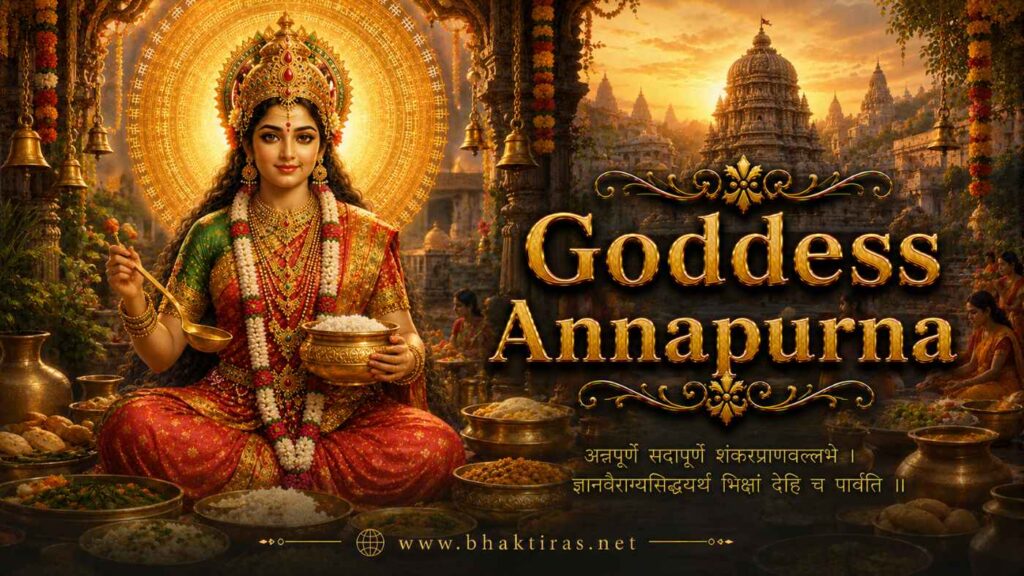
Annapurna is the Hindu goddess of food, nourishment and abundance, a gentle form of Parvati. Her name means she who is full of food. She is pictured with a jewelled bowl of kheer and a golden serving ladle, feeding all beings from her kitchen in Kashi. Even Lord Shiva receives his meal from her.
Who Is Goddess Annapurna
Annapurna is the goddess who feeds. Her name says it plainly – anna, food or grain, and purna, full – so she is the one who is full of food, the giver of every meal. She is worshipped as a warm and generous form of Parvati, the great Mother, turning her attention here to something ordinary and daily: the food on the plate, the grain in the pot, the milk that a child drinks.
Hindus see food as more than fuel. A meal is a gift, and behind that gift stands a goddess who never runs short. Annapurna is often shown holding a bowl of kheer or steaming rice in one hand and a golden ladle in the other, ready to serve. The message is gentle and clear – you are fed because she chooses to feed you.
Her home, in the spiritual imagination of India, is Kashi, the ancient city on the Ganga also called Varanasi. There she keeps a kitchen that never closes. The old saying of Kashi is that in her city no one goes hungry, and pilgrims still repeat it as they sit down to eat.
Because she embodies nourishment itself, Annapurna is loved by cooks, mothers, farmers and anyone who has ever worried about the next meal. To pray to her is to ask that the household always has enough, and enough to share.
The Goddess Who Feeds the World
In many traditions, holiness is placed far above the body and its needs. Annapurna gently corrects that. She makes the kitchen a holy place and the act of feeding an act of worship. When a family cooks with care and offers the first portion to God, they are following her.
Food, in her presence, becomes sacred and real. The grain that grows in the field, the water that cooks it, the hands that stir the pot – all of this is her work. She reminds devotees that a hungry person cannot pray, cannot study, cannot love well. Feed the body first, and the spirit follows. This is why so many Hindu festivals end not in silence but in a shared meal.
There is a quiet grace in how she is imagined. She does not withhold. She fills the bowl again and again, which is why her vessel is called akshaya patra, the bowl that never empties. To ask for her blessing is to ask for a home where the pot is always warm and the door is always open to a guest.
The Legend of Annapurna and Shiva in Kashi
When Shiva called food an illusion
The best loved story of Annapurna begins with a disagreement between the Divine Mother and her husband. Shiva, the great ascetic who needs almost nothing, once declared that the whole material world is maya, a passing illusion – and that food too is only part of that illusion, not something truly worth clinging to. Parvati listened, and she did not agree.
The world grows hungry
To show that nourishment is neither illusion nor a small thing, Parvati withdrew from the world. And when she withdrew, food itself vanished. The fields gave nothing, the rivers of milk ran dry, kitchens went cold. Famine spread across the earth. The people suffered, the sages weakened, and in time even the gods felt the ache of an empty stomach. Shiva himself, who had called food mere maya, grew hungry.
She returns as Annapurna
Moved by the suffering, Parvati appeared again in Kashi, this time as Annapurna, seated in a golden kitchen with a bowl of food and a ladle in her hands. She began to cook and to serve, feeding every hungry creature who came to her. Word spread that the Mother had returned and that no one at her door would be turned away.
The great ascetic with a begging bowl
Then came the most touching moment of all. Shiva, lord of the universe and the mightiest of ascetics, walked to Annapurna carrying a simple begging bowl. He held it out and asked her for food. She filled it. In that single act he accepted her lesson – that food is real, that it is divine, and that even he must receive his nourishment from the Mother. This is why Kashi says that Annapurna feeds everyone, and why no devotee in her city is left to go hungry.
Iconography & Symbols
Annapurna is easy to recognise once you know what to look for. Almost every symbol on her form points back to one idea – abundance freely given.
The Bowl of Food
In one hand she holds a jewelled bowl brimming with kheer, rice or sweet payasam. This is the akshaya patra, the vessel that never empties. However much she serves, it fills again, a picture of nourishment without limit.
The Golden Ladle
In her other hand rests a golden serving ladle, the darvi. She is not merely holding food, she is caught in the act of giving it. The ladle is the gesture of a mother at the stove, portioning out a meal to those she loves.
The Lotus Seat
She often stands or sits upon an open lotus. The lotus rises clean out of muddy water, a sign that her gift of food is pure and rooted in compassion rather than in any expectation of return.
Her Red and Gold Form
Annapurna is shown richly adorned, robed in red and gold, crowned and jewelled like a queen. The warm colours speak of plenty, of festival and full storehouses. She is the queen of the household, dignified and kind.
Annapurna of Kashi
Kashi, the city of Shiva on the banks of the Ganga, is also the city of Annapurna. Right beside the great Kashi Vishwanath shrine sits the Annapurna Devi temple, where she is worshipped as the queen who feeds Shiva’s own city. Pilgrims who come for the darshan of Vishwanath rarely leave without also bowing to her.
Inside, the goddess is often shown in her classic pose with bowl and ladle, and one image places Shiva before her, bowl in hand, receiving his meal. The temple keeps her legend alive in stone and in daily practice.
The heart of her worship at Kashi is the sharing of food. On special days, especially Annakut, mountains of cooked rice and dozens of dishes are offered to her and then given out as prasad to the crowds. The old promise of the city holds – come to Kashi and you will be fed. For centuries, dharamshalas and free kitchens near the temple have quietly kept that promise, serving the poor, the pilgrim and the wandering ascetic alike. In feeding them, the city feeds the goddess.
Food as Worship – Hospitality and Gratitude
To honour Annapurna, you do not need an elaborate ritual. You need only to take food seriously – to cook it with care, to give thanks for it, and to share it.
Hindu homes carry this teaching in small daily habits. A little of the meal is set aside before anyone eats, offered first to God or to the household deity. Grain is not wasted, and a fallen morsel is treated with respect. A guest who arrives at meal time is fed before questions are asked, because the guest is treated as a form of the divine, and turning them away hungry would grieve the Mother of food.
Feeding others – annadana, the gift of food – is counted among the highest acts of charity a person can perform. To fill a hungry stomach is to become, for a moment, a small helper of Annapurna. Free meals at temples, community feasts at festivals, and the simple offer of a plate to a stranger all draw on her spirit.
Her worship also asks for gratitude. Before you complain about the food, remember that having any at all is a blessing many do not share. A prayer to Annapurna is often really a prayer of thanks – for the meal already on the table, and for the mother-love that put it there.
How Goddess Annapurna Is Worshipped
Devotion to Annapurna tends to be warm and practical, centred on the kitchen and the shared plate more than on grand ceremony. Here are the main ways her devotees honour her.
- Annapurna Jayanti: Her main festival falls on Margashirsha Purnima, the full moon of the month of Margashirsha. Devotees clean and decorate the kitchen, worship the stove and cooking vessels, prepare fresh food and offer it to the goddess before feeding the family.
- Honouring the kitchen and grain: On her day, and often all year round, families treat the cooking place as sacred. The hearth or stove is not stepped over, grain stores are kept respectfully, and the first cooked portion is offered before anyone begins to eat.
- Feeding others (annadana): The truest worship of Annapurna is to feed the hungry. Devotees offer meals to the poor, to guests, to sadhus and to temple crowds, believing that the food they give returns to them as her blessing.
- Annakut offering: On Annakut, a great heap of cooked rice and many dishes is offered to the goddess and then distributed as prasad, a living picture of her endless bowl.
- Daily prayer and mantra: Many recite the Annapurna mantra or the Annapurna Stotra, especially before cooking or eating, asking that the home always has enough food and enough to share.
- Temple darshan at Kashi: Pilgrims to Varanasi visit the Annapurna Devi temple beside Kashi Vishwanath, offer food and grain, and receive prasad, seeking her promise that they will never go hungry.
Prayers & Mantras
Annapurna is called upon with short, heartfelt mantras and with a famous hymn attributed to Adi Shankaracharya. Many devotees whisper her name before the first bite of a meal.
The Annapurna Mantra
ॐ ह्रीं श्रीं क्लीं अन्नपूर्णायै नमः
Om Hreem Shreem Kleem Annapurnayai Namah
This seed-syllable mantra salutes Annapurna as the source of nourishment and prosperity. Hreem, Shreem and Kleem invoke her divine energy, her abundance and her grace, while the closing words offer humble salutation to her. Devotees repeat it to ask that food and plenty never leave their home.
The Annapurna Stotra
अन्नपूर्णे सदापूर्णे शङ्करप्राणवल्लभे।
ज्ञानवैराग्यसिद्ध्यर्थं भिक्षां देहि च पार्वति॥
Annapurne Sadapurne Shankara-prana-vallabhe,
Jnana-vairagya-siddhyartham bhiksham dehi cha Parvati.
This opening verse of the Annapurna Stotra prays: O Annapurna, ever full, beloved of Shiva as his very life, grant me alms, O Parvati, so that I may gain wisdom and freedom from worldly craving. It is the same humble request Shiva himself is said to have made in Kashi – asking the Mother for the food that sustains both body and soul.
Frequently Asked Questions about Goddess Annapurna
Who is Goddess Annapurna?
Annapurna is the Hindu goddess of food, nourishment and abundance, worshipped as a gentle form of Parvati. Her name means the one who is full of food. She is shown with a jewelled bowl of food and a golden ladle, feeding all beings, and is especially honoured in the holy city of Kashi.
Why does Shiva beg food from Annapurna?
In the famous legend, Shiva once said that food is only maya, an illusion. To show that nourishment is real and divine, Parvati withdrew and food vanished from the world, causing famine. She returned to Kashi as Annapurna and fed everyone, and Shiva himself came with a begging bowl to receive his meal, accepting that even he is fed by the Mother.
When is Annapurna Jayanti?
Annapurna Jayanti is celebrated on the full moon day of the Hindu month of Margashirsha, usually in November or December. On this day devotees clean and honour the kitchen, worship the stove and cooking vessels, cook fresh food, offer it to the goddess and then share it with family and the needy.
What does Annapurna hold in her hands?
Annapurna is usually shown holding a jewelled bowl full of food, often kheer or rice, in one hand and a golden serving ladle in the other. The bowl is the akshaya patra, the vessel that never empties, and the ladle shows her in the very act of serving a meal to her devotees.
Which is the most famous temple of Annapurna?
The most famous shrine is the Annapurna Devi temple in Varanasi, standing right beside the Kashi Vishwanath temple. Pilgrims visit it to offer food and grain and to receive prasad, trusting the old promise of Kashi that in the city of Annapurna no devotee is ever left hungry.
What is the meaning of the name Annapurna?
The name Annapurna comes from two words, anna, meaning food or grain, and purna, meaning full or complete. Together they describe her as the one who is full of food and the giver of nourishment. She is also known by names such as Annada, Vishalakshi and Annapoorneshwari.
How can I worship Annapurna at home?
You can honour Annapurna by treating food and the kitchen as sacred. Offer the first portion of each meal to God, avoid wasting grain, welcome guests with food, and share meals with those who have less. Reciting her mantra before cooking or eating and feeding the hungry are considered the truest forms of her worship.
May Goddess Annapurna keep your pot warm, your table full, and your door open to every hungry guest.