
Republic Day 2027 – India's Constitution Comes Alive
गणतंत्र दिवस
When is Republic Day in 2027?
Republic Day 2027 falls on Tuesday, 26 January. India marks it every year on this fixed date to remember the day in 1950 when the Constitution of India came into force and the country became a sovereign democratic republic. The main event is the grand parade in New Delhi, alongside flag-hoisting and cultural programmes across the country.
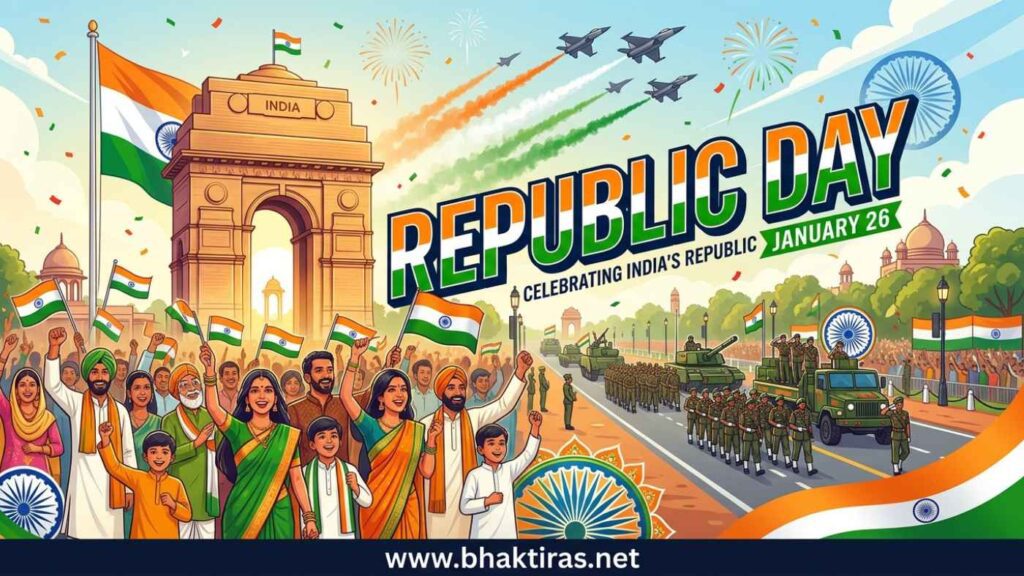
Republic Day is the day India honours its Constitution. Every 26 January the country remembers 1950, when the document drafted after years of debate came into force and India stopped being a dominion and became a republic – a nation whose head of state is chosen by its own people, not inherited. The date was picked on purpose: on 26 January 1930 the Indian National Congress had declared Purna Swaraj, complete independence. So the day carries two memories at once, a promise made and a promise kept.
Republic Day 2026-2028: Dates & Day
Republic Day is fixed on 26 January every year, so unlike lunar Hindu festivals the date never shifts – only the weekday changes. The next observance is Tuesday, 26 January 2027.
| Year | Date | Day | Notes |
|---|---|---|---|
| 2026 | 26 January | Monday | 77th Republic Day |
| 2027 | 26 January | Tuesday | Next occurrence – 78th Republic Day |
| 2028 | 26 January | Wednesday | 79th Republic Day |
The Republic Day parade in New Delhi traditionally begins mid-morning, and the wider celebrations close on 29 January with the Beating Retreat ceremony at Vijay Chowk, which marks the formal end of the Republic Day festivities.
Why Republic Day Is Celebrated
Republic Day is celebrated because 26 January 1950 is the day the Constitution of India came into effect, turning a newly independent country into a full republic governed by its own supreme law.
India won independence on 15 August 1947, but for over two years it still operated under a modified colonial-era law, the Government of India Act of 1935, with the British monarch as head of state. Republic Day marks the moment that ended. When the Constitution took over, sovereignty passed fully to the people of India, and the country gained its own elected President as head of state.
The choice of date was deliberate and heavy with meaning. On 26 January 1930, at the banks of the Ravi in Lahore, the Congress had unfurled the tricolour and declared Purna Swaraj. Bringing the Constitution into force on that same date twenty years later closed the circle.
The Constitution of India
The Constitution is the longest written constitution of any sovereign country. Drafted over nearly three years by a Constituent Assembly, it lays out fundamental rights, the structure of government, and the duties of citizens. It came into force on 26 January 1950, and that is the event Republic Day commemorates.
Becoming a republic
A republic is a state where power rests with the people and the head of state is elected rather than a hereditary monarch. On 26 January 1950 India became exactly that. The last Governor-General, C. Rajagopalachari, gave way to Dr Rajendra Prasad as the first President of the Republic.
Dr B. R. Ambedkar's role
Dr Bhimrao Ramji Ambedkar chaired the Drafting Committee of the Constituent Assembly and is widely honoured as the chief architect of the Constitution. His insistence on equality before the law, the abolition of untouchability, and safeguards for the marginalised shaped the document’s moral core, which is why he is remembered so strongly on this day.
A promise from 1930
The date links back to the Purna Swaraj declaration of 26 January 1930, when Indians first pledged to fight for complete independence rather than dominion status. Founders chose the same date for the Constitution so the republic would be born on the anniversary of that pledge.
How Republic Day Is Observed
Republic Day is marked by an official state ceremony in New Delhi and by flag-hoisting, parades and cultural events in every state, district and school across the country.
- Flag-hoisting by the President. Unlike Independence Day, when the Prime Minister raises the flag at the Red Fort, on Republic Day it is the President of India who unfurls the national flag – a nod to the President being the constitutional head of state.
- The national anthem and 21-gun salute. As the tricolour is raised, Jana Gana Mana is sung and a ceremonial 21-gun salute is fired, setting the tone for the day.
- The Delhi parade on Kartavya Path. The centrepiece is the parade along Kartavya Path (formerly Rajpath) in New Delhi, watched by huge crowds and broadcast live nationwide, with a foreign head of state or government as the chief guest.
- Military and marching contingents. Regiments of the Army, Navy and Air Force, along with paramilitary and police forces, march past in precise formation, showcasing India’s armed forces and their bands.
- State tableaux and folk dances. Colourful floats from different states and government ministries roll past, each telling a story about a region’s heritage, and troupes perform folk dances that bring the country’s variety onto one route.
- Bravery awards and honours. Gallantry awards are announced and presented, and children who have shown exceptional courage are recognised, giving the day a strong note of honouring quiet heroism.
- The flypast. The parade closes with a flypast by Indian Air Force jets and helicopters, which sweep over the crowd in tight formations and leave trails of saffron, white and green.
- Local flag-hoisting and school events. Away from Delhi, governors hoist the flag in state capitals, and schools, colleges and offices hold their own ceremonies with the anthem, patriotic songs, speeches and sweets distributed to children.
How It's Marked Across India
Republic Day is a national holiday observed everywhere in India, but the scale and flavour of the celebration differ from the capital to the smallest village.
New Delhi
The capital hosts the flagship event: the President’s flag-hoisting, the parade on Kartavya Path with a foreign chief guest, the state tableaux and the flypast. Security is tight and lakhs of people either attend in person or watch the live telecast.
State capitals
In each state, the Governor hoists the national flag and takes the salute at a state-level parade, often featuring local police, school contingents and tableaux that reflect that state’s culture and development.
Schools and colleges
Educational institutions hold morning assemblies with flag-hoisting, the national anthem, patriotic songs and short speeches on the Constitution and freedom fighters, usually followed by sweets for the students.
Villages and towns
Panchayats, municipal offices and local clubs raise the flag at community grounds, sometimes with cultural programmes, prize distributions and processions that give even small settlements a share in the day.
Indian diaspora
Indian embassies and community associations abroad organise flag-hoisting and cultural evenings, letting Indians overseas mark the day together far from home.
Republic Day Do's and Don'ts
A few simple points help you honour the flag and the day with the respect they carry.
Do
- Stand and remain silent while the national anthem is sung
- Fly the tricolour the right way up, with the saffron band on top
- Use a clean, undamaged flag and keep it in a place of honour
- Learn a little about the Constitution and share it with children
- Join or watch the parade and local flag-hoisting with attention
Avoid
- Do not let the flag touch the ground, water or the floor
- Do not use the flag as clothing, drapery or table cover
- Do not fly a torn, soiled or upside-down flag
- Do not treat the anthem casually or stay seated during it
- Do not discard paper or plastic flags carelessly after the day
Frequently Asked Questions
When is Republic Day in 2027?
Republic Day 2027 falls on Tuesday, 26 January. The date is fixed and never changes, since it marks the day in 1950 when the Constitution of India came into force. It is a gazetted national holiday across the country.
When is Republic Day in 2026 and 2028?
Republic Day is on Monday, 26 January 2026 and on Wednesday, 26 January 2028. The date is always 26 January; only the weekday shifts from year to year because Republic Day follows the fixed civil calendar, not a lunar one.
Why is Republic Day celebrated in India?
Republic Day is celebrated to mark 26 January 1950, the day the Constitution of India came into effect and India became a sovereign democratic republic. Independence in 1947 freed the country, but Republic Day is when it gained its own supreme law and an elected head of state in place of the British monarch.
What is the difference between Republic Day and Independence Day?
Independence Day, on 15 August, marks India’s freedom from British rule in 1947, and the Prime Minister hoists the flag at the Red Fort. Republic Day, on 26 January, marks the Constitution coming into force in 1950, and the President hoists the flag before the grand parade in New Delhi.
Why was 26 January chosen for Republic Day?
26 January was chosen because on that date in 1930 the Indian National Congress declared Purna Swaraj, or complete independence. The framers timed the Constitution to take effect on the same date twenty years later so the republic would be born on the anniversary of that pledge.
Who is honoured as the chief architect of the Constitution?
Dr B. R. Ambedkar is honoured as the chief architect of the Indian Constitution. He chaired the Drafting Committee of the Constituent Assembly and shaped its core principles of equality, fundamental rights and safeguards for the marginalised, which is why he is remembered strongly on Republic Day.
What happens at the Republic Day parade?
The Republic Day parade takes place on Kartavya Path in New Delhi with a foreign chief guest. It features marching contingents of the armed forces and police, military hardware, colourful state and ministry tableaux, folk dances, bravery awards and a closing flypast by Air Force aircraft.
Is Republic Day a religious festival?
No, Republic Day is a national civic observance, not a religious festival. It belongs to all Indians regardless of faith and honours the Constitution, the republic and the people who built them, so its symbols are the tricolour, the anthem and the parade rather than any deity or worship.
Republic Day belongs to everyone who calls India home. Wishing you a proud and happy Republic Day – Jai Hind.