
Goddess Kamalatmika
कमलात्मिका
Kamalatmika, often called Kamala, is the tenth and final Mahavidya, the Tantric form of Lakshmi. Seated on an open lotus and bathed by four elephants pouring water, golden-skinned and serene, she grants both worldly prosperity and inner fullness. She is abundance itself, the gentle blossoming that completes the Mahavidya path.
Who Is Goddess Kamalatmika?
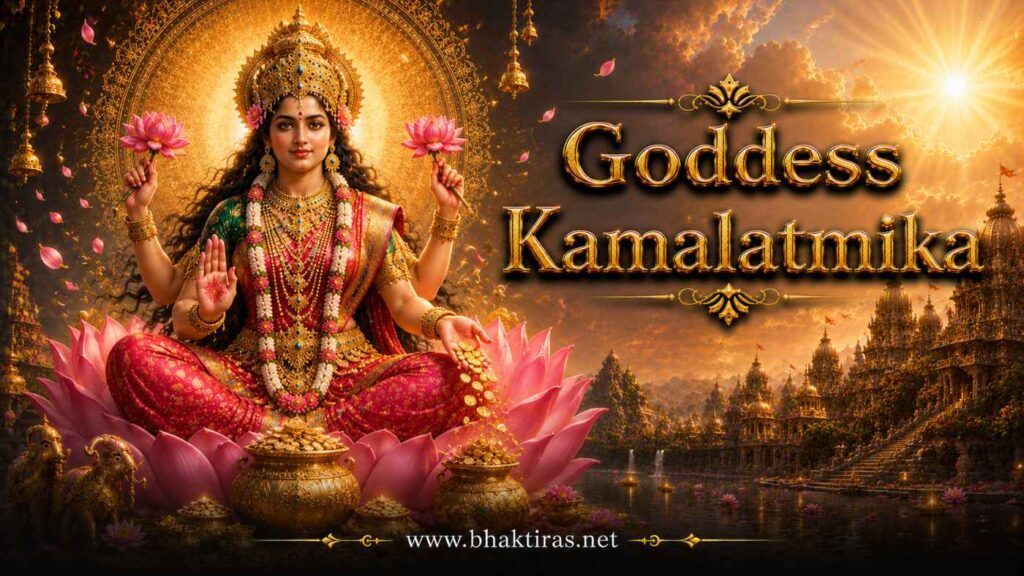
Picture a wide lotus resting on still water, and upon it a golden goddess, calm-faced, holding two more lotuses in her upper hands while her lower hands open outward – one saying do not be afraid, the other saying receive. On either side, elephants lift their trunks and pour clear water over her, an unending bath of blessing. This is Kamalatmika, whom devotees simply call Kamala.She is the tenth of the Ten Mahavidyas, the group of goddesses in Tantra who each hold a different door into the one great Mother. Where some of her sisters are fierce, dark, or strange, Kamala is soft and luminous. She is the face of the Goddess that the world already loves without knowing her Tantric name, because Kamalatmika is Lakshmi – the giver of grain, gold, children, and grace. Yet within the Mahavidya circle her sweetness carries extra weight. She is not placed first, as an easy beginning, but last, as an arrival. The wisdom that started in the cremation-ground stillness of Kali comes to rest here, in a garden of open lotuses. Abundance, in her, is not merely having much. It is being full.The Tantric Lakshmi – Abundance as Fullness
Most people meet Lakshmi at the threshold of a home during Diwali, a goddess of coins and lamps and good fortune. Kamalatmika is that same warmth, turned inward and understood more deeply.In her Tantric form, wealth stops meaning only money. The four elephants that bathe her pour not just water but life itself – rain for the fields, milk for children, clarity for the restless mind. Their water is abundance in every register at once: food and shelter, yes, but also health, love, courage, and the quiet richness of a settled heart. This is the teaching folded into her lotus. A lotus grows out of mud and dark water, and yet its petals come up clean, never stained by what it rose through. Kamala offers worldly plenty in exactly this spirit. She does not ask her devotees to reject the world or its comforts. She asks them to hold prosperity the way the lotus holds the pond – rooted in it, nourished by it, and free of it at the same time. So the abundance she grants is a single thing wearing two faces. Outer wealth that lets a life breathe without fear, and inner wealth – the fullness of consciousness that no loss can empty. To worship Kamalatmika is to ask for both, and to slowly learn that they were never really separate.Iconography and Symbols
Every part of Kamala’s image is a sentence in a quiet language of blessing. Read together, they describe a goddess who gives without hesitation and remains untouched by what she gives.The Open Lotus Seat
Kamala sits on a fully bloomed lotus floating on water. The flower is her name and her nature – beauty that rises unstained from the muddy depths. It marks her as pure, self-generated, and rooted in the living waters of creation rather than dependent on any ground.
The Four Elephants
Four white elephants flank her, trunks raised, pouring streams of water over her head. They echo the beloved Gaja Lakshmi image and stand for the four directions – her blessing reaching everywhere – and for the rain-giving, earth-shaking power that keeps the world fed and fertile.
Golden Radiance
Her skin is the deep gold of ripe grain and monsoon sunlight, the colour of harvest and of wealth itself. This warmth is not cold metal but living light, the glow of a field ready to be gathered and a heart ready to give.
Lotuses and the Two Mudras
Two of her hands hold lotus flowers; the other two form the abhaya mudra, granting fearlessness, and the varada mudra, granting boons. Together they say the whole of her message without words – be unafraid, and receive what you need.
Kamala and Lakshmi – Same yet Distinct
It is fair to ask whether Kamalatmika is simply Lakshmi with a longer name. The honest answer is yes, and also not quite.In substance they are one goddess. The consort of Vishnu, the lady of the lotus, the source of prosperity – all of this belongs to both. Devotees who chant to Kamala are chanting to Lakshmi, and the great Kamala mantra ends with the words Mahalakshmyai Namah, a bow to the great Lakshmi herself. What changes is the setting and the intent. Lakshmi, in the wider tradition, is worshipped mostly for her gifts – a good harvest, a prospering business, a home free of want. Kamalatmika places that same giving goddess inside the Mahavidya circle, where the aim reaches further. Here she is approached not only for outer fortune but for the wisdom that outer fortune is meant to serve. Think of it this way. Lakshmi is the blessing at the door of the house. Kamala is the same blessing understood as the door itself – the last opening in a series of ten, through which the seeker walks into wholeness. Same goddess, deeper key. The sweetness people already know, revealed as the goal all along.The Culmination of the Ten Mahavidyas
The Ten Mahavidyas are usually listed in an order that begins with Kali and ends with Kamala. That arrangement is not accidental – it traces a journey.At the head of the line waits Kali, black and unclothed, dancing on time itself. Hers is the wisdom of letting go, of the ego and the world being dissolved back into their source. It is a hard, honest beginning – everything the seeker clings to is loosened and released. Between the two ends move the other goddesses, each holding a different truth: Tara’s guiding compassion, Tripura Sundari’s beauty, Bhairavi’s fierce heat, Chinnamasta’s radical self-offering, Dhumavati’s teaching in loss and emptiness, and more. The path passes through darkness, fire, and stripping-away. And then it arrives at Kamalatmika. After the dissolution, the blossoming. What was emptied is now full; what was surrendered returns as grace. Kamala is what the world looks like to someone who has walked the whole road – no longer a place of grasping and fear, but a garden of open lotuses, generous and unafraid. This is why her softness is not a beginner’s comfort but a completion. She teaches that the goal of all that fierce inner work was never renunciation for its own sake. It was this: to be able to hold the fullness of life, wealth and beauty and love included, with clear and open hands. Kamala is the peace on the far side of the storm.How She Is Worshipped
Kamala’s worship blends the warm household devotion given to Lakshmi with the more precise, mantra-centred practice of the Tantric lineages. It ranges from a lamp lit at home to formal initiation under a guru.- Fridays and the fortnights of the moon are considered dear to her, as they are to Lakshmi; devotees often set aside Friday for her worship, lamp, and mantra.
- Lotus flowers are her most fitting offering – red or pink lotuses placed before her image, along with rice, sweets, and turmeric, echo her own lotus nature.
- The Sri Yantra and lotus-based yantras are used in Tantric practice as her geometric form, worshipped with the seed sound Shreem.
- Repetition of her mantra, especially the beeja Shreem and the longer Kamala mantra, is the heart of her sadhana, counted quietly on a rosary of lotus-seed or crystal beads.
- Diwali and Lakshmi Puja are naturally occasions to honour Kamala, since she is Lakshmi in her fullest form, invited into home and heart with light.
- Under a qualified guru, deeper Tantric worship approaches her not only for prosperity but for the ripening of consciousness that her abundance symbolises.
Temples and Sacred Sites
Because Kamalatmika is inseparable from Lakshmi, her presence is felt wherever Lakshmi is honoured, while her specifically Mahavidya form is kept alive in Shakta and Tantric shrines.- Shakti Peethas and Mahavidya shrines across India often include Kamala among the ten goddesses, with dedicated niches or panels for her lotus form.
- Bengal and Assam, strongholds of Tantra and Shakta worship, keep the Mahavidyas including Kamala especially close in temple ritual and household practice.
- Lakshmi temples everywhere – from grand South Indian complexes to small village shrines – carry her essence, since to worship Lakshmi is to worship Kamala.
- Ten-Mahavidya temples, where all ten goddesses are enshrined together, give Kamala her rightful final place, completing the circle of wisdom.
- Home altars remain her most common dwelling, where a simple picture of the lotus goddess, a lamp, and a Friday offering keep her worship living and personal.
Prayers and Mantras
Kamala’s mantras carry the seed sound Shreem, the sound of Lakshmi and of all auspicious increase. Chanted with attention, they are meant to open the heart to abundance in every sense – and to end, always, with a bow to the great Lakshmi.Seed mantra: श्रीं (Shreem) – the single sound of Kamala and of prosperity, repeated to draw her presence near. Kamala mantra (Devanagari):ॐ श्रीं ह्रीं श्रीं कमले कमलालये प्रसीद प्रसीद श्रीं ह्रीं श्रीं ॐ महालक्ष्म्यै नमः
Transliteration: Om Shreem Hreem Shreem Kamale Kamalalaye Praseeda Praseeda Shreem Hreem Shreem Om Mahalakshmyai Namah
Meaning: O Kamala, seated in the lotus, dweller in the lotus, be gracious, be gracious to me; salutations to the great Lakshmi. It is at once a plea and a homecoming – asking the lotus goddess for her favour, and recognising her as the fullness the seeker has been walking toward all along.
Frequently Asked Questions about Goddess Kamalatmika
Is Kamalatmika the same as Lakshmi?
In essence, yes. Kamalatmika, or Kamala, is the Tantric form of Lakshmi, placed as the tenth Mahavidya. She is the same goddess of the lotus and of prosperity, the consort of Vishnu. The difference lies in setting: within the Mahavidyas her abundance is understood as spiritual fullness as well as worldly wealth.
Why is Kamala called the tenth Mahavidya?
The Ten Mahavidyas are usually listed from Kali to Kamala, tracing a path from dissolution to blossoming. Kamalatmika comes last as the culmination – the point where the fierce inner work of the earlier goddesses ripens into gentle, complete abundance. Her final place marks arrival, not a beginner's starting point.
What does Kamalatmika grant her devotees?
She grants abundance in every sense at once: material prosperity, beauty, fertility, and good fortune, together with inner richness – the fullness of consciousness that no loss can empty. Her four elephants pouring water symbolise blessing flowing in all directions, nourishing both the outer life and the awakening heart.
Why is she shown bathed by four elephants?
The four elephants pouring water over her echo the well-loved Gaja Lakshmi image. They represent the four directions, so her blessing reaches everywhere, and the rain-bearing power that keeps the earth fertile. Their unending stream is abundance itself, poured freely and continuously upon the goddess and, through her, upon the world.
What is the seed mantra of Kamalatmika?
Her seed or beeja mantra is Shreem (श्रीं), the sound of Lakshmi and of all auspicious increase. It is repeated on its own or within her longer mantra, which ends with a bow to Mahalakshmi. Chanting Shreem with attention is the heart of her simplest devotional practice.
How is Kamalatmika worshipped at home?
At home she is honoured much like Lakshmi: a picture or small image of the lotus goddess, a lamp lit especially on Fridays, offerings of lotus flowers, rice, and sweets, and quiet repetition of her mantra. Diwali and Lakshmi Puja are natural occasions to invite her light into the household.
What does the lotus symbolise in her worship?
The lotus grows from muddy water yet opens clean and unstained. It is Kamala's name and her teaching: prosperity can be held purely, rooted in the world and nourished by it without being trapped by it. Her seat, her flowers, and her whole nature carry this image of unstained abundance.
May Kamalatmika, the lotus goddess of golden light, fill your life with both plenty and peace – and may you learn to hold them, as she does, with open and unafraid hands.