
Hemis Festival 2027 – Ladakh's Great Masked-Dance Celebration
ཧེ་མིས་ཚེས་བཅུ།
When is the Hemis Festival in 2027?
The Hemis Festival is expected around early to mid July 2027 (approximately 13-14 July), at Hemis Monastery near Leh in Ladakh. It falls on the 10th day (Tse-Chu) of the fifth month of the Tibetan lunar calendar, so the Gregorian date shifts each year and is confirmed close to the event. The two-day celebration honours the birth of Guru Padmasambhava with sacred masked Cham dances.
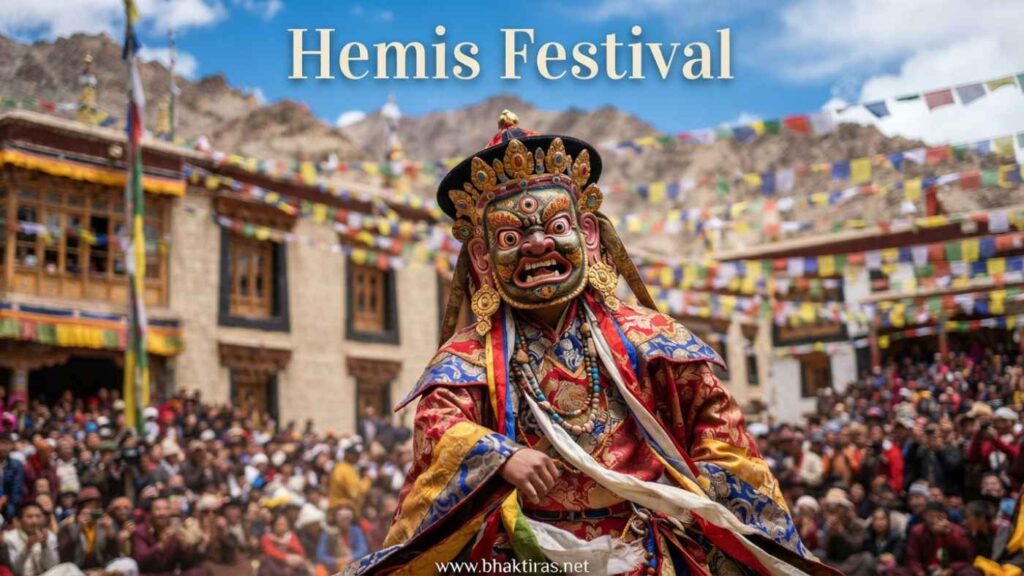
The Hemis Festival is the largest and best-known monastic celebration in Ladakh, held in the courtyard of Hemis Monastery about 40 km southeast of Leh. It marks the birth anniversary of Guru Padmasambhava (Guru Rinpoche), the eighth-century master credited with carrying Tantric Buddhism across the Himalayas. Over two days lamas of the Drukpa lineage perform the Cham, a cycle of sacred masked dances that dramatise the triumph of good over evil, accompanied by long horns, cymbals and drums. The date follows the Tibetan lunar calendar, so it moves year to year within June and July.
Hemis Festival 2026-2028: Dates & Calendar
The next Hemis Festival falls in 2027 (the 2026 celebration on 24-25 June has already passed). Because it is set by the Tibetan lunar calendar, the Gregorian date shifts each year and future dates are approximate until the monastery confirms them.
| Year | Dates | Days | Notes |
|---|---|---|---|
| 2026 | 24-25 June | Wed-Thu | Already observed |
| 2027 | approx 13-14 July | Tue-Wed | Next occurrence (approximate) |
| 2028 | approx 2-3 July | Sun-Mon | Rare 12-year giant thangka unfurling expected (approximate) |
The 2027 and 2028 dates are lunar estimates and may move by a day or two once the Tibetan calendar conversion is finalised. In 2028 the monastery is expected to unfurl its giant embroidered thangka of Guru Padmasambhava, an event held only once every 12 years.
Why the Hemis Festival Is Celebrated
The Hemis Festival honours the birth anniversary of Guru Padmasambhava, the master who brought Tantric (Vajrayana) Buddhism to Ladakh and Tibet, and celebrates the victory of good over evil.
Birth of Guru Rinpoche
Tibetan tradition holds that Padmasambhava, revered as a second Buddha, appeared on a lotus and later subdued the forces that opposed the dharma across the Himalayas. The Tse-Chu, the tenth day, is associated with his life and deeds, and Hemis marks it with special grandeur.
Good over evil
The Cham dances re-enact how enlightened protectors overcome ignorance, malice and the ego. Masked figures representing wrathful deities and guardians ritually defeat and dispel negative forces, a message that sits at the heart of the two-day programme.
The Drukpa seat in Ladakh
Hemis is the principal monastery of the Drukpa lineage in Ladakh, founded in the seventeenth century under royal patronage. The festival reaffirms the community’s devotion to its teachers and keeps its ritual dance traditions alive across generations.
Deities & Figures Honoured
The festival centres on Guru Padmasambhava, with the Cham dances also portraying protector deities and guardian figures of Vajrayana Buddhism.
Guru Padmasambhava
Known in Ladakh as Guru Rinpoche, the Precious Master. His birth is the reason for the festival, and every twelve years his giant appliqued thangka is displayed on the monastery wall for pilgrims to venerate.
Protector deities (Dharmapalas)
The masked Cham dances feature wrathful guardians such as the Dharmapalas, whose fierce forms are understood as compassionate power directed against ignorance rather than beings to be feared.
Key Rituals, Step by Step
The two days unfold as a carefully ordered programme of ritual music and masked dance in the monastery courtyard.
- Assembly and prayer. Lamas gather for early morning prayers and rituals inside the monastery before the courtyard programme begins.
- Sounding the horns. The performance opens with deep long horns (dungchen), cymbals and drums, calling the community and setting the ceremonial mood.
- Procession of the masks. Monks in heavy brocade robes and elaborate painted masks enter the courtyard in slow, measured steps around a central mast.
- The Cham cycle. A sequence of dances portrays deities, protectors and the subduing of hostile forces, each movement following a fixed liturgical meaning rather than improvisation.
- Destruction of the effigy. A symbolic figure representing negativity and ego is ritually dismantled, marking the triumph of good over evil.
- Blessings for onlookers. Pilgrims and visitors watch from the galleries and steps, receiving the merit of witnessing the sacred dances.
- Thangka unveiling (every 12 years). In special years the monastery unfurls its two-storey embroidered thangka of Guru Padmasambhava, the ritual high point, next expected in 2028.
Food & Fare at Hemis
Around the festival, Ladakhi staples and butter tea are shared, and stalls near the monastery serve simple mountain fare to the crowds.
Butter tea (gur gur cha)
Salty tea churned with butter, the everyday warming drink of the high desert, offered freely during gatherings.
Thukpa
A hearty noodle soup with vegetables or meat, welcome fuel in the cool mountain air of a Hemis morning.
Momos
Steamed dumplings filled with vegetables or meat, a popular snack sold from stalls set up for festival visitors.
Chhang
A mild traditional barley brew that appears at Ladakhi celebrations, shared in moderation among the community.
Hemis Festival Do's and Don'ts
A few simple courtesies help visitors respect a living religious event at a working monastery.
Do
- Dress modestly, covering shoulders and knees at the monastery.
- Arrive early to find a good spot, as the courtyard fills quickly.
- Watch the Cham dances quietly and attentively.
- Ask before photographing monks or rituals up close.
- Carry water, sun protection and warm layers for the altitude.
Avoid
- Do not walk into the dance area or block the performers.
- Do not point your feet at the shrine or altar when seated.
- Do not use flash or loud shutter sounds during solemn moments.
- Do not touch masks, costumes or ritual objects.
- Do not treat the event as mere spectacle; it is a sacred rite.
Frequently Asked Questions
When is the Hemis Festival in 2027?
The Hemis Festival in 2027 is expected around 13-14 July at Hemis Monastery near Leh, Ladakh. The exact date follows the Tibetan lunar calendar (the 10th day of the fifth month), so it is approximate until officially confirmed closer to the event.
When is the Hemis Festival in 2026 and 2028?
In 2026 the Hemis Festival was held on 24-25 June and has already passed. In 2028 it is expected around 2-3 July, and 2028 is a special year when the monastery is due to unfurl its giant thangka of Guru Padmasambhava, an event held only once every twelve years. Both future dates are lunar estimates.
Why is the Hemis Festival celebrated?
The Hemis Festival is celebrated to honour the birth anniversary of Guru Padmasambhava, the master who brought Tantric Buddhism to the Himalayas. Its sacred Cham dances dramatise the victory of good over evil and reaffirm the devotion of the Drukpa Buddhist community of Ladakh.
Where is the Hemis Festival held?
The Hemis Festival is held at Hemis Monastery, about 40 km southeast of Leh in Ladakh, India. Hemis is the largest and wealthiest monastery in the region and the principal seat of the Drukpa lineage in Ladakh.
What is the Cham dance at Hemis?
The Cham is a cycle of sacred masked dances performed by lamas in brocade robes and painted masks, set to long horns, cymbals and drums. Each movement carries a fixed ritual meaning, together enacting how enlightened forces overcome ignorance and evil.
How often is the giant Hemis thangka displayed?
The giant embroidered thangka of Guru Padmasambhava at Hemis is unfurled only once every twelve years. It was last shown in 2016 and is expected again in 2028, drawing large numbers of pilgrims when it appears.
Which religion does the Hemis Festival belong to?
The Hemis Festival is a Tibetan (Drukpa) Buddhist celebration. It is rooted in the Vajrayana tradition of Ladakh and is centred on the figure of Guru Padmasambhava, revered as Guru Rinpoche.
Is the Hemis Festival open to visitors?
Yes, the Hemis Festival is open to visitors, and it draws many travellers and photographers each year. Visitors are welcome to watch the Cham dances from the monastery galleries and courtyard, provided they dress modestly and respect the sacred nature of the rituals.
May the dances of Hemis carry the blessings of Guru Rinpoche across the mountains. Tashi delek.