
Vaikuntha Ekadashi 2026 – The Day Vishnu's Gate Opens
वैकुण्ठ एकादशी
When is Vaikuntha Ekadashi in 2026?
Vaikuntha Ekadashi falls on Sunday, 20 December 2026. It is the Shukla Paksha Ekadashi of the Dhanur (Margashirsha-Pausha) solar month and the holiest Ekadashi for Vaishnavas. Devotees fast, keep a night vigil and pass through the Vaikuntha Dwaram, the symbolic gateway to Vishnu’s heaven, at temples such as Srirangam and Tirumala.
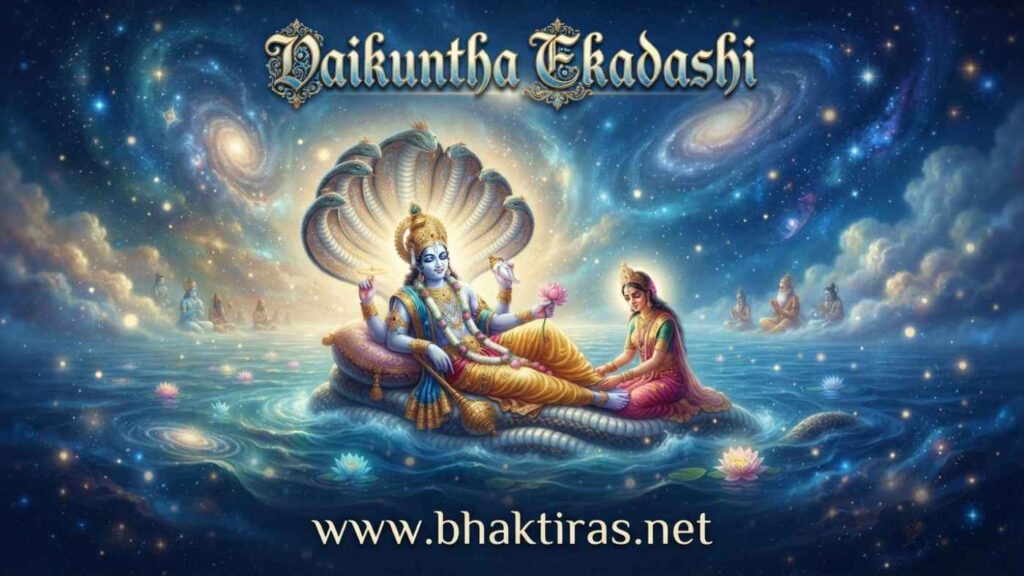
Vaikuntha Ekadashi, called Mukkoti Ekadashi across South India, is the single most important of the twenty-four annual Ekadashis for followers of Vishnu. It falls on the bright-fortnight eleventh lunar day of the Dhanur solar month, usually in late December or early January. On this day devotees believe the Vaikuntha Dwaram, the gateway to Vishnu’s eternal abode, swings open, and those who fast and keep an all-night vigil draw closer to liberation.
Vaikuntha Ekadashi 2026-2028: Dates & Calendar
The next Vaikuntha Ekadashi is on Sunday, 20 December 2026. Because the festival is fixed by the solar Dhanur month rather than a single lunar month, its Gregorian date drifts and some years carry none while others carry two.
| Year | Date | Day | Notes |
|---|---|---|---|
| 2026 | 20 December | Sunday | Next occurrence |
| 2027 | None | – | No Vaikuntha Ekadashi falls within the 2027 calendar year |
| 2028 | 8 January | Saturday | First of two in 2028; a second follows on 27 December |
There is no Vaikuntha Ekadashi in the 2027 calendar year: the solar-month timing places one in late December 2026 and the next in early January 2028, with a second later in December 2028. This is normal for a solar-reckoned observance.
Why Vaikuntha Ekadashi Is Celebrated
Vaikuntha Ekadashi is celebrated because devotees believe Vishnu opens the door to Vaikuntha, his heavenly realm, on this one day, making it the most auspicious Ekadashi for seeking liberation.
The gate to Vaikuntha opens
The core belief is that on this Ekadashi the Vaikuntha Dwaram, the northern doorway of Vishnu temples, is thrown open. Passing through it is treated as a symbolic entry into Vishnu’s abode. At Srirangam this doorway is the famous Paramapada Vasal, kept shut for the rest of the year.
A path to moksha
Vaishnava tradition holds that souls who leave the body on Vaikuntha Ekadashi attain moksha and reach Vishnu directly. This is why the day carries names like Swarga Vathil Ekadashi, the ekadashi of the gate of heaven, in Kerala.
The demon Muran story
One account explains the day through the demon Muran, whom Vishnu could not slay while awake. A maiden born of his energy, Ekadashi, destroyed the demon, and Vishnu granted that anyone fasting on this tithi would be freed from sin. The name Mukkoti is often linked to the belief that thirty-three crore devas gather to witness the gate opening.
Deities & Figures Worshipped
Vaikuntha Ekadashi is dedicated entirely to Vishnu, worshipped here as the lord who grants access to his eternal realm.
Vishnu
Vishnu is honoured as the preserver and as Paramapada Nathan, the lord of the supreme abode. At Srirangam he is worshipped as Ranganatha reclining on Adishesha; at Tirumala as Venkateswara. Devotees offer tulsi, recite the Vishnu Sahasranama and stay awake through the night in his praise.
Goddess Ekadashi
The personified goddess Ekadashi, said to have emerged from Vishnu to defeat the demon Muran, is remembered as the reason the tithi itself became sacred and fasting on it removes sin.
Key Rituals, Step by Step
Observance centres on a strict fast, a night of worship and passing through the temple’s Vaikuntha gate at dawn.
- Sankalpa and cleansing. Devotees bathe early, wear clean clothes and take a vow to observe the fast with devotion.
- The Ekadashi fast. Many keep a full fast without food or water; others take only fruit, milk and water and avoid grains, rice and beans through the day.
- Vishnu puja. The home or temple shrine is decorated, and Vishnu is worshipped with tulsi leaves, lamps, flowers and the recitation of the Vishnu Sahasranama and Ekadashi vrat katha.
- Jagarana, the night vigil. Devotees stay awake through the night singing bhajans, reading scripture and chanting Vishnu’s names, which is considered central to the vrat.
- Passing the Vaikuntha Dwaram. Before dawn the temple’s northern gate is opened and devotees file through it, symbolically entering Vishnu’s abode. At Srirangam this is the Paramapada Vasal.
- Darshan and parana. After the deity’s early darshan, the fast is broken (parana) the next morning within the prescribed window, often after offering food to Vishnu first.
Special Foods of Vaikuntha Ekadashi
The day itself is a fasting day, so food centres on the break-fast the following morning and on temple offerings of grain-free prasad.
Fasting fare (phalahar)
Those who do not keep a waterless fast take fruit, milk, curd and tubers. Grains, rice, lentils and beans are set aside for the full Ekadashi day.
Sabudana and fruit
Sabudana (tapioca) khichdi, fruit and dry fruit are widely used to sustain devotees who keep a lighter fast rather than a complete one.
Temple prasad
At Vishnu temples the parana prasad often includes sweet and savoury pongal, tamarind and curd rice and puliyodarai, distributed after the deity has been offered the food.
Regional Names & Variations
The same Ekadashi carries different names and forms across India, though the theme of Vishnu’s opened gate is constant.
Tamil Nadu (Srirangam)
Known as Mukkoti Ekadashi and Sorgavasal Ekadashi. The Sri Ranganathaswamy temple opens its Paramapada Vasal, the gate of the supreme abode, and lakhs of pilgrims pass through it at dawn.
Andhra Pradesh (Tirumala)
At Tirumala Venkateswara temple the Vaikuntha Dwaram is opened and devotees walk through the special Vaikuntha Dwara Mahadwaram during Vaikunta Dwara Darshanam.
Kerala
Called Swarga Vathil Ekadashi, the ekadashi of the door of heaven. Temples such as Guruvayur see large crowds seeking Vishnu’s darshan on this day.
North and pan-India
Elsewhere it is observed as the Shukla Ekadashi of the Margashirsha or Pausha month and kept as a strict Vishnu fast, sometimes called Pausha Putrada or Mokshada Ekadashi depending on the reckoning.
Vaikuntha Ekadashi Do's and Don'ts
A few simple observances help keep the vrat in its traditional spirit.
Do
- Bathe early and take a clear sankalpa (vow) before starting the fast.
- Worship Vishnu with tulsi leaves, lamps and the Vishnu Sahasranama.
- Keep the night vigil with bhajans, chanting and scripture reading.
- Break the fast (parana) the next morning within the correct time window.
- Give food, water or alms to others as part of the day’s merit.
Avoid
- Do not eat rice, grains, lentils or beans on the Ekadashi day.
- Avoid onion, garlic and tamasic or non-vegetarian food.
- Do not sleep through the night if you have taken the vigil vow.
- Avoid anger, gossip and quarrels, which are said to reduce the vrat’s benefit.
- Do not break the fast before the prescribed parana window the next day.
Frequently Asked Questions
When is Vaikuntha Ekadashi in 2026?
Vaikuntha Ekadashi in 2026 is on Sunday, 20 December. It is the Shukla Paksha Ekadashi of the Dhanur solar month and is observed with a day-long fast and a night vigil, with the break-fast (parana) on the morning of 21 December.
Is there a Vaikuntha Ekadashi in 2027, and when is it in 2028?
No Vaikuntha Ekadashi falls within the 2027 calendar year, because the solar Dhanur-month timing places one in late December 2026 and the next on Saturday, 8 January 2028. A second Vaikuntha Ekadashi then follows in 2028 on 27 December. Having none or two in a year is normal for this solar-reckoned observance.
Why is Vaikuntha Ekadashi celebrated?
Vaikuntha Ekadashi is celebrated because devotees believe Vishnu opens the Vaikuntha Dwaram, the gateway to his heavenly abode, on this single day of the year. Passing through this gate and fasting are believed to bring one closer to moksha, which makes it the holiest Ekadashi for Vaishnavas.
Which god is worshipped on Vaikuntha Ekadashi?
Vishnu is worshipped on Vaikuntha Ekadashi, honoured as the lord of Vaikuntha, his eternal abode. At Srirangam he is worshipped as Ranganatha and at Tirumala as Venkateswara, with offerings of tulsi, lamps and the recitation of the Vishnu Sahasranama.
What is the Vaikuntha Dwaram at Srirangam and Tirumala?
The Vaikuntha Dwaram is a special northern doorway in Vishnu temples that is opened only on Vaikuntha Ekadashi. At Srirangam it is called the Paramapada Vasal and at Tirumala the Vaikuntha Dwara, and pilgrims pass through it to symbolically enter Vishnu’s abode.
How do you observe the Vaikuntha Ekadashi fast?
The Vaikuntha Ekadashi fast is observed by avoiding grains, rice, lentils and beans for the whole day, with many keeping a complete fast without food or water. Devotees worship Vishnu, keep an all-night vigil of bhajans and chanting, and break the fast the next morning during the parana window.
What is Mukkoti Ekadashi?
Mukkoti Ekadashi is the South Indian name for Vaikuntha Ekadashi. The word is often linked to the belief that thirty-three crore (mukkoti) devas gather to witness Vishnu’s gate being opened on this day.
Can you eat during Vaikuntha Ekadashi?
On the Vaikuntha Ekadashi day itself, grains, rice, pulses and beans are avoided, and many devotees keep a full fast. Those who do not fast completely take only fruit, milk, curd and tubers, and normal food resumes at the parana on the following morning.
May the gate of Vaikuntha open for you this year. Om Namo Narayanaya.