
Pushkar Mela 2026 – The Great Camel Fair of Rajasthan
पुष्कर मेला
When is Pushkar Mela in 2026?
Pushkar Mela 2026 runs from about 17 to 24 November, with the sacred climax on Kartik Purnima, Tuesday 24 November 2026. Held in the temple town of Pushkar in Rajasthan, it combines one of the world’s largest camel and livestock fairs with a Hindu pilgrimage centred on a holy dip in Pushkar Lake and worship at the rare Brahma temple.
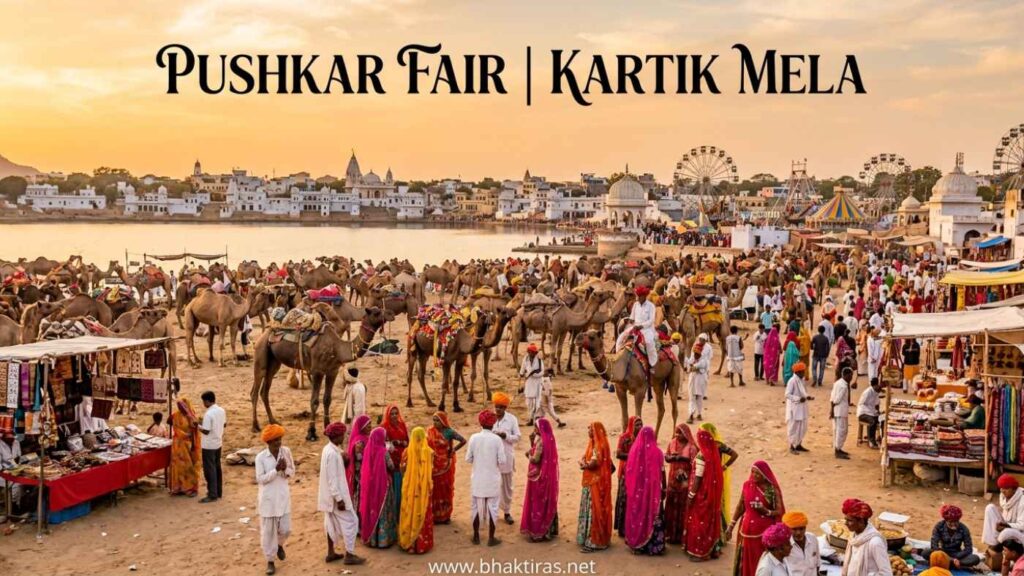
Pushkar Mela, the Pushkar Camel Fair, is an eight-day gathering in the small Rajasthani town of Pushkar that fills the dunes with tens of thousands of camels, horses and cattle. Timed to the Hindu month of Kartik and ending on the full moon of Kartik Purnima, it is two festivals in one: a working livestock market with camel races and beauty contests, and a serious pilgrimage where devotees bathe in Pushkar Lake and pray at one of India’s very few temples to Brahma. In 2026 it falls in mid to late November.
Pushkar Mela 2026-2028: Dates & Calendar
The next Pushkar Mela is in November 2026, ending on Kartik Purnima (24 November 2026). Because it follows the Hindu lunar calendar, the fair shifts by a couple of weeks each year.
| Year | Fair span | Kartik Purnima | Notes |
|---|---|---|---|
| 2026 | approx. 17-24 November | Tue, 24 November | Next occurrence |
| 2027 | approx. 6-14 November | Sun, 14 November | About two weeks earlier |
| 2028 | approx. 25 October – 2 November | Thu, 2 November | Falls into late October |
Trading and camel competitions dominate the opening days, while the closing days lean into ritual: the mass bathing on Kartik Purnima and darshan at the Brahma temple. Fair-span dates are indicative and may be adjusted by a day or two each year.
Why Pushkar Mela Is Celebrated
Pushkar Mela is celebrated because Kartik Purnima is considered one of the holiest bathing days of the year, and Pushkar Lake is one of the most sacred pilgrimage waters in Hinduism.
A holy dip on Kartik Purnima
Hindus believe a bath in Pushkar Lake on the Kartik full moon washes away sins and brings spiritual merit. Pilgrims gather at the lake’s bathing ghats from before dawn, making the final day the emotional and religious high point of the fair.
One of the few Brahma temples
Pushkar is home to the Jagatpita Brahma Mandir, among the very small number of temples dedicated to Brahma, the creator, anywhere in India. Legend links the lake to a lotus dropped by Brahma, which is why the town became a centre of his worship.
A livestock fair with deep roots
Alongside the pilgrimage, Pushkar has long been a trading fair where herders from across Rajasthan buy and sell camels, horses and cattle. Over time the market grew into a huge cultural event that now draws visitors from around the world.
Deities & Figures Worshipped
The central deity of Pushkar is Brahma, the creator god, worshipped at the Jagatpita Brahma Mandir beside the sacred lake.
Brahma
Brahma, the creator in the Hindu trinity, is the presiding deity of Pushkar. His temple here is one of the rare shrines devoted to him, and pilgrimage to Pushkar is closely tied to his worship.
Savitri and Gayatri
Brahma’s consorts are honoured at hill temples overlooking Pushkar – the Savitri temple on one ridge and the Gayatri temple on another. Many pilgrims climb to these shrines during the fair.
Key Rituals, Step by Step
The devotional side of Pushkar Mela follows a familiar rhythm, building towards the Kartik Purnima bath and temple visit.
- Arrive during the Kartik days. Pilgrims reach Pushkar in the days before the full moon, many camping near the fairground and the lake.
- Take the holy dip. On Kartik Purnima, devotees bathe at the ghats of Pushkar Lake before sunrise, the act believed to be especially purifying on this day.
- Offer prayers at the ghats. After bathing, pilgrims perform simple offerings and light lamps at the lakeside.
- Visit the Brahma temple. Worshippers walk to the Jagatpita Brahma Mandir for darshan of the creator god.
- Climb to Savitri or Gayatri. Many make the hilltop trek to the temples of Brahma’s consorts for wider views and blessings.
- Join the aarti and deep daan. As dusk falls, lamps are floated and lakeside aarti is performed, echoing the Dev Deepawali mood of Kartik Purnima.
- Experience the fair. Between rituals, visitors watch camel races, decorated-camel parades and folk performances on the fairground.
Special Foods at Pushkar
Pushkar is a strictly vegetarian town, and the fair is a good place to taste Rajasthani and Marwari cooking.
Dal baati churma
The signature Rajasthani plate of baked wheat balls with lentils and a sweet crushed-wheat churma is served everywhere during the fair.
Malpua and rabri
Pushkar is well known for its malpua, sweet fried pancakes often paired with thickened rabri milk.
Kachori and pyaaz kachori
Spiced, deep-fried kachoris are a popular fairground snack alongside samosas and hot chai.
Ghevar and Rajasthani sweets
Disc-shaped ghevar and other regional mithai appear in the bazaars, matching the festive Kartik season.
What to See at the Fair
Beyond the pilgrimage, Pushkar Mela is famous for a distinctive mix of livestock trading, contests and festivity.
Camel and livestock trading
Herders bring tens of thousands of camels, horses and cattle to buy and sell, making it one of the largest livestock markets in Asia. Animals are groomed, shorn into patterns and decked in bright harnesses.
Races and contests
Camel races, camel-decoration judging and tug-of-war draw big crowds. Human contests are just as popular, including the longest-moustache and turban-tying competitions.
Music, dance and balloons
Rajasthani folk musicians and dancers perform through the day, and hot-air balloon rides now lift visitors over the dunes for a view of the sprawling camp.
Bazaars and crafts
Temporary markets sell silver jewellery, textiles, leather camel-gear and Rajasthani handicrafts, turning the fair into a lively shopping ground.
Pushkar Mela Do's and Don'ts
A few simple courtesies keep your visit respectful and comfortable.
Do
- Dress modestly, especially near the lake ghats and temples.
- Remove shoes and leather items before approaching the bathing ghats.
- Carry water, a hat and sunscreen for long, hot fairground days.
- Ask before photographing pilgrims, herders and their animals.
- Book accommodation well in advance, as the town fills up quickly.
Avoid
- Do not bring alcohol, meat or eggs into this vegetarian, sacred town.
- Do not touch or feed animals at the trading ground without permission.
- Do not litter or use soap in the sacred Pushkar Lake.
- Do not haggle disrespectfully with herders over their livestock.
- Do not enter temple sanctums or ghat areas in footwear.
Frequently Asked Questions
When is Pushkar Mela in 2026?
Pushkar Mela 2026 runs from about 17 to 24 November, ending on Kartik Purnima, Tuesday 24 November 2026. The trading and camel competitions peak in the opening days, while the closing days focus on the holy dip in Pushkar Lake and worship at the Brahma temple.
When is Pushkar Mela in 2027 and 2028?
Pushkar Mela is expected around 6 to 14 November 2027, ending on Kartik Purnima on Sunday 14 November 2027, and around 25 October to 2 November 2028, ending on Kartik Purnima on Thursday 2 November 2028. Exact fair spans are set annually by the local administration, but the religious peak is always Kartik Purnima.
Where is Pushkar Mela held?
Pushkar Mela is held in the town of Pushkar in the Ajmer district of Rajasthan, India. The fair spreads across sandy grounds beside the sacred Pushkar Lake, close to the famous Brahma temple.
Why is Pushkar Mela celebrated?
Pushkar Mela is celebrated because Kartik Purnima is one of the holiest bathing days in Hinduism and Pushkar Lake is a deeply sacred pilgrimage water. Pilgrims come to bathe in the lake and worship Brahma, while herders gather for a centuries-old livestock trade that grew into a major cultural fair.
Which god is worshipped at Pushkar?
Brahma, the creator god, is the presiding deity of Pushkar, worshipped at the Jagatpita Brahma Mandir. It is one of the very few temples dedicated to Brahma anywhere in India, which makes Pushkar an unusual and important pilgrimage centre.
What happens at the Pushkar Camel Fair?
The Pushkar Camel Fair combines a huge livestock market with festivity and pilgrimage. Tens of thousands of camels, horses and cattle are traded, decorated and raced, while visitors enjoy folk music, moustache and turban contests, hot-air balloon rides and bazaars, and pilgrims bathe in the lake on Kartik Purnima.
How many camels come to the Pushkar Fair?
Tens of thousands of camels, along with horses and cattle, are brought to Pushkar each year, making it one of the largest livestock fairs in Asia. Herders groom and decorate their animals, and camel trading, racing and beauty contests are central attractions.
Is Pushkar Lake important during the fair?
Yes, Pushkar Lake is the spiritual heart of the fair. Bathing in its waters on Kartik Purnima is believed to cleanse sins and grant merit, so the ghats fill with pilgrims on the final day, followed by lamp offerings and lakeside aarti.
May your visit to Pushkar bring both the colour of the fair and the calm of the lake. Kartik Purnima ki shubhkamnayein.