
Onam 2026 – Kerala's Ten-Day Harvest Homecoming
ഓണം
When is Onam in 2026?
Onam 2026 peaks on Thiruvonam, Wednesday 26 August 2026, with the ten-day celebration opening on Atham, Monday 17 August. Onam is Kerala’s harvest festival, held in the Malayalam month of Chingam, marking the yearly homecoming of the asura king Mahabali to see his people.
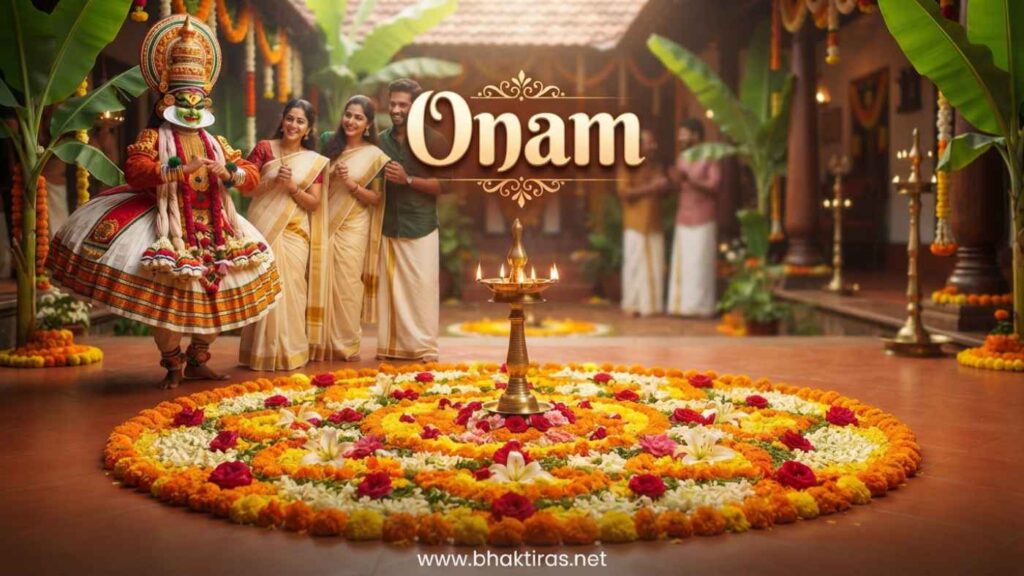
Onam is Kerala’s biggest festival, a ten-day harvest celebration in the Malayalam month of Chingam that welcomes the beloved asura king Mahabali back to his old kingdom. Legend says Vishnu, in his dwarf form Vamana, pressed the generous king down to the netherworld but granted him one visit home each year. Onam marks that homecoming with flower carpets on every doorstep, a grand vegetarian feast on banana leaves, snake-boat races and the sound of drums. In 2026 the main day, Thiruvonam, falls on Wednesday 26 August.
Onam 2026-2028: Dates & Calendar
Onam 2026 culminates on Thiruvonam, Wednesday 26 August 2026, having begun on Atham, Monday 17 August. Because it follows the Malayalam solar calendar and the Thiruvonam star, the date shifts within late August and September each year.
| Year | Atham (start) | Thiruvonam (main day) | Day |
|---|---|---|---|
| 2026 | 17 August | 26 August | Wednesday |
| 2027 | 3 September | 12 September | Sunday |
| 2028 | 23 August | 1 September | Friday |
The festival runs across ten star-days, sequentially Atham, Chithira, Chodhi, Vishakam, Anizham, Thriketa, Moolam, Pooradam, Uthradam and Thiruvonam. The pookalam grows a little larger each day, and Uthradam, the eve, is when families shop and cook in earnest.
Why Onam Is Celebrated
Onam celebrates the annual homecoming of King Mahabali, a just and generous asura ruler whose reign Malayalis remember as a golden age of equality and plenty.
The story goes that under Mahabali the people of the land wanted for nothing and no one was cheated or poor. His growing power worried the gods, so Vishnu took the form of Vamana, a small brahmin boy, and asked the king for as much ground as he could cover in three steps. When Mahabali agreed, Vamana grew vast, covering earth and sky in two strides. For the third step, the king offered his own head, and Vishnu pressed him down to the netherworld. Moved by his devotion, Vishnu granted Mahabali one visit to his people every year, and that visit is Onam.
A harvest thanksgiving
Onam falls at the close of the monsoon when the first rice is gathered, so it doubles as a harvest festival. The abundance on the Onasadya leaf is a direct thank-you for a good crop.
The king's homecoming
Malayalis clean and decorate their homes so that Mahabali finds his people happy and prosperous on Thiruvonam. The floral pookalam is laid partly to welcome him at the threshold.
A festival for everyone
Onam is celebrated by Malayalis across religions and communities, not by caste or creed. This shared, secular warmth is a big part of why it is Kerala’s state festival.
Deities & Figures Worshipped
Onam centres on two figures: King Mahabali, whose return it celebrates, and Vishnu in his Vamana avatar, who sent him below yet granted the yearly visit.
Mahabali
Mahabali, affectionately called Maveli, is the asura king whose golden reign Onam commemorates. Malayalis do not so much worship him as welcome him as a loved elder coming home. A conical clay or wooden figure called the Onathappan is placed at the centre of the pookalam to represent him and Vamana.
Vamana (Vishnu)
Vamana is the dwarf brahmin form of Vishnu who measured the universe in three steps and sent Mahabali to the netherworld. He is honoured for both humbling the king’s pride and rewarding his honesty with the boon of an annual visit. Some Kerala temples hold special Vamana pujas during Onam.
Key Rituals, Step by Step
Onam unfolds over ten days, building from a small flower carpet on Atham to the great feast and boat races around Thiruvonam.
- Atham – lay the first pookalam. On the opening day families sweep the courtyard and lay a small circular flower carpet at the doorstep, adding a new ring of blooms each morning.
- Shop on Uthradam. The eve of Thiruvonam is the busiest market day, when households buy vegetables, plantains and new clothes and finish preparing for the feast.
- Set up the Onathappan. The clay pyramid figures of Mahabali and Vamana are placed at the heart of the finished pookalam and offered flowers.
- Wear the Onakodi. On Thiruvonam morning everyone bathes early and dresses in new clothes, traditionally the cream-and-gold Kerala kasavu.
- Serve the Onasadya. The family gathers for the grand vegetarian feast served on a banana leaf, eaten with the hands in a set order of dishes.
- Play and perform. Afternoons fill with Kaikottikali and Thumbi Thullal dances, Pulikali tiger performers on the streets, and Onakalikal games such as tug-of-war.
- Race the snake boats. On the backwaters, villages send their long Vallam Kali chundan vallam boats out in thunderous rowing races cheered by huge crowds.
Special Foods of Onam
The heart of Onam is the Onasadya, a vegetarian banquet of two dozen or more dishes served on a banana leaf and eaten in a fixed sequence.
Onasadya
The Onam feast can carry 26 or more items on a single banana leaf, from rice and sambar to a spread of curries, pickles and papadam. Each dish has its place on the leaf, and the meal is served free of onion and garlic in many homes.
Payasam
No sadya ends without payasam, the sweet pudding that closes the meal. Ada pradhaman, made with rice flakes, jaggery and coconut milk, and the paler palada payasam are the favourites.
Avial
Avial is a thick medley of mixed vegetables in a ground coconut and curd sauce finished with coconut oil and curry leaves. It is one of the signature dishes of the sadya.
Olan, Kalan & Thoran
Olan is a mild ash-gourd and coconut-milk stew, Kalan a tangier yam-and-yoghurt curry, and thoran a dry stir-fry of vegetables with grated coconut. Together they give the leaf its range of textures.
Banana chips & Sharkara Varatti
Crisp Nendran banana chips fried in coconut oil and sharkara varatti, jaggery-coated banana pieces, are made in large batches for Onam and shared with visitors.
Where Onam Is Celebrated
Onam is above all Kerala’s festival, but Malayali communities keep it alive across India and around the world.
Kerala
Across Kerala, Onam is the state festival and a public holiday, marked in every district with pookalams, sadya feasts and the famous Vallam Kali boat races on the Pamba and other backwaters.
Aranmula & Aluva
Aranmula draws big crowds for its Uthrattadhi snake-boat regatta, while Thrikkakara temple near Aluva, linked to the Vamana legend, is treated as the spiritual home of Onam.
Rest of India
Malayali associations in Mumbai, Bengaluru, Delhi and Chennai host community sadya lunches, pookalam contests and cultural evenings for those away from home.
Gulf & global diaspora
In the Gulf states, the United States and the United Kingdom, large Malayali populations organise Onam melas with feasts, dance and games, keeping the festival firmly on the calendar abroad.
Onam Do's and Don'ts
A few simple customs keep the spirit of Onam warm and welcoming.
Do
- Lay a fresh pookalam at your doorstep and add to it through the ten days.
- Wear new clothes, ideally the cream-and-gold Kerala kasavu, on Thiruvonam.
- Share the Onasadya with family, neighbours and visitors.
- Welcome guests generously, in the spirit of Mahabali’s open kingdom.
- Join in the games, dances and, if you can, watch a boat race.
Avoid
- Do not treat Onam as only about food; the welcome and togetherness matter most.
- Avoid wasting the sadya; serve modestly and finish what is on your leaf.
- Do not skip inviting those who are alone or away from home.
- Avoid turning boat races or crowds into unsafe scrums near the water.
- Do not let the pookalam wilt untended; refresh the flowers each day.
Frequently Asked Questions
When is Onam in 2026?
Onam 2026 peaks on Thiruvonam, Wednesday 26 August 2026. The ten-day festival opens on Atham, Monday 17 August, and Thiruvonam is the main day of feasting and celebration.
When is Onam in 2027 and 2028?
Onam Thiruvonam falls on Sunday 12 September in 2027 and on Friday 1 September in 2028. In each year the ten days begin on Atham, nine days before Thiruvonam, so around 3 September 2027 and 23 August 2028.
Why is Onam celebrated?
Onam is celebrated to welcome the asura king Mahabali home for his yearly visit and to give thanks for the harvest. Malayalis remember Mahabali’s reign as a time of equality and plenty, and Onam recreates that happiness so the king finds his people content.
Who is Mahabali and how does he relate to Vishnu?
Mahabali was a generous asura king whose power grew so great that Vishnu, as the dwarf Vamana, asked for three steps of land and then pressed him to the netherworld. Moved by the king’s honesty, Vishnu granted him one visit home each year, and that homecoming is Onam.
How long does Onam last?
Onam lasts ten days, running from Atham to Thiruvonam. The days are named Atham, Chithira, Chodhi, Vishakam, Anizham, Thriketa, Moolam, Pooradam, Uthradam and Thiruvonam, with the flower carpet growing larger each day and the feast on the final day.
What is the Onasadya?
The Onasadya is the grand vegetarian feast of Onam, served on a banana leaf with two dozen or more dishes eaten by hand in a set order. It ranges from rice, sambar and avial to pickles and payasam, and sharing it is the centrepiece of Thiruvonam.
What is a pookalam?
A pookalam is the circular carpet of fresh flower petals laid at the doorstep during Onam. Families start with a small design on Atham and add a new ring of blooms each day, placing the Onathappan figure at its centre to welcome Mahabali.
Is Onam a religious or a harvest festival?
Onam is both a harvest thanksgiving and a festival rooted in the Mahabali legend, and it is celebrated by Malayalis across communities. It falls as the first rice is gathered in the month of Chingam, which is why the abundant feast sits at its heart.
However you keep it, near the backwaters or far from home, may your leaf be full and your doorstep bright. Happy Onam – Onam Ashamsakal!