
Rishi Panchami 2026 – Fast for the Seven Sages
ऋषि पंचमी
When is Rishi Panchami in 2026?
Rishi Panchami falls on Tuesday, 15 September 2026. It is observed on Bhadrapada Shukla Panchami, the fifth lunar day of the bright fortnight, one day after Ganesh Chaturthi. Women keep a fast in honour of the Saptarishi, the seven great sages, and eat only foods grown without ploughing the earth.
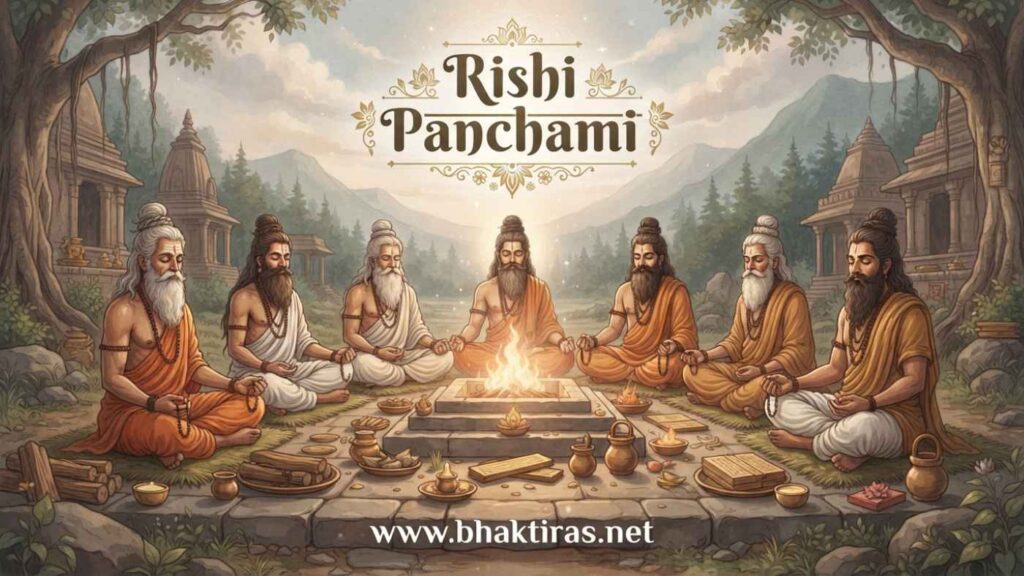
Rishi Panchami is a quiet, introspective vrat kept mainly by women on the fifth day of the bright half of Bhadrapada, the day after Ganesh Chaturthi. Rather than honouring a temple deity, it turns to the Saptarishi, the seven sages of Vedic tradition, in gratitude for the knowledge and moral order they are said to have preserved. The day combines a cleansing bath, a simple puja to the sages and a fast in which only foods grown without a plough are eaten. It is widely observed across North India, Maharashtra and Nepal.
Rishi Panchami 2026-2028: Dates & Calendar
Rishi Panchami next falls on 15 September 2026. Because it follows the lunar calendar, the date shifts each year against the Gregorian one, usually landing in late August or September.
| Year | Date | Day | Notes |
|---|---|---|---|
| 2026 | 15 September | Tuesday | Next occurrence |
| 2027 | 4 September | Saturday | Panchami through the morning |
| 2028 | 24 August | Thursday | Falls in late August |
The vrat is observed one day after Ganesh Chaturthi and two days after Hartalika Teej, so these three observances cluster together in the same week of Bhadrapada.
Why Rishi Panchami Is Observed
Rishi Panchami is kept to honour the Saptarishi and to seek release from any impurity, especially faults incurred unknowingly during menstruation, while earning spiritual merit through discipline and gratitude.
Gratitude to the Saptarishi
The day sets aside worship of any single god and instead thanks the seven sages together. Tradition credits them with carrying forward the Vedas, dharma and the sciences, and the vrat is a way of acknowledging that inheritance.
Purification and forgiveness
A central theme is atonement for inadvertent impurity, particularly touching household items during menstruation when the old rules were not, or could not be, kept. The fast and bath are treated as acts of cleansing rather than punishment.
Discipline over display
Unlike louder festivals of the season, Rishi Panchami is deliberately austere. Eating only unploughed foods keeps the observance simple and turns attention inward, towards restraint and self-examination.
The Saptarishi Worshipped
Rishi Panchami honours the Saptarishi, the seven sages, rather than a temple deity. The seven are usually named as Kashyapa, Atri, Bharadvaja, Vishvamitra, Gautama, Jamadagni and Vasishtha.
Kashyapa
A patriarch-sage regarded in the texts as an ancestor of many divine and human lineages, invoked at the head of the group.
Atri and Vasishtha
Two of the most cited Rigvedic seers, associated with hymns and with the ideal of the composed, truthful householder-sage.
Bharadvaja, Gautama, Jamadagni
Sages linked to major gotra lineages, remembered for teaching, ascetic practice and the transmission of Vedic learning.
Vishvamitra
The sage-king who is said to have won brahmarshi status through austerity, and who is traditionally connected with the Gayatri mantra.
Rishi Panchami Vrat, Step by Step
The vrat is simple and can be kept at home. The core is a cleansing bath, a short puja to the seven sages and a single restrained meal.
- Rise early and bathe. A bath at dawn, ideally in a river or with a symbolic touch of sacred water, opens the observance. In some regions apamarga (a medicinal plant) is used while bathing.
- Take the sankalpa. The woman keeping the fast makes a quiet resolve to observe the vrat for the Saptarishi and to seek forgiveness for any unknowing impurity.
- Set up the puja. Seven small heaps of rice, betel, or an image or drawing representing the seven sages are arranged, often with Arundhati, the wife of sage Vasishtha, remembered alongside them.
- Offer worship. Flowers, sandal paste, incense, a lamp and simple naivedya are offered while the names of the seven sages are recited.
- Read or hear the Vrat Katha. The traditional story of the vrat, which explains why the fast releases inadvertent fault, is read or listened to.
- Keep the fast. Grains grown by ploughing are avoided for the day; many keep a partial or fruit-and-tuber fast until the puja is complete.
- Eat the unploughed meal. The single meal uses foods raised without breaking the earth, such as samvat rice, certain tubers and gourds.
- Close with a donation. Giving food or a small dakshina to a Brahmin or to those in need is a customary way to complete the day.
Foods of Rishi Panchami
The defining rule of the day is to eat only what grows without ploughing, so the harvest of oxen-drawn tillage is set aside. The result is a light, largely wild or self-seeding menu.
Samvat rice
Barnyard millet, called samvat or samo, stands in for cultivated rice and is the staple of the day’s meal, often cooked plain or as a khichdi with permitted vegetables.
Root vegetables and tubers
Colocasia (arbi), sweet potato, yam and similar tubers that come from land not turned by a plough are common, prepared simply with minimal spice.
Gourds and greens
Bottle gourd, pumpkin and wild or garden greens that grow without formal tillage feature in many households’ Rishi Panchami plate.
Curd, fruit and rock salt
Fresh curd, seasonal fruit and sendha namak (rock salt) round out a sattvic meal that avoids onion, garlic and common table salt.
Regional Names & Variations
The core vrat is shared, but the way Rishi Panchami sits within the wider festival season varies from place to place.
North India
Across the Hindi belt the day is kept as a women’s fast for the Saptarishi, closely tied to Ganesh Chaturthi the day before, with the unploughed-food rule strictly followed.
Maharashtra
In Maharashtra the observance is often called Rushi Panchami and is well known for its dedicated vegetable dish made only from unploughed produce, eaten after the Saptarishi puja.
Nepal
In Nepal the day is the culmination of the Teej-Rishi Panchami sequence. Women bathe ritually, worship the seven sages and complete the multi-day cycle of fasting and purification that begins with Haritalika Teej.
Rishi Panchami Do's and Don'ts
A few simple customs shape the day.
Do
- Bathe early and keep the observance clean and calm
- Worship all seven sages together, remembering Arundhati
- Eat only foods grown without ploughing the earth
- Read or listen to the Vrat Katha with attention
- Offer food or a small donation to complete the vrat
Avoid
- Do not eat grains or vegetables from ploughed fields
- Avoid onion, garlic and ordinary table salt in the meal
- Do not treat the day as a feast; keep it austere
- Avoid harsh speech, anger and quarrels while fasting
- Do not skip the sankalpa or rush through the puja
Frequently Asked Questions
When is Rishi Panchami in 2026?
Rishi Panchami is on Tuesday, 15 September 2026. It falls on Bhadrapada Shukla Panchami, the fifth day of the bright fortnight, one day after Ganesh Chaturthi.
When is Rishi Panchami in 2027 and 2028?
Rishi Panchami is on Saturday, 4 September 2027 and on Thursday, 24 August 2028. The date moves each year because it is fixed to the Panchami tithi of Bhadrapada Shukla Paksha in the Hindu lunar calendar.
Why is Rishi Panchami observed?
Rishi Panchami is observed to honour the Saptarishi, the seven sages, and to seek forgiveness for impurity incurred unknowingly, especially during menstruation. Keeping the fast is believed to bring purification and spiritual merit.
Who are the Saptarishi worshipped on this day?
The Saptarishi are the seven great sages, usually named as Kashyapa, Atri, Bharadvaja, Vishvamitra, Gautama, Jamadagni and Vasishtha. Rishi Panchami honours all seven together rather than a single temple deity, and Arundhati, wife of Vasishtha, is often remembered alongside them.
What foods are eaten on Rishi Panchami?
Only foods grown without ploughing the earth are eaten on Rishi Panchami. The meal usually centres on samvat rice (barnyard millet) with tubers, gourds, curd and rock salt, avoiding cultivated grains, onion, garlic and common salt.
Who keeps the Rishi Panchami vrat?
The Rishi Panchami vrat is kept mainly by women, though anyone may observe it. It involves an early bath, a puja to the seven sages, reading the Vrat Katha and a single restrained meal of unploughed foods.
How is Rishi Panchami related to Ganesh Chaturthi and Teej?
Rishi Panchami is observed one day after Ganesh Chaturthi and two days after Hartalika Teej, so all three fall in the same week of Bhadrapada. In Nepal it forms the closing day of the Teej-Rishi Panchami sequence.
Is Rishi Panchami a festival or a fast?
Rishi Panchami is a vrat, a religious fast and observance, rather than a celebratory festival. The day is deliberately simple and introspective, centred on purification, gratitude to the sages and self-discipline.
May the discipline of Rishi Panchami bring a clear mind and a grateful heart. Rishi Panchami ki shubhkamnayein.