
Vat Savitri Vrat 2027 – The Married Woman's Vow for Her Husband
वट सावित्री व्रत
When is Vat Savitri Vrat in 2027?
Vat Savitri Vrat falls on Friday, 4 June 2027 in North India, observed on Jyeshtha Amavasya (the new moon of the Jyeshtha month). It is a fasting vow kept by married women for the long life and wellbeing of their husbands, centred on worship of the vat (banyan) tree and the legend of Savitri and Satyavan.
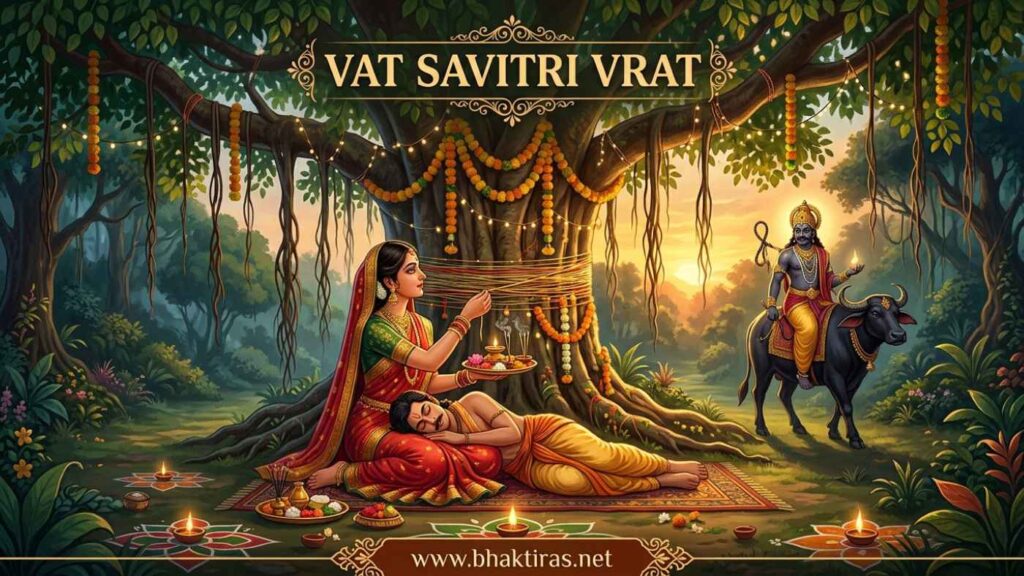
Vat Savitri Vrat is a day-long fast that married Hindu women keep for the long life, health and prosperity of their husbands. On Jyeshtha Amavasya, women dress in bridal colours, gather at a vat (banyan) tree, wind sacred thread around its trunk and offer water while retelling the story of Savitri, who followed Yama himself to reclaim her husband Satyavan’s life. In North India it is tied to the new moon; across Maharashtra and Gujarat many keep the same vow a fortnight later as Vat Purnima.
Vat Savitri Vrat 2026-2028: Dates & Calendar
The next Vat Savitri Vrat is on Friday, 4 June 2027. The date shifts each year because it follows the Hindu lunar month of Jyeshtha, not the Gregorian calendar.
| Year | Date (Amavasya) | Day | Notes |
|---|---|---|---|
| 2026 | 16 May | Saturday | Coincides with Shani Jayanti |
| 2027 | 4 June | Friday | Next occurrence |
| 2028 | 14 May | Sunday | Jyeshtha new moon |
In the Purnimanta calendar the vow is kept on Jyeshtha Amavasya (new moon), which also marks Shani Jayanti. Under the Amanta calendar, followed in Maharashtra, Gujarat and parts of South India, the same vow is observed on Jyeshtha Purnima (full moon) as Vat Purnima, roughly fifteen days later.
Why Vat Savitri Vrat Is Observed
Vat Savitri Vrat is observed to seek a long, healthy life for one’s husband and a lasting marriage, drawing on the devotion of Savitri who refused to accept her husband’s death.
The vow of Savitri
Savitri, daughter of King Ashwapati, chose Satyavan as her husband despite a sage’s warning that he would die within a year. On the fated day she followed Yama, the god of death, as he carried Satyavan’s soul away. Her wisdom and steadfast words so moved Yama that he granted her boon after boon, and she cleverly won back Satyavan’s life.
The banyan tree
The banyan under which Satyavan revived became the emblem of the fast. Its long-lived, spreading roots and evergreen shade stand for a marriage that endures and a husband’s long life, which is why women circle and honour the vat tree on this day.
A woman's resolve
The story is remembered less as a tale of miracle and more as one of resolve. Savitri does not weep or plead; she reasons with death itself. For many women the vrat is a yearly renewal of that same steady commitment to family.
Deities & Figures Worshipped
The fast centres on the figure of Savitri and the banyan tree rather than a temple deity, with Satyavan, Yama and Savitri’s story at its heart.
Savitri
The devoted wife whose determination brought her husband back from death. Women invoke her name and retell her story as the model of the fast.
The Vat (Banyan) tree
The tree itself is worshipped as a living symbol of longevity and marital continuity. Water, vermilion, rice and thread are offered at its trunk.
Yama
The god of death, who in the legend is won over by Savitri’s wisdom and grants Satyavan’s return to life. He is remembered in the retelling rather than worshipped directly.
Key Rituals, Step by Step
The vrat is a single day of fasting and tree worship, usually kept from sunrise until the rituals are complete.
- Take the fast. Married women rise early, bathe, and dress in bridal finery with bangles, bindi and sindoor, resolving to keep the day’s fast for their husband’s wellbeing.
- Prepare the offering. A thali is arranged with water, vermilion, rice, flowers, fruit, soaked gram, and a length of raw cotton thread.
- Go to a banyan tree. Women gather at a vat tree, often together with others from the family or neighbourhood.
- Offer water and worship. Water is poured at the roots and vermilion, rice and flowers are applied to the trunk while prayers are offered.
- Wind the sacred thread. The cotton thread is wound around the trunk, traditionally seven times, while circling the tree and recalling Savitri’s devotion.
- Recite the Savitri katha. The story of Savitri and Satyavan is read or narrated, and women listen together.
- Seek blessings. Younger women touch the feet of elders and offer them gifts, receiving blessings for a long married life.
- Break the fast. After the puja the fast is broken, often with the soaked gram, fruit and simple food prepared for the day.
Special Foods of Vat Savitri Vrat
As a fasting day the food is simple, with soaked grains and seasonal fruit central to breaking the vow.
Soaked gram (chana)
Black or Bengal gram soaked overnight is offered at the tree and eaten when the fast is broken, a light and traditional staple of the day.
Seasonal fruit
Mango, jackfruit and other early-summer fruit are offered and shared, marking the Jyeshtha season in which the vow falls.
Puri and sabzi
In homes observing Vat Purnima, a fuller meal of puris with a simple vegetable is often prepared once the puja is done.
Sweets and prasad
Homemade sweets such as laddu or halwa are prepared as prasad, shared among family and offered along with the puja items.
Regional Names & Variations
The same vow is kept under different names and on two different tithis across the country and in Nepal.
North India
In Uttar Pradesh, Bihar, Madhya Pradesh, Punjab and Haryana the fast is kept on Jyeshtha Amavasya as Vat Savitri Vrat, coinciding with Shani Jayanti.
Maharashtra & Gujarat
Women here observe Vat Purnima on Jyeshtha Purnima (full moon), about a fortnight after the northern date, with the same banyan-tree worship and thread ritual.
Nepal
The vow is widely kept in Nepal as well, where married women worship the banyan tree for their husbands’ long life on the Jyeshtha new moon.
Vat Savitri Vrat Do's and Don'ts
A few simple customs shape how the day is kept.
Do
- Keep the fast with a calm, sincere intention rather than as a formality.
- Worship a living, healthy banyan tree where one is available.
- Offer water, vermilion and thread and circle the trunk as tradition guides.
- Recite or listen to the Savitri and Satyavan story.
- Seek and give blessings among the women of the family.
Avoid
- Do not cut or damage the banyan tree while worshipping it.
- Avoid heavy grain-based meals until the fast is broken.
- Do not treat the day only as fasting; the intention and story matter.
- Avoid arguments and harsh words within the household on the day.
- Do not force the fast on anyone unwell; health comes first.
Frequently Asked Questions
When is Vat Savitri Vrat in 2027?
Vat Savitri Vrat is on Friday, 4 June 2027 in North India, observed on Jyeshtha Amavasya (new moon). It is the next occurrence and is kept by married women as a fast for their husbands’ long life.
When is Vat Savitri Vrat in 2026 and 2028?
Vat Savitri Vrat falls on Saturday, 16 May 2026 and on Sunday, 14 May 2028, both on Jyeshtha Amavasya. The date moves each year because it follows the Hindu lunar month of Jyeshtha rather than a fixed Gregorian date.
Why is Vat Savitri Vrat celebrated?
Vat Savitri Vrat is kept by married women for the long life and wellbeing of their husbands. It recalls Savitri, who followed Yama, the god of death, and by her wisdom won back the life of her husband Satyavan.
Why is the banyan tree worshipped on this day?
The banyan (vat) tree is worshipped because Satyavan revived beneath one in the legend, and its long-lived, evergreen form symbolises a lasting marriage and a husband’s long life. Women wind sacred thread around its trunk and offer water at its roots.
What is the difference between Vat Savitri Vrat and Vat Purnima?
Both are the same vow with the same rituals but on different tithis. North India observes Vat Savitri Vrat on Jyeshtha Amavasya (new moon), while Maharashtra, Gujarat and parts of South India keep it as Vat Purnima on Jyeshtha Purnima (full moon), about a fortnight later.
Who worships on Vat Savitri Vrat?
Vat Savitri Vrat is observed chiefly by married Hindu women for the wellbeing of their husbands. The fast centres on the figure of Savitri and the banyan tree rather than a temple deity.
How is the Vat Savitri fast kept?
Married women fast through the day, dress in bridal colours, and gather at a banyan tree to offer water, vermilion, rice and flowers. They wind cotton thread around the trunk, circle it while recalling Savitri, listen to her story, and break the fast after the puja.
Which month does Vat Savitri Vrat fall in?
Vat Savitri Vrat falls in the Hindu month of Jyeshtha, which corresponds to May or June in the Gregorian calendar. The North Indian date is the Jyeshtha new moon and the Maharashtra and Gujarat date is the Jyeshtha full moon.
May the vow of Savitri bring long life and quiet happiness to your home. Vat Savitri Vrat ki shubhkaamnaayein.