
Baisakhi 2027 – Punjab’s Harvest Festival & Khalsa Day
ਵਿਸਾਖੀ / वैसाखी
When is Baisakhi in 2027?
Baisakhi falls on Wednesday, 14 April 2027. It is a solar harvest festival of Punjab that marks the Vaisakh Sankranti and the ripe rabi wheat crop, and for Sikhs it honours the founding of the Khalsa by Guru Gobind Singh in 1699.
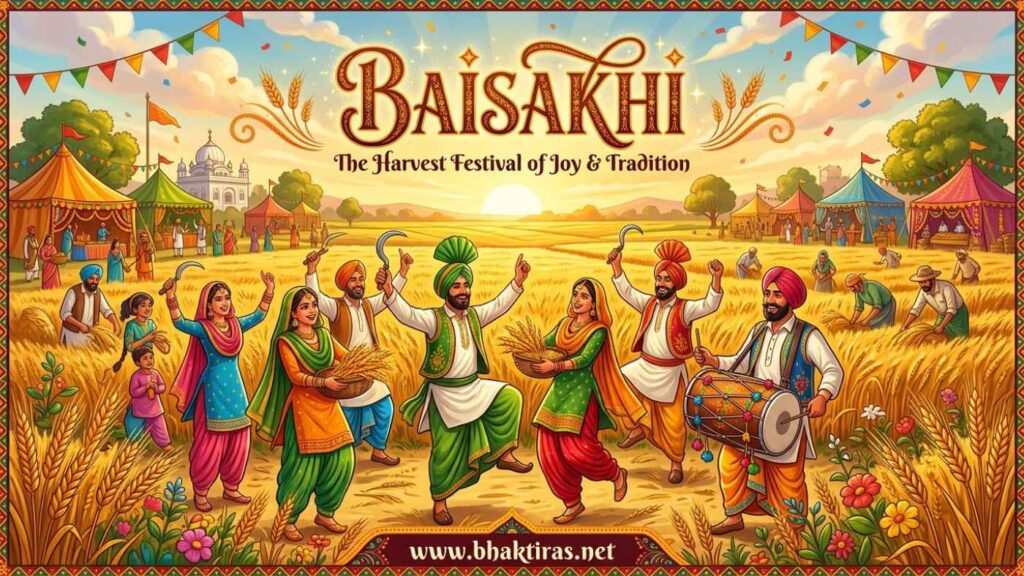
Baisakhi, also spelt Vaisakhi, is one of the few Hindu-Sikh festivals fixed by the solar calendar rather than the moon, landing on 13 or 14 April each year. It marks the Vaisakh Sankranti and the moment the golden rabi wheat is ready to cut across Punjab, Haryana and Delhi. Farmers give thanks for the harvest with bhangra and gidda, while for Sikhs the day carries deeper weight: on Baisakhi in 1699, Guru Gobind Singh founded the Khalsa and initiated the Panj Pyare, the five beloved ones.
Baisakhi 2026-2028: Dates & Calendar
The next Baisakhi falls on Wednesday, 14 April 2027. Because it follows the sun rather than the moon, the date barely moves, staying on 13 or 14 April year after year.
| Year | Date | Day | Notes |
|---|---|---|---|
| 2026 | 14 April | Tuesday | Vaisakh Sankranti |
| 2027 | 14 April | Wednesday | Next occurrence |
| 2028 | 13 April | Thursday | Falls a day earlier |
The one-day shift you sometimes see between years comes from the sun’s crossing into the zodiac sign of Mesha (Aries), which the solar calendar tracks precisely.
Why Baisakhi Is Celebrated
Baisakhi is celebrated for three reasons at once: it gives thanks for the wheat harvest, it opens the solar new year, and for Sikhs it marks the birth of the Khalsa in 1699.
The harvest thanksgiving
For Punjab’s farming families, Baisakhi is payday for a year of labour. The rabi wheat sown in winter is finally ripe, and the fields turn gold just as the festival arrives. The dancing, feasting and fairs are, at their root, gratitude for a full granary.
The birth of the Khalsa
On Baisakhi 1699 at Anandpur Sahib, Guru Gobind Singh called for volunteers ready to give their lives for their faith. Five stepped forward and became the Panj Pyare, the five beloved ones. The Guru initiated them into the Khalsa, the community of committed Sikhs, and then asked them to initiate him in turn.
Community and equality
The langar, or free community kitchen, sits at the centre of the day. Everyone sits on the floor in a single row and eats the same meal, regardless of caste or wealth. Baisakhi carries that message of equality forward every spring.
Key Figures & Whom It Honours
Baisakhi is a solar festival tied to no single deity. For Sikhs the day honours Guru Gobind Singh, the tenth Sikh Guru, who founded the Khalsa on this date in 1699.
Guru Gobind Singh
Guru Gobind Singh created the Khalsa at Anandpur Sahib on Baisakhi 1699 and initiated the first Panj Pyare. Gurudwara services, Akhand Path readings and Nagar Kirtan processions on Baisakhi remember this founding.
The Panj Pyare
The five men who first offered their lives are honoured as the Panj Pyare. They lead Nagar Kirtan processions today, walking ahead of the Guru Granth Sahib carrying the Sikh flag.
Key Rituals, Step by Step
A typical Baisakhi runs from an early gurudwara visit through the day’s processions to evening dancing and langar.
- Early bath and gurudwara visit. Devotees rise early, and many take a dip in a sacred sarovar, most famously the pool that surrounds the Golden Temple at Amritsar.
- Akhand Path. Gurudwaras hold a continuous, unbroken reading of the Guru Granth Sahib that is timed to conclude on the morning of Baisakhi.
- Kada prasad. Worshippers receive kada prasad, the warm semolina offering, after the morning prayers and hymns.
- Nagar Kirtan. A procession moves through the streets led by the Panj Pyare and the Sikh flag, with hymn-singing, drumming and displays of gatka martial arts.
- Harvest thanksgiving. Farmers offer thanks for the ripe wheat, and rural fairs and cattle markets spring up across the countryside.
- Bhangra and gidda. Men perform the high-energy bhangra and women the gidda to the beat of the dhol, often in a field or open ground.
- Langar. The free community meal is served to all, everyone seated together on the floor as equals.
Special Foods of Baisakhi
Baisakhi food is hearty Punjabi cooking, split between the sweet gurudwara offerings and the rich langar and home dishes.
Kada prasad
A warm, ghee-rich pudding of wheat flour, sugar and water, distributed to everyone after the gurudwara service as a blessed offering.
Meethe chawal
Golden sweet rice cooked with saffron, sugar and cardamom, a festive dish that turns the everyday grain into a celebration plate.
Makki di roti with sarson da saag
The signature Punjabi pairing: flatbread of cornmeal served with a slow-cooked mustard-greens curry, finished with a spoon of white butter.
Chhole
A spiced chickpea curry that appears on many langar and home tables through the day, eaten with rice or bhature.
Lassi
Thick, cooling yoghurt drink whisked with sugar or salt, the classic answer to a warm April afternoon of dancing.
Where It’s Celebrated
Baisakhi is strongest in Punjab, Haryana and Delhi, but the same mid-April solar new year is marked under different names across India.
Punjab
The heartland of Baisakhi, where gurudwaras hold Nagar Kirtan and the countryside fills with harvest fairs, bhangra and gidda.
Amritsar
Crowds gather at the Golden Temple for a dawn dip in the sarovar and prayers, making it one of the largest Baisakhi gatherings in the world.
Delhi & the diaspora
Delhi’s gurudwaras and large Punjabi communities in the UK, Canada and beyond hold Nagar Kirtan processions and langar, carrying the day well past Punjab’s borders.
Baisakhi Do’s and Don’ts
A few simple courtesies help you take part respectfully, especially inside a gurudwara.
Do
- Cover your head with a scarf or cloth before entering a gurudwara.
- Remove your shoes and wash your hands and feet at the entrance.
- Sit on the floor for langar and accept the meal graciously.
- Give thanks for the harvest and share food with others.
- Join the Nagar Kirtan and greet friends with the day’s good wishes.
Avoid
- Do not step over or point your feet towards the Guru Granth Sahib.
- Do not bring meat, alcohol or tobacco into the gurudwara.
- Do not turn your back on the holy scripture when leaving the prayer hall.
- Do not waste the langar food you take onto your plate.
- Do not treat it as only a party; remember the harvest and Khalsa meaning behind the day.
Frequently Asked Questions
When is Baisakhi in 2027?
Baisakhi in 2027 falls on Wednesday, 14 April. It is a solar festival, so unlike most Hindu festivals its date barely shifts and stays on 13 or 14 April every year.
When is Baisakhi in 2026 and 2028?
Baisakhi is on 14 April 2026 (a Tuesday) and 13 April 2028 (a Thursday). The occasional one-day difference comes from the exact moment the sun enters the sign of Mesha, which the solar calendar tracks.
Why is Baisakhi celebrated?
Baisakhi is celebrated for three reasons: it gives thanks for the ripe rabi wheat harvest, it marks the solar new year, and for Sikhs it commemorates the founding of the Khalsa by Guru Gobind Singh in 1699.
What is the significance of Baisakhi for Sikhs?
For Sikhs, Baisakhi marks the birth of the Khalsa in 1699, when Guru Gobind Singh initiated the first Panj Pyare, the five beloved ones, at Anandpur Sahib. It is one of the most important days in the Sikh calendar.
Which god is worshipped on Baisakhi?
Baisakhi is a solar harvest festival tied to no single deity. For Sikhs the day honours Guru Gobind Singh, the tenth Sikh Guru, and the founding of the Khalsa rather than a specific god.
How is Baisakhi celebrated?
Baisakhi is celebrated with early gurudwara visits, Akhand Path readings, Nagar Kirtan processions and langar, alongside harvest thanksgiving, fairs and energetic bhangra and gidda dancing. Many take a holy dip, most famously in the Golden Temple sarovar at Amritsar.
What foods are eaten on Baisakhi?
Baisakhi foods include kada prasad and langar dishes from the gurudwara, plus Punjabi favourites such as chhole, makki di roti with sarson da saag, meethe chawal (sweet saffron rice) and cooling lassi.
Is Baisakhi a Hindu or Sikh festival?
Baisakhi is both a Hindu and a Sikh festival, celebrated mainly by Punjabis. Hindus mark it as the solar new year and harvest thanksgiving, while Sikhs additionally honour it as the day the Khalsa was founded in 1699.
However you mark the day, in a golden wheat field or the langar hall, may your harvest be full. Happy Baisakhi.