
ॐ
Bagalamukhi Chalisa
श्री बगलामुखी चालीसा
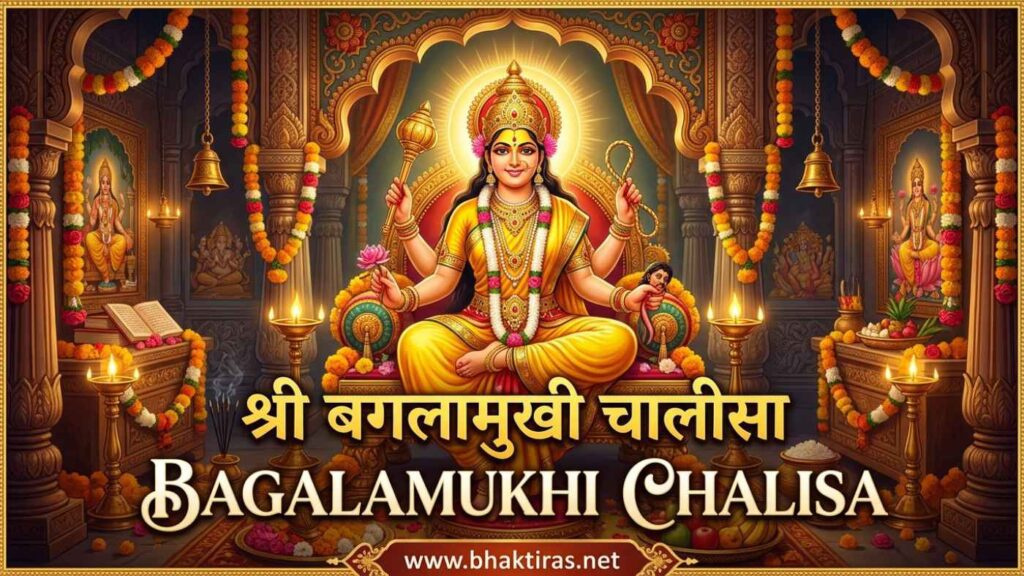
The Bagalamukhi Chalisa is a forty-verse hymn to Goddess Bagalamukhi, the eighth of the ten Mahavidyas, who is invoked to halt and disarm hostile forces. Dressed in yellow and seated on a golden throne, she is the deity devotees turn to for victory in conflict, court cases, debate and any situation where an opponent must be stilled. This page carries the complete Roman-English transliteration of the chalisa along with a plain meaning for every doha and chaupai, so you can read along, follow the sense, and recite with understanding.
Bagalamukhi Chalisa Lyrics in English (Transliteration)
Roman transliteration for easy chanting. Tap “Meaning” under any verse for the English translation.
Sira Navai Bagalamukhi, Likhun Chalisa Aja
Kripa Karahu Mopara Sada, Purana Ho Mama Kaja
Meaning
I bow my head to you, O Bagalamukhi, as I begin to write this chalisa today. Keep your grace upon me always, so that every task I undertake reaches completion.
Jai Jai Jai Shri Bagala Mata
Adishakti Saba Jaga Ki Trata
Meaning
Victory again and again to you, Shri Bagala Mata. You are the primordial power and the guardian of the whole world.
Bagala Sama Taba Anana Mata
Ehi Te Bhayau Nama Vikhyata
Meaning
O Mother, your face resembles that of a crane, and it is from this likeness that your well-known name, Bagalamukhi, arose.
Shashi Lalata Kundala Chhavi Nyari
Astuti Karahin Deva Nara Nari
Meaning
The moon shines on your forehead and your earrings glow with a beauty all their own. Gods, men and women alike sing your praises.
Pitavasana Tana Para Tava Rajai
Hathahin Mudgara Gada Virajai
Meaning
Yellow garments grace your form, and in your hands a mace and club are held in splendour.
Tina Nayana Gala Champaka Mala
Amita Teja Prakatata Hai Bhala
Meaning
You bear three eyes and a garland of champak flowers at your throat, while boundless radiance streams from your brow.
Ratna-Jatita Sinhasana Sohai
Shobha Nirakhi Sakala Jana Mohai
Meaning
Your jewel-set lion throne is a thing of beauty, and all who behold your grandeur are drawn to you.
Asana Pitavarna Maharani
Bhaktana Ki Tuma Ho Varadani
Meaning
Seated upon a yellow seat, O great queen, you are the giver of boons to those devoted to you.
Pitabhushana Pitahin Chandana
Sura Nara Naga Karata Saba Vandana
Meaning
Adorned with yellow ornaments and yellow sandal paste, you receive the homage of gods, humans and serpents alike.
Ehi Vidhi Dhyana Hridaya Mein Rakhai
Veda Purana Santa Asa Bhakhai
Meaning
Whoever holds this form of yours in the heart and meditates on it is glorified, so declare the Vedas, the Puranas and the saints.
Aba Puja Vidhi Karaun Prakasha
Jake Kiye Hota Dukha Nasha
Meaning
Now I set out the method of your worship, the doing of which brings every sorrow to an end.
Prathamahin Pita Dhwaja Phaharavai
Pitavasana Devi Pahiravai
Meaning
First a yellow banner is raised, and the Goddess is then robed in yellow garments.
Kumkuma Akshata Modaka Besana
Abira Gulala Supari Chandana
Meaning
Vermilion, unbroken rice, modak, gram flour, abir and gulal powders, betel nut and sandalwood are offered.
Malya Haridra Aru Phala Pana
Sabahin Chadhai Dharai Ura Dhyana
Meaning
After presenting garlands, turmeric, fruit and betel leaf, one should meditate on you with a steady heart.
Dhupa Dipa Karpura Ki Bati
Prema Sahita Taba Karai Arati
Meaning
With incense, lamp and a wick of camphor, the devotee then performs your aarti in love.
Astuti Karai Hatha Dou Jore
Puravahu Matu Manoratha More
Meaning
With both hands joined I offer my praise. Fulfil my heart's wishes, O Mother.
Matu Bhagati Taba Saba Sukha Khani
Karahu Kripa Mopara Janajani
Meaning
O Mother, devotion to you is the wellspring of all happiness. Show me your grace and count me as your own.
Trividha Tapa Saba Duhkha Nashavahu
Timira Mitakara Gyana Badhavahu
Meaning
Undo the three kinds of suffering and every grief. Clear the darkness of ignorance and let wisdom grow in me.
Bara-Bara Main Binavaun Tohin
Avirala Bhagati Gyana Do Mohin
Meaning
Time and again I make my plea to you. Grant me unbroken devotion and true knowledge.
Pujananta Mein Havana Karavai
So Nara Manavanchhita Phala Pavai
Meaning
One who completes the worship with a fire offering receives the fruit their heart has longed for.
Sarshapa Homa Karai Jo Koi
Take Vasha Sacharachara Hoi
Meaning
Whoever offers a homa with mustard seeds brings the entire moving and unmoving world within their influence.
Tila Tandula Sanga Kshira Miravai
Bhakti Prema Se Havana Karavai
Meaning
One who blends sesame, rice and milk and performs the fire offering with love and devotion gains your favour.
Duhkha Daridra Vyapai Nahin Soi
Nishchaya Sukha-Sampati Saba Hoi
Meaning
Sorrow and poverty no longer touch such a person; happiness and prosperity surely come to them.
Phula Ashoka Havana Jo Karai
Take Griha Sukha-Sampatti Bharai
Meaning
One who performs the fire offering with ashoka blossoms finds their home filled with comfort and wealth.
Phala Semara Ka Homa Karijai
Nishchaya Vako Ripu Saba Chhijai
Meaning
When the homa is made with the fruit of the silk-cotton tree, the worshipper's enemies are surely worn away.
Guggula Ghrita Homai Jo Koi
Tehi Ke Vasha Mein Raja Hoi
Meaning
One who offers guggul resin and ghee in the fire can bring even a king under their sway.
Guggula Tila Sanga Homa Karavai
Tako Sakala Bandha Kata Javai
Meaning
One who offers guggul together with sesame in the fire finds every binding difficulty cut away.
Bijakshara Ka Patha Jo Karahin
Bijamantra Tumharo Uchcharahin
Meaning
Those who recite the seed syllables and pronounce your beej mantra draw near to your power.
Eka Masa Nishi Jo Kara Japa
Tehi Kara Mitata Sakala Santapa
Meaning
One who repeats your mantra by night for a full month sees all their torment dissolve.
Ghara Ki Shuddha Bhumi Jahan Hoi
Sadhaka Japa Karai Tahan Soi
Meaning
Wherever there is clean ground within the house, the practitioner should sit there to perform the japa.
Soi Ichchhita Phala Nishchaya Pavai
Jame Nahin Kachhu Sanshaya Lavai
Meaning
Such a one surely obtains the fruit they desire, with no room left for any doubt.
Athava Tira Nadi Ke Jai
Sadhaka Japa Karai Mana Lai
Meaning
Or the practitioner may go to a river bank and perform the japa there with a focused mind.
Dasa Sahasra Japa Karai Jo Koi
Sakala Kaja Tehi Kara Sidhi Hoi
Meaning
One who completes ten thousand repetitions finds every undertaking carried through to success.
Japa Karai Jo Lakshahin Bara
Takara Hoya Suyasha Vistara
Meaning
One who repeats the mantra a hundred thousand times sees their good name spread far and wide.
Jo Tava Nama Japai Mana Lai
Alpakala Mahan Ripuhin Nasai
Meaning
One who chants your name with a steady mind overcomes even great adversaries in a short while.
Saptaratri Jo Japahin Nama
Vako Purana Ho Saba Kama
Meaning
One who chants your name across seven nights finds all their aims fulfilled.
Nava Dina Japa Kare Jo Koi
Vyadhi Rahita Takara Tana Hoi
Meaning
One who performs the japa for nine days gains a body freed from disease.
Dhyana Karai Jo Bandhya Nari
Pavai Putradika Phala Chari
Meaning
A childless woman who meditates on you receives the four blessings, a child among them.
Pratah Kale Jo Karai Pathana
Take Hota Vipatti Nivarana
Meaning
One who recites this chalisa in the morning has their misfortunes turned aside.
Sandhya Kale Jo Kare Path
Take Mana Hara Saba Klesha
Meaning
One who recites it at dusk is relieved of all the distress weighing on the mind.
Jo Nitya Kare Patha Niyam
Take Hota Saba Kama Samyam
Meaning
One who recites it daily as a steady practice finds all their affairs set in good order.
Jo Padhe Shri Bagala Chalisa, Prema Sahita Dhyan
Saba Sukha Sampatti Paye, Hoya Saphala Jehi Pran
Meaning
Whoever reads this Shri Bagala Chalisa with love and meditation receives every happiness and prosperity, and their life is made fruitful.
Benefits of Reciting the Bagalamukhi Chalisa
Devotees recite the Bagalamukhi Chalisa to call on the goddess who stills hostile forces and clears the path ahead. Its benefits are described as follows:
- Victory in conflict: It is recited for the upper hand in litigation, debate, negotiation and any contest where an opponent must be calmed or stopped.
- Protection: The hymn is used to guard against ill-will, hostile intent and harmful influence directed at the devotee.
- Removal of obstacles and fear: Regular recitation is said to dissolve anxiety, legal trouble and the hindrances that block one’s work.
- Prosperity and good name: The verses promise comfort, wealth at home and a reputation that spreads far when the practice is kept up.
- Mental clarity and wisdom: The goddess is asked to lift the darkness of ignorance and steady the mind, replacing grief with understanding.
- Relief from suffering: Daily reading at dawn or dusk is said to turn aside calamity and ease the distress carried in the heart.
When and How to Chant the Bagalamukhi Chalisa
Thursday is regarded as the most fitting day to recite the Bagalamukhi Chalisa, and early morning or dusk are the favoured hours, with Bagalamukhi Jayanti being especially auspicious. Many devotees bathe first, wear yellow, and sit facing east or north before an image of the goddess, lighting a lamp and incense. Yellow offerings such as turmeric and gram are traditional, in keeping with her Pitambara form. Above all the chalisa is meant to be read slowly and with attention to its meaning, so the recitation carries genuine focus rather than mere repetition.
About the Bagalamukhi Chalisa
The Bagalamukhi Chalisa follows the familiar Hindi devotional pattern of an opening doha, forty chaupai verses, and a closing doha. It is addressed to Bagalamukhi, the eighth of the ten Mahavidyas, the yellow goddess who paralyses and silences whatever opposes the devotee. The verses move from describing her form, her three eyes, yellow robes, mace and golden throne, to a detailed account of how she is worshipped, the offerings made to her, and the fruits attributed to chanting her mantra and reading the text at different times of day. The transliteration here is given in Roman script for readers who recite in English; like most chalisas it is handed down through tradition rather than credited to a single named author.
Frequently Asked Questions
What is the Bagalamukhi Chalisa?
It is a forty-verse Hindi devotional hymn to Goddess Bagalamukhi, the eighth of the ten Mahavidyas. The text praises her yellow-clad form and describes how she is worshipped and the benefits of chanting her mantra.
What are the benefits of reciting the Bagalamukhi Chalisa?
Devotees recite it for victory in conflict, court cases and debate, for protection from ill-will, and for the removal of obstacles, fear and grief. It is also said to bring prosperity, mental clarity and a steady reputation.
Which day is best to recite the Bagalamukhi Chalisa?
Thursday is considered the most suitable day, recited in the early morning or at dusk. Bagalamukhi Jayanti is regarded as especially auspicious, and the chalisa may also be read whenever one faces a difficult situation.
How many verses are in the Bagalamukhi Chalisa?
It contains forty chaupai verses, framed by an opening doha and a closing doha, which is the standard form for a chalisa.
Why is Bagalamukhi associated with the colour yellow?
Bagalamukhi is the Pitambara goddess, dressed in yellow and worshipped with yellow offerings such as turmeric. Devotees often wear yellow when reciting her chalisa, reflecting her form as described in the verses.
Can the Bagalamukhi Chalisa be recited in English?
Yes. This page provides the full Roman-English transliteration alongside the meaning of each verse, so it can be recited in English while still following the sound and sense of the original.
॥ Bagalamukhi Chalisa ॥