
ॐ
Vishnu Chalisa
श्री विष्णु चालीसा
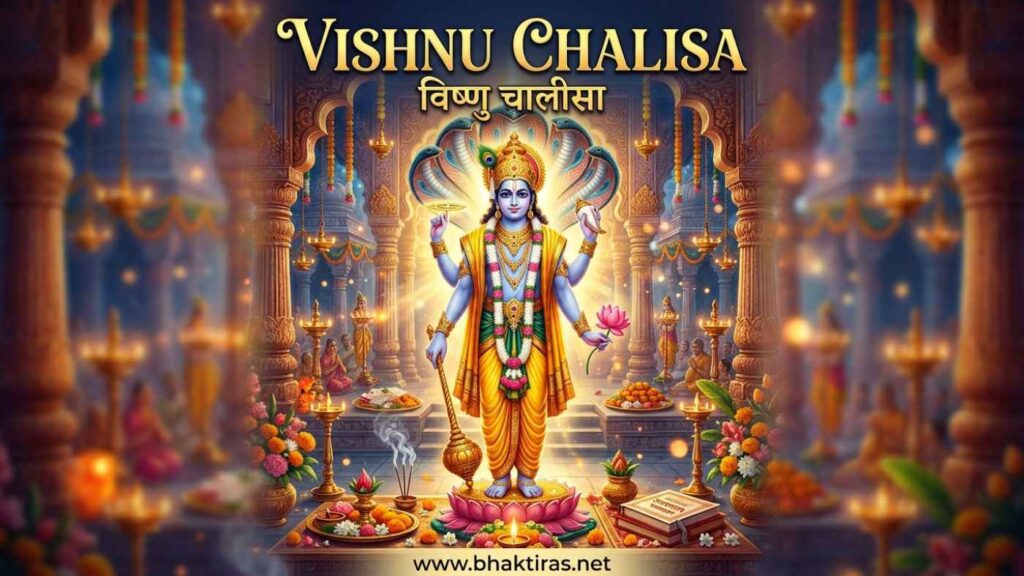
The Vishnu Chalisa is a forty-line Hindi hymn of praise to Lord Vishnu, the preserver who sustains the three worlds and descends through his avatars whenever dharma weakens. Its verses recall his form holding the conch, discus, mace and lotus, retell episodes such as Varaha, Matsya, Kurma and the rescue of devotees like Dhruva and Prahlada, and close with a humble plea for his grace. This page gives the full text in Roman transliteration with a clear English meaning for every verse, so you can both recite it and follow what each line says.
Vishnu Chalisa Lyrics in English (Transliteration)
Roman transliteration for easy chanting. Tap “Meaning” under any verse for the English translation.
Vishnu Suniye Vinay Sevak Ki Chitlaay
Kirat Kuch Varnan Karun Dijai Gyan Bataay
Meaning
The reciter opens by asking Lord Vishnu to attend to a servant's humble request: that he be able to describe some of the Lord's glory, and that Vishnu grant him understanding to do so.
Namo Vishnu Bhagwan Kharari
Kasht Nashaavan Akhil Vihari
Meaning
Salutations to Lord Vishnu, slayer of the demon Khara, remover of troubles, who pervades and moves through the entire universe.
Prabal Jagat Mein Shakti Tumhari
Tribhuvan Phail Rahi Ujiyari
Meaning
Your power is supreme throughout the world; the light of your glory spreads across all three realms.
Sundar Roop Manohar Surat
Saral Swabhav Mohini Murat
Meaning
Your form is beautiful and your face captivating; your nature is gentle and your image enchanting to behold.
Tan Par Pitambar Ati Sohat
Baijanti Mala Man Mohat
Meaning
The yellow silk garment on your body looks splendid, and the Vaijayanti garland you wear steals the heart of the devotee.
Shankh Chakra Kar Gada Viraje
Dekhat Daitya Asur Dal Bhaje
Meaning
The conch, discus and mace shine in your hands; at the mere sight of them the ranks of demons turn and flee.
Satya Dharm Mad Lobh Na Gaaje
Kam Krodh Mad Lobh Na Chaaje
Meaning
Where truth and dharma prevail, arrogance and greed cannot thunder; desire, anger, pride and greed find no place to take hold.
Santbhakt Sajjan Manranjan
Danuj Asur Dushtan Dal Ganjan
Meaning
You delight the hearts of saints, devotees and good people, while you crush the hordes of demons, titans and the wicked.
Sukh Upjaay Kasht Sab Bhanjan
Dosh Mitaay Karat Jan Sajjan
Meaning
You give rise to happiness and break apart every hardship; you wipe away faults and make ordinary people virtuous.
Paap Kaat Bhav Sindhu Utaaran
Kasht Naashakar Bhakt Ubaaran
Meaning
You cut away sins and carry souls across the ocean of worldly existence; you destroy suffering and lift your devotees to safety.
Karat Anek Roop Prabhu Dhaaran
Keval Aap Bhakti Ke Karan
Meaning
You assume many forms, O Lord, taking them on purely for the sake of your devotees' love and faith.
Dharani Dhenu Ban Tumhi Pukaara
Tab Tum Roop Ram Ka Dhaara
Meaning
When the Earth, taking the form of a cow, cried out to you in distress, you then took on the form of Rama.
Bhaar Utaar Asur Dal Maara
Ravan Aadik Ko Sanhaara
Meaning
You lifted the Earth's burden by destroying the armies of demons and slaying Ravana and others like him.
Aap Varaah Roop Banaaya
Hiranyaaksh Ko Maar Giraaya
Meaning
You took the form of the boar, Varaha, and struck down the demon Hiranyaksha, killing him.
Dhar Matsya Tan Sindhu Banaaya
Choudah Ratanan Ko Nikalaaya
Meaning
Taking the body of a fish, Matsya, you moved through the ocean, and the fourteen jewels were drawn out from the churning of the sea.
Amilakh Asuran Dwand Machaaya
Roop Mohini Aap Dikhaaya
Meaning
When the demons created strife over the nectar, you appeared in the enchanting form of Mohini.
Devan Ko Amrit Paan Karaaya
Asuran Ko Chavi Se Bahalaaya
Meaning
You let the gods drink the nectar of immortality, while distracting the demons with your captivating beauty.
Kurm Roop Dhar Sindhu Mathaaya
Mandraachal Giri Turant Uthaaya
Meaning
Taking the form of the tortoise, Kurma, you supported the churning of the ocean and at once bore up Mount Mandara.
Shankar Ka Tum Phand Chudaaya
Bhasmasur Ko Roop Dikhaaya
Meaning
You freed Lord Shankar from danger by showing yourself, as Mohini, to the demon Bhasmasura and turning his own boon against him.
Vedan Ko Jab Asur Dubaaya
Kar Prabandh Unhe Dhundhavaaya
Meaning
When a demon stole and submerged the Vedas, you arranged matters so that they were sought out and recovered.
Mohit Banakar Khalahi Nachaaya
Usahi Kar Se Bhasm Karaaya
Meaning
By enchanting the wicked one you set him dancing to his own ruin, and by his own hand he was reduced to ashes.
Asur Jalandhar Ati Baldaai
Shankar Se Un Kinhi Ladaai
Meaning
The demon Jalandhara, mighty in strength, waged war against Lord Shankar himself.
Haar Paar Shiv Sakal Banaai
Kin Sati Se Chhal Khal Jaai
Meaning
With Shiva unable to overcome him, the demon's power rested on his wife's virtue, so a stratagem touching her chastity became necessary.
Sumiran Kin Tumhe Shivraani
Batlaai Sab Vipat Kahaani
Meaning
The consort of Shiva remembered and called upon you, telling you the whole story of the calamity.
Tab Tum Bane Munishwar Gyaani
Vrinda Ki Sab Surati Bhulaani
Meaning
You then took the guise of a wise sage and caused Vrinda, Jalandhara's devoted wife, to lose her awareness.
Dekhat Teen Danuj Shaitaani
Vrinda Aay Tumhe Lipataani
Meaning
Seeing what seemed to be her husband returned, the demon's wife Vrinda came and clung to you.
Ho Sparsh Dharm Kshati Maani
Hanaa Asur Ur Shiv Shaitaani
Meaning
With her chastity broken by that touch, the demon's protection failed, and the wickedness of the titan was undone so Shiva could destroy him.
Tumne Dhruv Prahlaad Ubaare
Hirnaakush Aadik Khal Maare
Meaning
You uplifted devotees like Dhruva and Prahlada, and slew evil ones such as Hiranyakashipu.
Ganika Aur Ajaamil Taare
Bahut Bhakt Bhav Sindhu Utaare
Meaning
You redeemed even the courtesan and Ajamila, and carried countless devotees across the ocean of existence.
Harahu Sakal Santaap Hamaare
Kripa Karahu Hari Sirajan Haare
Meaning
Remove all our sorrows; show your grace, O Hari, creator and sustainer of all.
Dekhhu Main Nij Darash Tumhaare
Din Bandhu Bhaktan Hitkaare
Meaning
Let me always behold your presence, O friend of the lowly, well-wisher of your devotees.
Chahataa Aapakaa Sevak Darshan
Karahu Daya Apani Madhusudan
Meaning
Your servant longs for your sight; grant your mercy, O Madhusudana, slayer of the demon Madhu.
Janu Nahi Yogya Jab Poojan
Hoy Yagya Stuti Anumodan
Meaning
I do not even know the proper way to worship; may my faltering praise be accepted as if it were a complete offering.
Shiladaya Santosh Sulakshan
Vidit Nahi Vratbodh Vilakshan
Meaning
Good conduct, compassion and contentment are auspicious marks, yet the deeper knowledge of vows and disciplines is unknown to me.
Karhu Apaka Kis Vidhi Poojan
Kumati Vilok Hote Dukh Bhishan
Meaning
By what method should I worship you? Looking at my own poor understanding fills me with deep distress.
Karahu Pranaam Kaun Vidhi Sumiran
Kaun Bhaanti Mai Karahu Samarpan
Meaning
In what manner should I bow, in what way should I remember you, and how should I surrender myself to you?
Sur Muni Karat Sada Sevkaai
Harshit Rahat Param Gati Paai
Meaning
Gods and sages serve you constantly and remain joyful, attaining the highest goal.
Din Dukhin Par Sada Sahaai
Nij Jan Jaan Lev Apanaai
Meaning
You are ever the helper of the poor and the suffering; recognising me as your own, take me as yours.
Paap Dosh Santaap Nashaao
Bhav Bandhan Se Mukt Karaao
Meaning
Destroy my sins, faults and afflictions, and free me from the bondage of worldly existence.
Sut Sampati De Sukh Upjaao
Nij Charanan Ka Daas Banaao
Meaning
Grant well-being and prosperity and bring forth happiness, and make me a servant at your own feet.
Nigam Sada Ye Vinay Sunavai
Padhai Sune So Jan Sukh Paavai
Meaning
The scriptures forever convey this prayer: whoever reads or hears it attains happiness.
Bhakt Hriday Mein Vaas Karein, Poorn Keejiye Kaaj
Shankh Chakra Aur Gada Padma, Hey Vishnu Maharaj
Meaning
Closing couplet: O Lord Vishnu, bearer of the conch, discus, mace and lotus, dwell in your devotee's heart and bring every undertaking to fulfilment.
Benefits of Reciting the Vishnu Chalisa
Devotees recite the Vishnu Chalisa to invite Lord Vishnu’s protection and steadiness into daily life. Common reasons people turn to it include:
- Protection and stability: As the preserver, Vishnu is invoked to guard the household and keep difficulties at bay.
- Peace of mind: The repeated remembrance of his calm, gracious form helps settle anxiety and restlessness.
- Prosperity and well-being: Several verses ask for sustenance, family welfare and freedom from want.
- Relief from obstacles: The hymn names Vishnu as the remover of troubles and the one who carries devotees across hard times.
- Devotional focus: Daily recitation builds a steady habit of bhakti and gratitude.
- Auspicious starts: Many read it before beginning new work, echoing the closing plea that every task reach completion.
When and How to Chant the Vishnu Chalisa
Thursday is the day most closely linked with Lord Vishnu, and the eleventh lunar day, Ekadashi, is considered especially suited to his worship. After bathing, sit before an image or picture of Vishnu, light a lamp or incense, and recite the chalisa calmly and attentively, ideally beginning and ending with the dohas. The spirit matters more than perfect pronunciation; recite with sincerity and an unhurried mind, and let the meaning of each verse register as you go.
About the Vishnu Chalisa
The Vishnu Chalisa is a traditional Hindi devotional poem of forty chaupai (four-line) verses framed by an opening and a closing doha (couplet). Its language is plain Hindi in the chalisa style made popular by the Hanuman Chalisa, and no single named author is reliably attached to it. The verses move through praise of Vishnu’s form and qualities, brief recollections of his avatars and famous acts such as Varaha, Matsya, Kurma and the Mohini episode, the rescue of devotees like Dhruva and Prahlada, and finally a personal plea for guidance, forgiveness and grace.
Frequently Asked Questions
What is the Vishnu Chalisa?
The Vishnu Chalisa is a forty-verse Hindi hymn praising Lord Vishnu, the preserver of the universe. It describes his form, his avatars and his protection of devotees, and ends with a request for his grace. 'Chalisa' refers to its forty main verses.
What are the benefits of reciting the Vishnu Chalisa?
Devotees recite it to seek Vishnu's protection, peace of mind, prosperity and relief from obstacles. As a regular practice it strengthens devotion and provides a calming, focused start to the day.
Which day is best to recite the Vishnu Chalisa?
Thursday is traditionally associated with Lord Vishnu, and Ekadashi (the eleventh lunar day) is also considered especially auspicious. It can, however, be recited on any day with devotion.
How many verses are in the Vishnu Chalisa?
It has forty chaupai (main) verses, which give the chalisa its name, along with an opening doha and a closing doha (couplets) that frame the hymn.
Can the Vishnu Chalisa be recited in English?
Yes. This page provides the full Vishnu Chalisa in Roman (English) transliteration so it can be recited by readers who do not read Devanagari, along with an English meaning for each verse.
॥ Vishnu Chalisa ॥