
ॐ
Santoshi Mata Chalisa
श्री सन्तोषी माता चालीसा
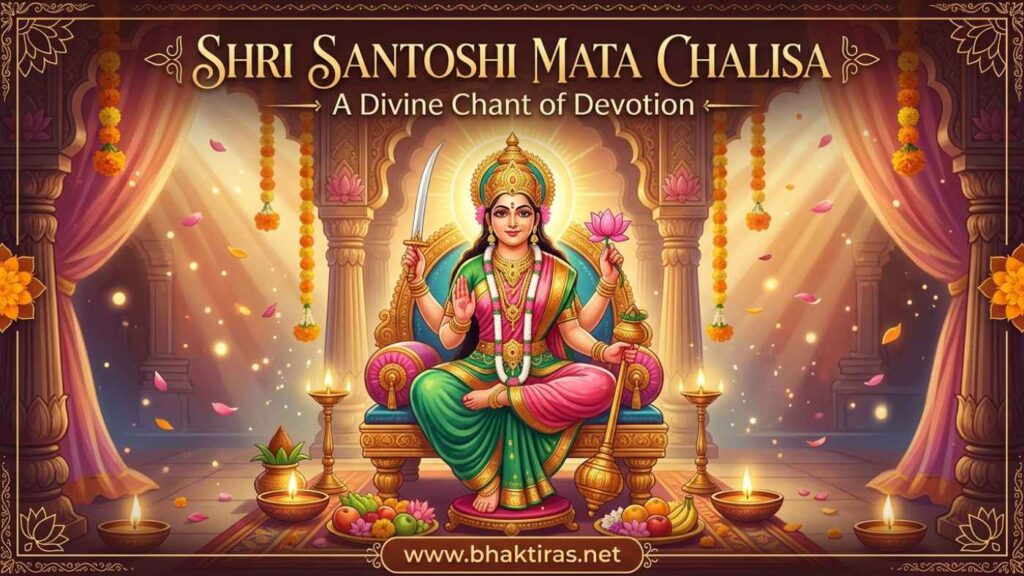
The Santoshi Mata Chalisa is a forty-verse hymn to the goddess of contentment and satisfaction, the deity at the centre of the popular Friday (Shukravar) vrat kept for peace at home and the fulfilment of sincere wishes. Devotees recite it to ask the Mother for steadiness of mind, relief from worry and harmony in the family. This page gives the full Roman transliteration of every verse alongside an original line-by-line English meaning, so you can both read along and understand what each chaupai says.
Santoshi Mata Chalisa Lyrics in English (Transliteration)
Roman transliteration for easy chanting. Tap “Meaning” under any verse for the English translation.
Shri Ganpati pad naay sir, dhari hiy Sharada dhyan
Santoshi Maa ki karun, keerati sakal bakhan
Meaning
Bowing the head at Ganesha's feet and holding Saraswati in the heart, the devotee begins to recount the full glory and fame of Santoshi Mata.
Jai Santoshi Maa jag janani
Khal mati dusht daitya dal hanani
Meaning
Victory to Santoshi Mata, mother of the whole world, who destroys the armies of the wicked-minded and cruel demons.
Ganpati dev tumhare tata
Riddhi Siddhi kahlavahin mata
Meaning
Lord Ganesha is honoured as your father, and his consorts Riddhi and Siddhi are called your mothers.
Mata-pita ki rahau dulari
Keerati kehi vidhi kahun tumhari
Meaning
You remain the cherished daughter of your parents; in what way can anyone fully describe your renown?
Krit mukut sir anupam bhari
Kanan kundal ko chhavi nyari
Meaning
A matchless, heavy crown rests upon your head, and the ear ornaments shine with a beauty all their own.
Sohat ang chhata chhavi pyari
Sundar cheer sunahari dhari
Meaning
Every limb glows with a lovely radiance as you wear a beautiful golden-hued garment.
Aap chaturbhuj sughad vishala
Dharan karahu gale van mala
Meaning
You are four-armed, graceful and grand, wearing a garland of forest flowers around your neck.
Nikat hai gau amit dulari
Karahu mayur aap aswari
Meaning
A dearly loved cow stands near you, and at times you ride upon a peacock.
Janat sabahi aap prabhutai
Sur nar muni sab karahin badai
Meaning
All beings know your sovereign power; gods, humans and sages alike sing your praise.
Tumhare darash karat kshan mai
Dukh daridra sab jaay nasai
Meaning
In the very moment one beholds you, O Mother, sorrow and poverty are wholly destroyed.
Ved Puran rahe yash gai
Karahu bhakt ki aap sahai
Meaning
The Vedas and Puranas keep singing your fame, and you give your help to the devotees.
Brahma dhing Saraswati kahai
Lakshmi roop Vishnu dhing aai
Meaning
Beside Brahma you are known as Saraswati, and as Lakshmi you appear at Vishnu's side.
Shiv dhing Girja roop biraji
Mahima teenon lok mein gaji
Meaning
Beside Shiva you shine in the form of Parvati, and your glory resounds across all three worlds.
Shakti roop pragti jan jani
Rudra roop bhai Mat Bhavani
Meaning
Recognised by the faithful as power itself, you took form as Bhavani in the fierce aspect of Rudra.
Dushtadalan hit pragti Kali
Jagmag jyoti prachand nirali
Meaning
To crush the wicked you appeared as Kali, blazing with a fierce, dazzling and unrivalled light.
Chand Mund Mahishasur mare
Shumbh Nishumbh asur hani dare
Meaning
You slew Chanda, Munda and the buffalo-demon Mahishasura, and struck down the demons Shumbha and Nishumbha.
Mahima Ved Puranan barni
Nij bhaktan ke sankat harni
Meaning
The Vedas and Puranas describe your greatness; you remove the troubles of your own devotees.
Roop Sharada hans mohini
Nirankar saakar dahini
Meaning
You take the enchanting form of Saraswati riding a swan; you are both the formless and the embodied, ever auspicious.
Pragtai chahundish nij maya
Kan kan mein hai tej samaya
Meaning
You have spread your divine power in all four directions, and your radiance pervades every particle of creation.
Prithvi Surya Chandra aru tare
Tav ingit kram baddh hain sare
Meaning
The earth, the sun, the moon and the stars all move in ordered sequence at your mere signal.
Palan poshan tumhin karta
Kshan bhangur mein pran harta
Meaning
You alone nurture and sustain all life, and in a fleeting moment you can also take it away.
Brahma Vishnu tumhein nit dhyavain
Shesh Mahesh sada man lave
Meaning
Brahma and Vishnu meditate on you daily, and Shesha and Shiva ever fix their minds upon you.
Manokamna puran karni
Paap katni bhav bhay tarni
Meaning
You fulfil heartfelt wishes, cut away sins, and carry devotees across the fear of worldly existence.
Chitt lagay tumhein jo dhyata
So nar sukh sampatti hai pata
Meaning
Whoever meditates on you with a focused mind attains happiness and prosperity.
Bandhya nari tumahin jo dhyavain
Putra pushp lata sam vah pavain
Meaning
A childless woman who meditates on you is blessed with offspring, flourishing like a flowering vine.
Pati viyogi ati vyakulnari
Tum viyog ati vyakulyari
Meaning
A woman separated from her husband and deeply distressed finds in you the one who eases the pain of that separation.
Kanya jo koi tumko dhyavai
Apna man vanchhit var pavai
Meaning
An unmarried girl who meditates on you obtains the husband her heart desires.
Sheelvan gunvan ho maiya
Apne jan ki nav khivaiya
Meaning
You are virtuous and full of noble qualities, O Mother, the boatwoman who rows your devotees safely across.
Vidhi purvak vrat jo koi karahin
Tahi amit sukh sampatti bharahin
Meaning
Whoever keeps your vow according to the proper rules is filled with boundless happiness and wealth.
Gud aur chana bhog tohi bhavai
Seva karai so anand pavai
Meaning
You are pleased by an offering of jaggery and roasted chickpeas; whoever serves you in this way finds joy.
Shraddha yukt dhyan jo dharahin
So nar nishchay bhav son tarahin
Meaning
Whoever meditates on you with sincere faith will surely cross over the ocean of worldly existence.
Udyapan jo karahi tumhara
Tako sahaj karahu nistara
Meaning
For the one who completes your vow with its concluding rite, you grant deliverance with ease.
Nari suhagin vrat jo karti
Sukh sampatti son godi bharti
Meaning
A married woman who keeps your vow has her lap filled with happiness and prosperity.
Jo sumirat jaisi man bhava
So nar vaiso hi phal pava
Meaning
As each devotee remembers you with the wish in their heart, so exactly do they receive its fruit.
Saat shukra jo vrat man dhare
Take puran manorath sare
Meaning
Whoever observes your vow over seven Fridays with sincere intent has all their wishes fulfilled.
Seva karahi bhakti yut joi
Tako door daridra dukh hoi
Meaning
Whoever serves you with devotion sees their poverty and sorrow driven far away.
Jo jan sharan mata teri aavai
Take kshan mein kaj banavai
Meaning
For any person who comes to your refuge, O Mother, you set their tasks right in an instant.
Jai jai jai Ambe Kalyani
Kripa karau mori Maharani
Meaning
Victory, victory, victory to Ambe, bestower of welfare; show your grace upon me, my Queen.
Jo koi padhai Mat Chalisa
Tape karahin kripa Jagdisha
Meaning
Whoever reads this Chalisa of the Mother receives the grace of the Lord of the universe.
Nit prati path karai ik bara
So nar rahai tumhara pyara
Meaning
Whoever recites it once every single day remains dear to you.
Naam let byadha sab bhage
Rog dosh kabahun nahin lage
Meaning
At the very utterance of your name all afflictions flee, and disease and defect never take hold.
Santoshi Maa ke sada, bandhun pag nish vas
Puran manorath hon sakal, Mat harau bhav tras
Meaning
I bow always at the feet of Santoshi Mata, day and night; may all my wishes be fulfilled, and may the Mother remove the dread of worldly existence.
Benefits of Reciting the Santoshi Mata Chalisa
Devotees recite the Santoshi Mata Chalisa to cultivate contentment and to ask the Mother for steadiness in daily life. Commonly cited benefits include:
- Contentment of mind: The hymn turns attention toward gratitude and satisfaction with what one has, which is the central blessing the goddess represents.
- Family harmony: It is recited for peace at home and for warmth between family members.
- Fulfilment of sincere wishes: The verses repeatedly speak of heartfelt wishes (manokamna) being granted to faithful devotees.
- Relief from worry and hardship: Several lines describe sorrow and poverty being dispelled for those who remember the goddess.
- Support for the Friday vrat: Recited as part of the Shukravar vrat, it anchors the fast with focused prayer and the traditional offering of jaggery and chickpeas.
- Refuge and reassurance: The closing verses promise that those who come to the Mother’s shelter find their concerns resolved.
When and How to Chant the Santoshi Mata Chalisa
The Santoshi Mata Chalisa is most often recited on Friday, the day of her vrat, ideally after bathing and in front of an image or picture of the goddess with a lit lamp. Many devotees keep the vow over a run of consecutive Fridays and offer jaggery and roasted chickpeas as prasad, taking care to avoid sour foods on the fast day as the tradition prescribes. Beyond the formal vrat, the Chalisa can be read once daily as a short, calm practice; what matters most is reciting it with genuine faith and an attitude of gratitude rather than mere repetition.
About the Santoshi Mata Chalisa
The Santoshi Mata Chalisa follows the familiar Chalisa form: an opening doha, forty chaupai couplets, and a closing doha, composed in simple devotional Hindi. Its verses praise the goddess as the daughter of Ganesha, identify her with the great forms of Shakti such as Saraswati, Lakshmi, Parvati, Durga and Kali, and dwell on the rewards of her Friday vrat. Devotion to Santoshi Mata grew especially widespread across North India in the twentieth century, and the hymn reflects that household, vrat-centred tradition of seeking contentment and the fulfilment of everyday hopes.
Frequently Asked Questions
What is the Santoshi Mata Chalisa?
It is a forty-verse Hindu devotional hymn praising Santoshi Mata, the goddess of satisfaction and contentment. It is recited especially during her Friday (Shukravar) vrat to seek peace at home, relief from worry and the fulfilment of sincere wishes.
What are the benefits of reciting the Santoshi Mata Chalisa?
Devotees recite it for contentment of mind, family harmony, the fulfilment of heartfelt wishes, and relief from sorrow and hardship. It is also recited to support the Friday vrat with focused prayer.
Which day is best to recite the Santoshi Mata Chalisa?
Friday (Shukravar) is the traditional day, as it is the day of Santoshi Mata's vrat. Many devotees keep the vow over several consecutive Fridays, though the Chalisa may also be read daily.
How many verses are in the Santoshi Mata Chalisa?
It has forty chaupai verses, framed by an opening doha and a closing doha, in keeping with the standard Chalisa form.
Can the Santoshi Mata Chalisa be recited in English?
Yes. This page provides the full Roman (English) transliteration of every verse along with a clear English meaning, so it can be read and understood by those who do not read Hindi script.
What is offered to Santoshi Mata during the vrat?
The traditional offering is jaggery (gud) and roasted chickpeas (chana). Devotees keeping the vrat also typically avoid sour foods on the fast day.
॥ Santoshi Mata Chalisa ॥