
ॐ
Tulsi Chalisa
श्री तुलसी चालीसा
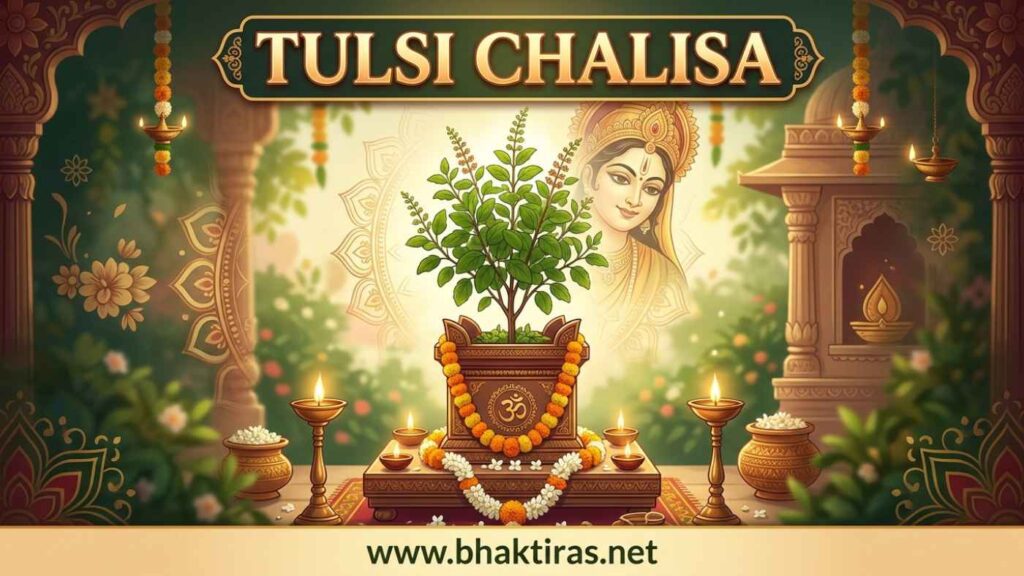
The Tulsi Chalisa is a forty-verse hymn to Tulsi Mata, the holy basil revered as Vrinda, the dearest beloved of Lord Vishnu. Its verses retell how she earned her sacred plant form across three births and why a single tulsi leaf delights Hari more than any offering. This page gives the full chalisa in easy English transliteration, with a clear, original meaning under every verse.
Tulsi Chalisa Lyrics in English (Transliteration)
Roman transliteration for easy chanting. Tap “Meaning” under any verse for the English translation.
Jaya Jaya Tulasi Bhagavati, Satyavati Sukhadani
Namo Namo Hari Preyasi, Shri Vrinda Guna Khani
Meaning
Victory to divine Tulsi, the truthful one who gives joy. Again and again I bow to her, the beloved of Hari and a mine of every virtue, known also as Vrinda.
Shri Hari Shisha Birajini, Dehu Amara Vara Amba
Janahita He Vrindavani, Aba Na Karahu Vilamba
Meaning
You who rest upon the head of Lord Hari, grant me the boon of deathless devotion, O Mother. For the good of your devotees, O Lady of Vrindavan, do not delay now.
Dhanya Dhanya Shri Tulasi Mata
Mahima Agama Sada Shruti Gata
Meaning
Blessed, ever blessed is Mother Tulsi, whose greatness is beyond reach and is forever sung in the sacred scriptures.
Hari Ke Pranahu Se Tuma Pyari
Harihin Hetu Kinho Tapa Bhari
Meaning
You are dearer to Hari than his own life; to win him you performed long and severe penance.
Jaba Prasanna Hai Darshana Dinhyo
Taba Kara Jori Vinaya Usa Kinhyo
Meaning
When the Lord, pleased by that penance, gave you his vision, you folded your hands and made a humble plea to him.
He Bhagavanta Kanta Mama Hohu
Dina Jani Jani Chhadahu Chhohu
Meaning
O Lord, become my husband; seeing me lowly and helpless, do not abandon your affection for me.
Suni Lakshmi Tulasi Ki Bani
Dinho Shrapa Kadha Para Ani
Meaning
Hearing Tulsi's words, Lakshmi grew angry and brought a curse down upon her.
Usa Ayogya Vara Mangana Hari
Hohu Vitapa Tuma Jada Tanu Dhari
Meaning
For asking the Lord for so unfit a boon as her husband, Lakshmi cursed her to take the unmoving body of a plant.
Suni Tulasi Hin Shrapyo Tehin Thama
Karahu Vasa Tuhu Nichana Dhama
Meaning
Hearing this, Tulsi cursed Lakshmi in return at that very spot, saying that she too would have to dwell in a lowly place.
Diyo Vachana Hari Taba Tatkala
Sunahu Sumukhi Jani Hohu Bihala
Meaning
Then the Lord at once gave his promise: "Listen, fair one, do not be distressed."
Samaya Pai Vhau Rau Pati Tora
Pujihau Asa Vachana Sata Mora
Meaning
"In due time I will surely become your husband; this word of mine will be fulfilled and proven true."
Taba Gokula Maha Gopa Sudama
Tasu Bhai Tulasi Tu Bama
Meaning
Then in Gokul there was a cowherd named Sudama, and Tulsi was born as his wife.
Krishna Rasa Lila Ke Mahi
Radhe Shakyo Prema Lakhi Nahi
Meaning
During Krishna's rasa-lila, Radha could not bear to see the love between them.
Diyo Shrapa Tulasiha Tatkala
Nara Lokahi Tuma Janmahu Bala
Meaning
At once Radha cursed Tulsi, saying she would be born again as a girl in the world of mortals.
Yo Gopa Vaha Danava Raja
Shankha Chuda Namaka Shira Taja
Meaning
That cowherd was reborn as a demon king named Shankhachuda, bearing his fame at the cost of his life.
Tulasi Bhai Tasu Ki Nari
Parama Sati Guna Rupa Agari
Meaning
Tulsi became his wife, a supremely chaste woman, foremost in virtue and in beauty.
Asa Dvai Kalpa Bita Jaba Gayau
Kalpa Tritiya Janma Taba Bhayau
Meaning
When two such ages had passed in this way, her third birth then took place.
Vrinda Nama Bhayo Tulasi Ko
Asura Jalandhara Nama Pati Ko
Meaning
In that birth Tulsi was named Vrinda, and her husband was the demon named Jalandhara.
Kari Ati Dvanda Atula Baladhama
Linha Shankara Se Sangrama
Meaning
Possessing immense, matchless strength, Jalandhara waged a fierce battle against Lord Shankara.
Jaba Nija Sainya Sahita Shiva Hare
Marahi Na Taba Hara Harihi Pukare
Meaning
When Shiva and his whole army were being defeated, and Jalandhara could not be slain, Shiva called out to Hari for help.
Pativrata Vrinda Thi Nari
Kou Na Sake Patihi Sanhari
Meaning
Vrinda was a wife utterly devoted to her husband, and because of the power of her chastity no one could destroy him.
Taba Jalandhara Hi Bhesha Banai
Vrinda Dhiga Hari Pahuchyo Jai
Meaning
Then Hari took on the very form of Jalandhara and went and approached Vrinda in disguise.
Shiva Hita Lahi Kari Kapata Prasanga
Kiyo Satitva Dharma Tohi Bhanga
Meaning
For Shiva's sake he carried out this deception and so broke the vow of Vrinda's chastity.
Bhayo Jalandhara Kara Sanhara
Suni Ura Shoka Upara
Meaning
With her chastity broken, Jalandhara was slain, and on hearing this grief rose up in Vrinda's heart.
Tihi Kshana Diyo Kapata Hari Tari
Lakhi Vrinda Duhkha Gira Uchari
Meaning
At that moment Hari set aside his disguise, and seeing him, the sorrowing Vrinda spoke out.
Jalandhara Jasa Hatyo Abhita
Soi Ravana Tasa Harihi Sita
Meaning
"Just as you killed Jalandhara without fear by deceit, so will a Ravana one day carry off your own Sita."
Asa Prastara Sama Hridaya Tumhara
Dharma Khandi Mama Patihi Sanhara
Meaning
"Your heart is as hard as stone, for you shattered my honor and destroyed my husband."
Yahi Karana Lahi Shrapa Hamara
Hove Tanu Pashana Tumhara
Meaning
"For this reason receive my curse: that your body too shall turn to stone."
Suni Hari Turatahi Vachana Uchare
Diyo Shrapa Bina Vichare
Meaning
Hearing this, Hari at once spoke in reply, telling how she had pronounced the curse without proper thought.
Lakhyo Na Nija Karatuti Pati Ko
Chhalana Chahyo Jaba Paravati Ko
Meaning
"You did not consider your own husband's deeds, how he had sought to deceive even Parvati."
Jadamati Tuhu Asa Ho Jadarupa
Jaga Maha Tulasi Vitapa Anupa
Meaning
"Dull of mind, so be it that you take an unmoving form; in this world you shall be the matchless tulsi plant."
Dhagva Rupa Hama Shaligrama
Nadi Gandaki Bicha Lalama
Meaning
"And I myself shall take the form of the Shaligram stone, a jewel found in the bed of the Gandaki river."
Jo Tulasi Dala Hamahi Chadha Ihain
Saba Sukha Bhogi Parama Pada Paihai
Meaning
"Whoever offers a tulsi leaf to me shall enjoy every happiness and attain the highest state."
Binu Tulasi Hari Jalata Sharira
Atishaya Uthata Shisha Ura Pira
Meaning
Without tulsi, Hari's body feels as if it burns, and a great ache rises in his head and chest.
Jo Tulasi Dala Hari Shira Dharata
So Sahasra Ghata Amrita Darata
Meaning
Whoever places a tulsi leaf upon Hari's head pours upon him, as it were, a thousand pots of nectar.
Tulasi Hari Mana Ranjani Hari
Roga Dosha Duhkha Bhanjani Hari
Meaning
Tulsi delights the heart of Hari, and she breaks apart disease, fault and sorrow.
Prema Sahita Hari Bhajana Nirantara
Tulasi Radha Mein Nahi Antara
Meaning
For one who worships Hari ceaselessly with love, there is no difference at all between Tulsi and Radha.
Vyanyana Ho Chhappanahu Prakara
Binu Tulasi Dala Na Harihi Pyara
Meaning
Though there be the fifty-six varieties of food laid before him, without a tulsi leaf none of it is dear to Hari.
Sakala Tirtha Tulasi Taru Chhahi
Lahata Mukti Jana Sanshaya Nahi
Meaning
All holy places dwell in the shade of the tulsi tree, and the devotee attains liberation there without any doubt.
Kavi Sundara Ika Hari Guna Gavata
Tulasihi Nikata Sahasaguna Pavata
Meaning
When a poet sings even a single virtue of Hari near the tulsi, he gains a thousandfold the fruit of his praise.
Basata Nikata Durbasa Dhama
Jo Prayasa Te Purva Lalama
Meaning
Near her abides the home of the sage Durvasa; her grace comes through devoted effort to the worthy one.
Patha Karahi Jo Nita Nara Nari
Hohi Sukha Bhashahi Tripurari
Meaning
Whatever man or woman recites this daily shall find happiness, so declares Lord Shiva, the conqueror of the three cities.
Tulasi Chalisa Padhahi, Tulasi Taru Graha Dhari
Dipadana Kari Putra Phala, Pavahi Bandhyahu Nari
Meaning
Those who read the Tulsi Chalisa and keep a tulsi plant in the home, who light lamps before it, gain the blessing of children, even a childless woman among them.
Sakala Duhkha Daridra Hari, Hara Hvai Parama Prasanna
Ashiya Dhana Jana Ladahi, Graha Basahi Purna Atra
Meaning
All sorrow and poverty are removed, and Shiva, being greatly pleased, bestows blessings, wealth and family, so the home dwells in fullness.
Lahi Abhimata Phala Jagata, Maha Lahi Purna Saba Kama
Jei Dala Arpahi Tulasi Tanha, Sahasa Basahi Harirama
Meaning
One obtains every desired fruit in the world and sees all wishes fulfilled; where a tulsi leaf is offered, there Lord Hari abides a thousandfold.
Benefits of Reciting the Tulsi Chalisa
Devotees turn to the Tulsi Chalisa for both inner devotion and everyday well-being:
- Vishnu’s grace: Since a single tulsi leaf is said to please Hari above all offerings, reciting it draws the blessings of Vishnu and his consort Lakshmi.
- Purity of mind: The verses on chastity and steadfast love help cultivate sincerity and a clean, focused heart in worship.
- Health and protection: Tulsi is honored as a remover of disease and fault, and the prayer is recited for physical wellness and a protected home.
- Domestic harmony: Keeping and revering a tulsi plant alongside this recitation is traditionally linked with family prosperity and the blessing of children.
- Freedom from sorrow: The closing dohas promise relief from grief and poverty for the steady reciter.
- Liberation: The text holds that all sacred places rest in tulsi’s shade, so devotion to her becomes a path toward final release.
When and How to Chant the Tulsi Chalisa
The Tulsi Chalisa is most often recited in the evening, lighting a lamp before a tulsi plant in the courtyard or home shrine; it holds special importance during Kartik month and on Tulsi Vivah, the day Tulsi is ceremonially married to Vishnu. After a bath and with a calm, devotional mind, offer water and a lamp to the plant, then read the verses slowly enough to follow each meaning. The spirit matters more than speed: recite with affection for Tulsi Mata and gratitude to Hari, and the act of daily care for the plant itself becomes part of the worship.
About the Tulsi Chalisa
The Tulsi Chalisa follows the classic chalisa form, built from opening and closing dohas (couplets) framing forty chaupai verses. Composed in Hindi with Awadhi coloring, it is presented here in Roman transliteration so non-Devanagari readers can recite it. Its narrative weaves together the well-known Puranic legends of Tulsi across three births, including her penance to win Vishnu, the curses exchanged with Lakshmi and Radha, and the story of Vrinda and Jalandhara that explains how she became the sacred plant and Vishnu the Shaligram stone. The text is traditional and anonymous in origin, sung across India in Vaishnava households.
Frequently Asked Questions
What is the Tulsi Chalisa?
The Tulsi Chalisa is a devotional hymn of forty verses praising Tulsi Mata, the holy basil revered as Vrinda and as the beloved of Lord Vishnu. It recounts her sacred story and celebrates the tulsi plant as the offering dearest to Hari.
What are the benefits of reciting the Tulsi Chalisa?
Devotees recite it to seek the grace of Vishnu and Lakshmi, purity of heart, good health, family prosperity and relief from sorrow. Tulsi is honored as a remover of disease and fault, and the prayer is linked with a protected, harmonious home.
Which day is best to recite the Tulsi Chalisa?
It is commonly recited daily in the evening, with special significance during the month of Kartik and on Tulsi Vivah, the festival marking Tulsi's marriage to Vishnu. Many devotees read it while offering a lamp to a tulsi plant.
How many verses are in the Tulsi Chalisa?
It contains forty main verses (chaupais), framed by opening and closing dohas (couplets) in the traditional chalisa form.
Can the Tulsi Chalisa be recited in English?
Yes. This page provides the full Tulsi Chalisa in Roman transliteration so it can be read and recited without knowing the Devanagari script, with an English meaning given for every verse.
॥ Tulsi Chalisa ॥