
ॐ
Ganesh Chalisa
श्री गणेश चालीसा
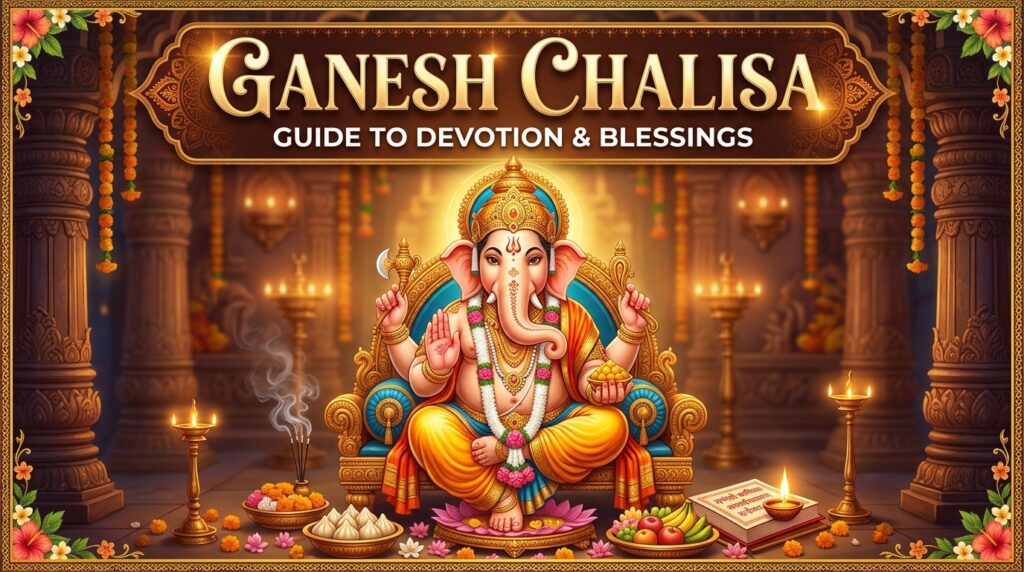
The Ganesh Chalisa is a forty-line devotional hymn sung in praise of Lord Ganesha, the elephant-headed deity Hindus invoke before any new undertaking to clear away obstacles. Its verses recall his birth, the restoring of his head, and the boon that made him the first god to be worshipped at every rite. Below you will find the complete English transliteration of the Ganesh Chalisa together with the meaning of each verse, so you can both chant the words and follow what they say.
Ganesh Chalisa Lyrics in English (Transliteration)
Roman transliteration for easy chanting. Tap “Meaning” under any verse for the English translation.
Jai Ganpati Sadgun Sadan Kavivar Badan Kripal,
Vighna Haran Mangal Karan Jai Jai Girijalal.
Meaning
Victory to Ganpati, the dwelling of every noble virtue, gracious lord with the face praised by poets. He removes obstacles and brings auspiciousness — hail again and again to the beloved son of Girija (Parvati).
Jai Jai Jai Ganpati Raju,
Mangal Bharan Karan Shubh Kaju.
Meaning
Hail, hail, hail to King Ganpati, who fills our lives with blessings and brings every good task to a fortunate completion.
Jai Gajbadan Sadan Sukhdata,
Vishwa Vinayak Buddhi Vidhata.
Meaning
Glory to the elephant-faced one, the home and giver of happiness, leader of the whole world and the dispenser of wisdom and intellect.
Vakra Tund Shuchi Shund Suhavan,
Tilak Tripund Bhal Man Bhavan.
Meaning
His curved tusk and pure, graceful trunk are lovely to behold, and the three-lined tilak on his forehead delights the heart of every devotee.
Rajit Mani Muktan Ur Mala,
Swarn Mukut Shir Nayan Vishala.
Meaning
A garland of gems and pearls shines upon his chest, a golden crown rests on his head, and his eyes are large and wide.
Pustak Pani Kuthar Trishulam,
Modak Bhog Sugandhit Phulam.
Meaning
In his hands he holds a book, an axe and a trident, and he is offered modak sweets and fragrant flowers.
Sundar Pitambar Tan Sajit,
Charan Paduka Muni Man Rajit.
Meaning
His body is adorned in a beautiful yellow silk garment, and the sandals upon his feet delight the minds of the sages.
Dhani Shivsuvan Shadanan Bhrata,
Gauri Lalan Vishwa-Vidhata.
Meaning
Blessed son of Shiva and brother of the six-faced Kartikeya, the darling of Gauri and the sustainer of the universe.
Riddhi Siddhi Tav Chanwar Dulave,
Mushak Vahan Sohat Dware.
Meaning
Riddhi and Siddhi fan you with whisks, while your mount, the mouse, waits gracefully at your door.
Kahaun Janm Shubh Katha Tumhari,
Ati Shuchi Pavan Mangal Kari.
Meaning
I now tell the blessed story of your birth, an account that is utterly pure, sanctifying and bringer of good fortune.
Ek Samay Giriraj Kumari,
Putra Hetu Tap Kinha Bhari.
Meaning
Once the daughter of the mountain king, Parvati, performed severe penance in her longing for a son.
Bhayo Yagya Jab Purn Anupa,
Tab Pahunchyo Tum Dhari Dwij Rupa.
Meaning
When that matchless sacrifice was complete, you arrived there having taken the form of a brahmin.
Atithi Jani Kai Gauri Sukhari,
Bahu Vidhi Seva Kari Tumhari.
Meaning
Recognising you as a guest, Gauri was gladdened and served you in many ways.
Ati Prasann Hvai Tum Var Dinha,
Matu Putra Hit Jo Tap Kinha.
Meaning
Greatly pleased, you granted her the boon she had sought through her penance for the sake of a son.
Milahi Putra Tuhi Buddhi Vishala,
Bina Garbh Dharan Yahi Kala.
Meaning
You declared that she would obtain a son of vast intelligence, and at that very moment, without conceiving in the womb.
Gannayak Gun Gyan Nidhana,
Pujit Pratham Rup Bhagvana.
Meaning
He would be the leader of the ganas, a treasury of virtue and knowledge, the Lord worshipped first of all the gods.
As Kahi Antardhan Rup Hvai,
Palna Par Balak Swarup Hvai.
Meaning
Having said this, you vanished from sight, and appeared as an infant lying in the cradle.
Bani Shishu Rudan Jabahi Tum Thana,
Lakhi Mukh Sukh Nahin Gauri Samana.
Meaning
When you, become a baby, began to cry, Gauri gazed upon your face with a joy beyond all measure.
Sakal Magan Sukh Mangal Gavahin,
Nabh Te Suran Suman Varshavahin.
Meaning
Everyone, absorbed in delight, sang songs of happiness and auspiciousness, while the gods rained down flowers from the sky.
Shambhu Uma Bahudan Lutavahin,
Sur Muni Jan Sut Dekhan Avahin.
Meaning
Shiva and Parvati gave away gifts in abundance, and gods, sages and people came to behold their son.
Lakhi Ati Anand Mangal Saja,
Dekhan Bhi Aaye Shani Raja.
Meaning
Seeing the great joy and festive splendour, King Shani too came to look upon the child.
Nij Avgun Guni Shani Man Mahin,
Balak Dekhan Chahat Nahin.
Meaning
Aware of his own fault within his heart, Shani was unwilling to look at the child.
Girja Kachu Man Bhed Badhayo,
Utsav Mor Na Shani Tuhi Bhayo.
Meaning
Parvati grew a little suspicious in her mind, thinking that Shani did not share in her celebration.
Kahan Lage Shani Man Sakuchai,
Ka Karihau Shishu Mohi Dikhai.
Meaning
For how long could Shani hold back out of hesitation? He wondered what harm would come if he were shown the infant.
Nahin Vishwas Uma Kar Bhayau,
Shani Son Balak Dekhan Kahyau.
Meaning
Uma did not believe his caution and insisted that Shani look upon the child.
Padatahin Shani Drig Kon Prakasha,
Balak Shir Udi Gayo Akasha.
Meaning
The moment Shani's sidelong glance fell upon him, the child's head flew off into the sky.
Girja Girin Vikal Hvai Dharni,
So Dukh Dasha Gayo Nahin Varni.
Meaning
Parvati, overcome with grief, collapsed to the ground, and the depth of that sorrow cannot be described.
Hahakar Machyo Kailasha,
Shani Kinhyon Lakhi Sut Ko Nasha.
Meaning
An outcry of anguish broke out across Kailash when it was seen that Shani's glance had destroyed the son.
Turat Garud Chadhi Vishnu Sidhaye,
Kati Chakra So Gaj Shir Laye.
Meaning
At once Vishnu set out riding Garuda, and with his discus he cut off and brought back the head of an elephant.
Balak Ke Dhad Upar Dharyo,
Pran Mantra Padh Shankar Daryo.
Meaning
He placed it upon the child's body, and Shankar recited the life-giving mantra to restore his breath.
Nam Ganesh Shambhu Tab Kinhe,
Pratham Pujya Buddhi Nidhi Var Dinhe.
Meaning
Shiva then gave him the name Ganesha and granted him the boon of being worshipped first and of being a storehouse of wisdom.
Buddhi Pariksha Jab Shiv Kinha,
Prithvi Ki Pradakshina Linha.
Meaning
When Shiva set a test of intelligence, the task was to circle the whole earth in reverence.
Chale Shadanan Bharmi Bhulai,
Rachi Baith Tum Buddhi Upai.
Meaning
The six-faced Kartikeya set off wandering and lost his way, while you sat and devised a clever plan.
Charan Matu-Pitu Ke Dhar Linhen,
Tinke Sat Pradakshin Kinhen.
Meaning
You took hold of the feet of your mother and father and circled around them seven times.
Dhani Ganesh Kahi Shiv Hiy Harshe,
Nabh Te Suran Suman Bahu Barse.
Meaning
Crying 'Blessed Ganesha!', Shiva rejoiced in his heart, and the gods showered down a great rain of flowers from the heavens.
Tumhari Mahima Buddhi Badai,
Shesh Sahas Mukh Sakai Na Gai.
Meaning
Your glory and the greatness of your wisdom are such that even thousand-mouthed Shesha cannot fully sing them.
Main Mati Hin Malin Dukhari,
Karahun Kaun Bidhi Vinay Tumhari.
Meaning
I am dull of mind, impure and sorrowful — in what fitting way can I possibly offer you my prayer?
Bhajat Ramsundar Prabhudasa,
Lakh Prayag Kakra Durvasa.
Meaning
Ramsundar Prabhudas worships you, having seen Prayag, Kakra and the seat of Durvasa.
Ab Prabhu Daya Din Par Kijai,
Apni Shakti Bhakti Kuchh Dijai.
Meaning
Now, O Lord, show your mercy upon this humble one, and grant me some measure of your strength and devotion.
Shri Ganesh Yah Chalisa Path Karen Dhar Dhyan,
Nit Nav Mangal Grih Basai Lahe Jagat Sanman.
Meaning
Whoever recites this Ganesh Chalisa with focused meditation will find fresh blessings dwelling in their home each day and will earn the esteem of the world.
Samvat Apan Sahasra Dash Rishi Panchami Dinesh,
Puran Chalisa Bhayo Mangal Murti Ganesh.
Meaning
In the stated Samvat year, on the Rishi Panchami day under the sun, this Chalisa to the auspicious form of Ganesha was completed.
Benefits of Reciting the Ganesh Chalisa
Devotees turn to the Ganesh Chalisa for the steadying focus and confidence it brings before any important step in life. Regular recitation is held to carry these blessings:
- Clearing of obstacles: As Vighna-Harta, Ganesha is invoked to smooth away the hurdles that block work, study and new ventures.
- Sharper intellect: The hymn praises Ganesha as the giver of buddhi, and chanting it is associated with clearer thinking and better decisions.
- Auspicious beginnings: Reciting it before starting a task, journey or ceremony is believed to invite a fortunate outcome.
- Calm and confidence: The steady rhythm of the verses settles a restless mind and replaces worry with a sense of trust.
When and How to Chant the Ganesh Chalisa
The Ganesh Chalisa can be chanted on any day, though Wednesday is traditionally linked to Ganesha and is considered especially favourable. Many devotees recite it on the Chaturthi tithi each month and with particular devotion on Ganesh Chaturthi, the festival of his birth. It is also commonly read at the start of a new job, business, examination or journey, after a bath and before a clean image or idol, ideally with a lamp and some flowers or modak offered. Reciting it with a quiet, attentive mind matters more than speed.
About the Ganesh Chalisa
The Ganesh Chalisa is a traditional hymn of forty verses set in simple Awadhi-Hindi, composed in the chaupai-and-doha form used by many popular Chalisas. Rather than only listing praises, it tells a story: it recounts Ganesha’s miraculous birth, the moment Shani’s glance cost him his head, Vishnu’s fetching of an elephant’s head to revive him, and Shiva’s boon naming him pratham pujya — the deity to be worshipped first at every rite. Passed down through oral and printed tradition, it has no single fixed author and is sung across homes and temples in northern and central India.
Frequently Asked Questions
Who is the Ganesh Chalisa dedicated to?
It is dedicated to Lord Ganesha, the elephant-headed son of Shiva and Parvati, who is revered as the remover of obstacles (Vighna-Harta) and the giver of wisdom, and who is worshipped before any new beginning.
How many verses are in the Ganesh Chalisa?
The core of the hymn is forty chaupai lines, which is what 'Chalisa' (from chaalis, meaning forty) refers to. This version has 38 numbered chaupais framed by an opening doha and two closing dohas.
What are the benefits of reciting the Ganesh Chalisa?
Devotees recite it to clear obstacles from their path, to sharpen the intellect, to bless new ventures with a good start, and to calm the mind. It is valued as much for the focus it brings as for the blessings it is believed to invoke.
When should the Ganesh Chalisa be chanted?
It can be chanted on any day, but Wednesday and the monthly Chaturthi tithi are considered especially suitable, and Ganesh Chaturthi most of all. It is also commonly recited before beginning new work, a journey or an exam.
Why is Ganesha worshipped first?
According to the story told in the Chalisa, Shiva granted Ganesha the boon of being pratham pujya — worshipped before all other gods — after he wisely circled his parents instead of the earth. Because he removes obstacles, invoking him first is meant to ensure a smooth ritual or task.
॥ जय श्री गणेश ॥ • ॥ गणपति बाप्पा मोरया ॥