
ॐ
Shiv Chalisa
श्री शिव चालीसा
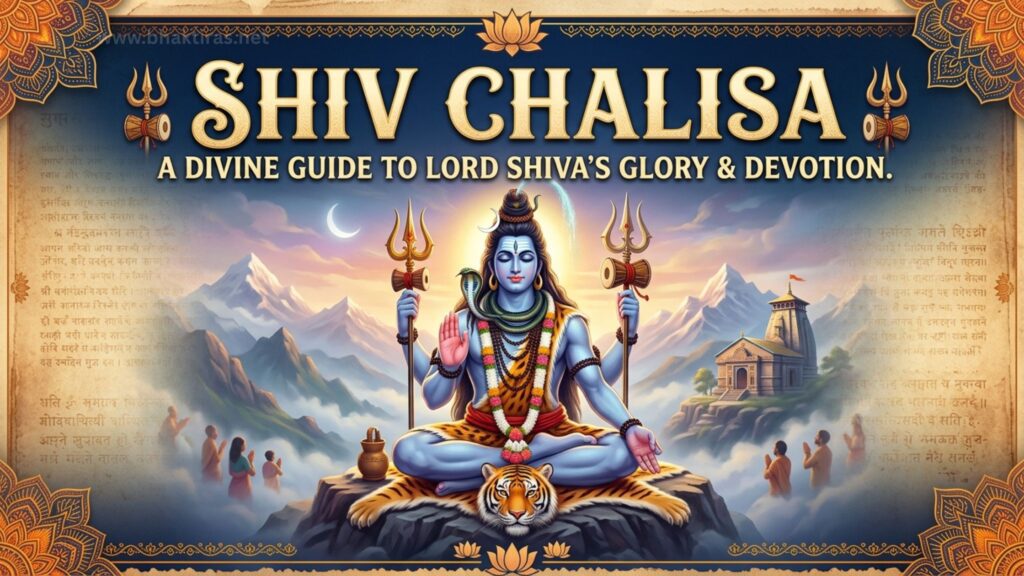
The Shiv Chalisa is a forty-verse hymn of praise to Lord Shiva — Mahadev, the destroyer and renewer of the universe — traditionally attributed to the poet Ayodhyadas. Its verses picture Shiva’s form (the crescent moon, the Ganga in his hair, the serpent and tiger-skin, the trident) and recount his great deeds, from drinking the ocean’s poison to blessing his devotees. Below is the complete Shiv Chalisa in easy English transliteration, with the meaning of every verse a tap away.
Shiv Chalisa Lyrics in English (Transliteration)
Roman transliteration for easy chanting. Tap “Meaning” under any verse for the English translation.
Jai Ganesh Girija Suvan, Mangal Mul Sujan;
Kahat Ayodhyadas tum, dehu abhay vardan.
Meaning
Victory to Ganesha, son of Parvati, the root of all auspiciousness and the wise one. Ayodhyadas prays: grant me the boon of fearlessness.
Jai Girijapati Dinadayala,
sada karat santan pratipala.
Meaning
Victory to the Lord of Parvati, compassionate to the humble, ever protecting his devotees.
Bhal chandrama sohat nike,
kanan kundal naagphani ke.
Meaning
The crescent moon graces his forehead; serpent-hooded rings adorn his ears.
Ang gaur shir gang bahaye,
mundmaal tan kshaar lagaye.
Meaning
His body is fair and the Ganga flows from his head; a garland of skulls hangs on him and sacred ash anoints his form.
Vastra khaal baghambar sohe,
chhavi ko dekhi naag man mohe.
Meaning
Clad in a tiger-skin garment, his beauty enchants even the serpents.
Maina maatu ki havai dulari,
baam ang sohat chhavi nyari.
Meaning
Parvati, beloved daughter of Maina, graces his left side with matchless beauty.
Kar trishul sohat chhavi bhari,
karat sada shatrun kshaykari.
Meaning
The trident shines mightily in his hand, ever destroying his foes.
Nandi Ganesh sohain tahan kaise,
saagar madhya kamal hain jaise.
Meaning
Nandi and Ganesha grace his side like lotuses in the midst of the ocean.
Kartik Shyam aur Ganarau,
ya chhavi ko kahi jaat na kauoo.
Meaning
Dark-hued Kartikeya and Ganesha attend him; none can fully describe this vision.
Devan jabahin jaay pukara,
tab hi dukh prabhu aap nivara.
Meaning
Whenever the gods came crying for help, the Lord at once removed their sorrow.
Kiya updrav Taarak bhari,
devan sab mili tumhin juhari.
Meaning
When the demon Taraka wrought great havoc, all the gods together worshipped you.
Turat Shadanan aap pathayau,
lav nimesh mahan maari giraayau.
Meaning
At once you sent forth six-faced Kartikeya, who slew the demon in an instant.
Aap Jalandhar asur sanhara,
suyash tumhar vidit sansara.
Meaning
You destroyed the demon Jalandhara; your glory is known throughout the world.
Tripurasur san yuddh machai,
sabahin kripa kar leen bachai.
Meaning
You waged war with Tripurasura and, in your grace, saved all.
Kiya tapahin Bhagirath bhari,
purab pratigya taasu purari.
Meaning
Bhagiratha performed great penance; O slayer of Tripura, you fulfilled his long-held vow.
Daanin mahan tum sam kou nahin,
sevak stuti karat sadahin.
Meaning
Among the generous none equals you; your servants ever sing your praise.
Ved maahi mahima tum gaai,
akath anadi bhed nahin paai.
Meaning
The Vedas sing your glory; you are ineffable and beginningless, your mystery unfathomed.
Prakate udadhi manthan mein jwala,
jarat surasur bhaye vihala.
Meaning
When the churning of the ocean brought forth the burning poison, gods and demons alike were tormented.
Keenh daya tahan kari sahai,
Neelkanth tab naam kahai.
Meaning
You showed mercy and came to their aid; thus you came to be called Neelkanth, the blue-throated.
Poojan Ramchandra jab keenha,
jeet ke Lank Vibhishan deenha.
Meaning
When Rama worshipped you, he conquered Lanka and bestowed it upon Vibhishana.
Sahas kamal mein ho rahe dhari,
keenh pariksha tabahin purari.
Meaning
Rama offered a thousand lotuses; then, O Lord, you tested his devotion.
Ek kamal prabhu raakheu joi,
kamal nayan poojan chahan soi.
Meaning
You concealed one lotus; lotus-eyed Rama then resolved to offer his own eye in worship.
Kathin bhakti dekhi prabhu Shankar,
bhaye prasanna diye ichchhit var.
Meaning
Seeing such unshakeable devotion, Lord Shankara was pleased and granted the boon he desired.
Jai jai jai Anant Avinashi,
karat kripa sab ke ghatvasi.
Meaning
Victory to the infinite, imperishable one who dwells in every heart and showers his grace.
Dusht sakal nit mohi satavai,
bhramat rahaun mohi chain na aavai.
Meaning
Wicked forces torment me daily; I wander restless and find no peace.
Trahi trahi main Nath pukaro,
yahi avsar mohi aan ubaro.
Meaning
“Save me, save me,” I cry, O Lord; come at this hour and deliver me.
Le trishul shatrun ko maaro,
sankat se mohi aan ubaro.
Meaning
Take up your trident, smite my enemies, and rescue me from distress.
Mat-pita bhrata sab koi,
sankat mein poochhat nahin koi.
Meaning
Mother, father, brother and all the rest — in times of trouble none truly stands by.
Swami ek hai aas tumhari,
aay harahu mam sankat bhari.
Meaning
You alone, O Master, are my hope; come and lift away my heavy sorrow.
Dhan nirdhan ko det sadahin,
jo koi janche so phal pahin.
Meaning
You ever grant wealth to the poor; whoever asks of you receives the fruit.
Astuti kehi vidhi karaun tumhari,
kshamahu Nath ab chook hamari.
Meaning
How can I fittingly praise you? Forgive, O Lord, every fault of mine.
Shankar ho sankat ke naashan,
mangal kaaran vighna vinaashan.
Meaning
O Shankara, destroyer of distress, source of auspiciousness and remover of obstacles.
Yogi yati muni dhyan lagavain,
Sharad Narad sheesh navavain.
Meaning
Yogis, ascetics and sages meditate upon you; Saraswati and Narada bow their heads before you.
Namo namo jai namah Shivay,
sur Brahmadik paar na paay.
Meaning
Salutations, salutations, victory and homage to Shiva; even Brahma and the gods cannot reach your limit.
Jo yah paath kare man laai,
ta par hot hai Shambhu sahai.
Meaning
Whoever recites this with a devoted heart receives the help of Shambhu.
Riniya jo koi ho adhikari,
paath kare so paavanhaari.
Meaning
One burdened by debt who recites this is made free and purified.
Putra hon kar ichchha joi,
nishchay Shiv prasad tehi hoi.
Meaning
Whoever longs for a child surely obtains it by Shiva’s grace.
Pandit trayodashi ko laave,
dhyan purvak hom karave.
Meaning
Let one invite a learned priest on the thirteenth lunar day and perform the fire-offering with devotion.
Trayodashi vrat karai hamesha,
tan nahin taake rahai kalesha.
Meaning
One who always keeps the trayodashi fast is freed from bodily affliction.
Dhoop deep naivedya chadhave,
Shankar sammukh paath sunave.
Meaning
Offering incense, lamp and food before Shankara, let the devotee recite this aloud.
Janm janm ke paap nasave,
ant dhaam Shivpur mein paave.
Meaning
The sins of countless births are destroyed, and at the end one attains the abode of Shiva.
Nit nem kar pratah hi, paath karo chalis;
tum meri manokamna, purna karo Jagdish.
Meaning
Reciting these forty verses faithfully each morning — O Lord of the universe, fulfil my heart’s desire.
Benefits of Reciting the Shiv Chalisa
The Shiv Chalisa is recited for inner strength and relief from life’s pressures. Its closing verses promise that sincere recitation eases debt, calms troubled circumstances, and brings the grace of Shambhu to those who turn to him in difficulty.
- Relief from hardship: traditionally recited to ease debt, obstacles and worry.
- Health & well-being: associated with the trayodashi fast and freedom from affliction.
- Courage & protection: invokes Shiva’s trident against fear and negativity.
- Peace of mind: daily morning recitation builds a steady devotional rhythm.
When and How to Chant the Shiv Chalisa
Monday is the day most dear to Shiva, and the festival of Maha Shivaratri and the month of Shravan are considered especially auspicious for the Shiv Chalisa. Many devotees recite it after a morning bath before a Shivling or image of Shiva, offering water, bilva leaves, incense and a lamp. Recited with steady attention, often after the opening Doha, it is a simple daily practice that needs only sincerity.
Who Wrote the Shiv Chalisa?
The Shiv Chalisa is traditionally attributed to the devotional poet Ayodhyadas, who names himself in the opening Doha — a customary poet’s signature. Like the Hanuman Chalisa, it follows the chalisa form of forty verses (chaupais) framed by dohas, drawing its imagery and stories from the Puranas.
Frequently Asked Questions
Who composed the Shiv Chalisa?
The Shiv Chalisa is traditionally attributed to the poet Ayodhyadas, who places his name in the opening Doha. It draws its imagery and stories from the Puranas.
How many verses are in the Shiv Chalisa?
It has forty chaupais — the chalisa form — framed by an opening Doha and closing Dohas, like the Hanuman Chalisa.
What are the benefits of reciting the Shiv Chalisa?
Devotees recite it for relief from hardship and debt, for health and protection, and for peace of mind. Its verses invoke Shiva’s grace against fear and obstacles.
When should the Shiv Chalisa be chanted?
Monday is most dear to Shiva, and Maha Shivaratri and the month of Shravan are especially auspicious. It is commonly recited after a morning bath before a Shivling or image of Shiva.
Why is Shiva called Neelkanth in the Chalisa?
During the churning of the cosmic ocean a burning poison arose; Shiva drank it to save creation, and it stained his throat blue — so he is called Neelkanth, “the blue-throated.” This is recounted in verses 17–18.
॥ ओम् नमः शिवाय ॥ • ॥ हर हर महादेव ॥