
Shrinathji
श्रीनाथजी
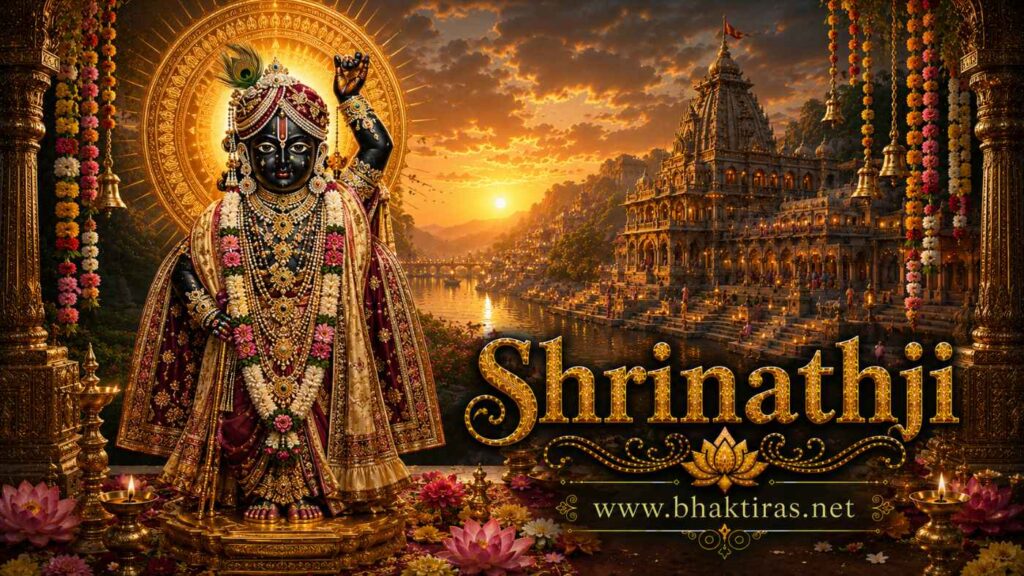
Shrinathji is Lord Krishna worshipped as a seven-year-old child, his left arm lifted as when he raised Mount Govardhan to shelter the cowherds of Braj. His self-manifested black-stone image is enshrined at Nathdwara in Rajasthan and is the beloved central deity of the Pushtimarg, the Vaishnava path of grace founded by Shri Vallabhacharya.
Who Is Shrinathji?
Shrinathji is Lord Krishna loved and served as a small child, a boy of about seven years, caught forever in the moment he lifted a mountain to keep his people dry. His image shows the left arm raised high, the palm turned as though the whole of Mount Govardhan rests on a single fingertip. Because of this, devotees call him Govardhannath and Govardhandhari, the Lord who bears Govardhan.
What sets Shrinathji apart from many temple deities is the feeling that surrounds him. He is not approached only with awe. He is approached with tenderness, the way one cares for a child at home. His devotees dress him, feed him, sing to him, and let him rest, following the rhythms of a real day. This closeness is the heart of the Krishna worship at Nathdwara.
The black-stone image is understood to be swayambhu, self-manifested rather than carved by human hands. It rose from Govardhan Hill near Mathura and was later carried west into Mewar, in present-day Rajasthan, where it found its home at Nathdwara on the banks of the Banas. There it remains the living centre of the Pushtimarg, the devotional tradition founded by Shri Vallabhacharya.
To his devotees, especially in Gujarat and Rajasthan, Shrinathji is family. Households keep his picture in the prayer room, plan pilgrimages to see him, and speak of him with an affection reserved for someone very near and very dear.
The Child Who Lifted Govardhan
The raised arm tells an old story from Braj. The cowherds of Vrindavan and the surrounding pastures used to hold a yearly worship for Indra, the god of rain, hoping for good showers over their grazing land. The young Krishna suggested something different. He told them to honour Govardhan Hill instead, the hill that gave them grass, water, herbs and shelter every single day. The rain, he said, would come or not come by its own nature; it was the hill that truly fed their cows.
Indra took this as an insult. In anger he sent down a punishing storm, sheets of rain meant to drown the fields and frighten the people back to worshipping him. The cowherds, their children and their cattle had nowhere to run.
Then the child did something no child could do. He bent, slipped a hand beneath Govardhan, and lifted the entire hill, holding it up on one finger like an enormous umbrella. Under that stone roof the whole of Braj sheltered – families, calves, elders, everyone – safe and dry while the storm raged for seven days and seven nights. When Indra finally understood who this boy was, his pride broke, and he came to bow.
Shrinathji holds that instant still. The lifted left arm is not a pose of power for its own sake; it is a promise. It says that the Lord will raise whatever weight is needed to keep his people safe, and that those who take refuge under him have nothing to fear from the storm.
The Journey to Nathdwara
The Face on Govardhan Hill
The image is said to have revealed itself slowly on Govardhan Hill near Mathura. First an arm was seen emerging from the rock, then, over time, the full form of the child Krishna with the raised left hand. Shri Vallabhacharya recognised the swarup and established its worship there, and a grand temple grew up around it on the hill that Krishna himself had once lifted.
Leaving Braj
Centuries later, during the reign of Aurangzeb, the community feared for the safety of the image. To protect it, the swarup was taken from Govardhan and carried westward in a bullock cart, moving quietly across the land in search of a secure home far from harm. It was a long and anxious journey for the priests who travelled with their Lord.
The Wheel That Stopped at Sinhad
As the cart moved through Mewar, it is told that its wheels sank deep into the ground at a village called Sinhad and would not move another step. The travellers understood this as the Lord choosing his own resting place. The ruler of Mewar welcomed the deity, a temple was raised on that very spot, and the village became known as Nathdwara – the gate, or doorway, of the Lord. There, beside the Banas, Shrinathji has remained ever since, and pilgrims from across India come to stand before him.
The Pushtimarg – the Path of Grace
Shrinathji is the principal deity of the Pushtimarg, a name that means the path of nourishment or the path of divine grace. It was founded by Shri Vallabhacharya, a great teacher and philosopher, and after him carried forward by his descendants, the Goswami lineage, whose head priest at Nathdwara is honoured as the Tilkayat.
The teaching at the centre of this path is simple and moving. Liberation, it holds, is not earned by force of effort or ritual bargaining. It is received as a gift, freely given by the Lord to those he draws to himself out of love. The devotee’s part is not to conquer but to offer – to surrender the self and place everything at the feet of Krishna. The mool mantra of the tradition, Shri Krishnah Sharanam Mama, says exactly this: Krishna is my refuge.
Because grace is understood as a relationship, worship in the Pushtimarg takes the shape of loving service, or seva. The deity is not a distant idol to be petitioned but a beloved child to be cared for. Everything follows from that one tender idea, and it is why the days at Nathdwara are arranged around the child’s comfort rather than around the worshipper’s requests.
Living Seva – the Eight Darshans
A day with Shrinathji unfolds like a day in the life of a beloved child. The temple opens him to view in eight darshan periods, called jhankis, each a brief glimpse marked by its own mood, clothing, food and song. Between them the doors close so the Lord may rest, eat or play, and devotees wait for the next opening the way a family waits to see a child wake. Each jhanki carries its own feeling across the hours of the day and night:
- Mangala – the dawn waking, when the child is roused gently and shown for the first time that day, still fresh from sleep.
- Shringar – the dressing and adorning, when Shrinathji is clothed in the day’s garments and jewels, chosen for the season and the festival.
- Gwal – the sending off, recalling the hour Krishna would set out with the cows to the pastures of Braj.
- Rajbhog – the great midday meal, the richest offering of the day, laid before the Lord with care.
- Utthapan – the rousing from the afternoon rest, when the child is woken once more.
- Bhog – a lighter refreshment offered in the later part of the day.
- Sandhya – the evening darshan at dusk, recalling Krishna’s return home from the fields.
- Shayan – the night, when Shrinathji is put to bed and the day of service comes gently to a close.
Through all of this runs the art of shringar – the changing of garments and ornaments. Fine fabrics, fresh flowers, painted cloth backdrops known as pichhwai, and seasonal foods are matched to the weather and the calendar, so that no two days look quite the same. This constant, loving attention is what makes Shrinathji feel present and alive to those who serve him.
Festivals at Nathdwara
The festivals at Nathdwara turn the year into a long celebration of the child Lord, and each one draws crowds who travel great distances simply to catch his darshan on a special day.
Annakut, the festival of the mountain of food, is perhaps the most striking. Held the day after Diwali, it remembers the lifting of Govardhan directly. Before Shrinathji is heaped an enormous offering of cooked rice, sweets and dishes, arranged to resemble the very hill he once raised. Devotees see in this abundance the Lord’s own promise of plenty and protection.
Janmashtami marks Krishna’s birth and is kept with music, swinging of the deity, and joyful midnight celebration, the whole town alive with the arrival of the divine child. Holi, the festival of colour, is played before Shrinathji with special tenderness, dry colours and songs filling the temple in the days leading up to it, echoing the playful Krishna of Braj who splashed colour among his companions.
Alongside these, the changing seasons bring their own smaller observances, so that hardly a stretch of the year passes without some occasion to dress, feed and sing to the Lord in a new way.
Iconography and Symbols
The Raised Left Arm
The single most recognisable feature. The left arm lifts high with the palm turned, the gesture of holding up Mount Govardhan. It marks Shrinathji at once as the child Krishna and as the shelter of all who take refuge in him.
The Black-Stone Form
The swarup is dark stone, understood as self-manifested rather than sculpted. Its deep colour recalls the rain-cloud hue of Krishna, and its origin from Govardhan Hill ties the image to the very earth of Braj.
Lotus Eyes and Child's Face
The face is that of a young boy, with wide lotus-shaped eyes and a gentle expression. Everything about the form invites affection rather than fear, keeping the mood of a beloved child at the centre of worship.
Shringar and Pichhwai
Rich garments, jewels, garlands and the painted cloth hangings behind the deity change with the season and festival. This ever-shifting adornment is not decoration alone; it is an act of love, a daily offering to the child Lord.
How Shrinathji Is Worshipped
Worship of Shrinathji is above all seva, loving service offered as one would care for a child at home. Devotees carry this feeling into their own homes and pilgrimages in simple, heartfelt ways:
- Reciting the mool mantra Shri Krishnah Sharanam Mama, surrendering oneself as his refuge.
- Making the pilgrimage to Nathdwara to stand before him during the eight jhankis and receive his darshan.
- Keeping a picture or small swarup of Shrinathji at home and offering it food, flowers and song through the day.
- Singing the devotional poetry of the Pushtimarg poets, whose verses describe the child Krishna’s play in Braj.
- Celebrating Annakut, Janmashtami and Holi with the community, sharing prasad received from the Lord.
- Offering seasonal foods and fresh clothing in the spirit of shringar, matching the gift to the time of year.
Running through all of it is a single attitude: not demanding from the Lord but giving to him, trusting that his grace will do the rest.
Prayers and Mantras
The central prayer of the Pushtimarg is short, and it holds the whole of the path within it. It is not a request for anything; it is an act of surrender.
The mool mantra is श्री कृष्णः शरणं मम, transliterated as Shri Krishnah Sharanam Mama, meaning Shri Krishna is my refuge. To say it is to place oneself entirely in the care of the Lord, the way the people of Braj placed themselves under the lifted hill. Devotees repeat it at waking, before darshan, and at rest, letting it become the quiet ground beneath the day.
Alongside it, worshippers sing the devotional verses of the tradition’s poets and offer the simple prayers of a child speaking to a parent, sure of being heard.
Frequently Asked Questions about Shrinathji
Who is Shrinathji?
Shrinathji is Lord Krishna worshipped as a seven-year-old child, shown with his left arm raised as when he lifted Mount Govardhan to shelter the people of Braj. His self-manifested black-stone image is enshrined at Nathdwara in Rajasthan and is the central deity of the Pushtimarg, the path of grace founded by Shri Vallabhacharya.
Why is Shrinathji's arm raised?
The raised left arm recalls the moment the child Krishna lifted Mount Govardhan on one finger, holding it up like an umbrella to shelter the cowherds of Braj from Indra's punishing storm. Because of this he is called Govardhannath and Govardhandhari, and the gesture stands as his promise to protect all who seek refuge in him.
Where is the Shrinathji temple?
The temple is at Nathdwara in Rajasthan, on the banks of the Banas river, about an hour from Udaipur. The town's name means the gate of the Lord, marking the place where the bullock cart carrying the swarup halted at the village of Sinhad and refused to move, which was understood as Shrinathji choosing his own home.
What is the Pushtimarg?
The Pushtimarg is the path of divine grace, a Vaishnava tradition founded by Shri Vallabhacharya. It teaches that liberation is a gift freely given by Krishna out of love, received through surrender rather than earned by effort. Shrinathji is its principal deity, and its worship takes the form of loving service, or seva, to the child Lord.
What are the eight darshans of Shrinathji?
The eight darshans, or jhankis, are the daily viewing periods at Nathdwara: Mangala, Shringar, Gwal, Rajbhog, Utthapan, Bhog, Sandhya and Shayan. Each has its own mood, clothing, food and song, following the rhythm of a child's day from waking at dawn to being put to bed at night, with the doors closing between them so the Lord may rest.
Is Shrinathji the same as Krishna?
Yes. Shrinathji is a form of Lord Krishna, specifically Krishna as a young child at the moment he lifted Govardhan. He is not a separate god but a beloved, intimate manifestation of Krishna, worshipped with the tenderness one gives to a child, which is what makes his devotion so warm and homely.
What is Annakut and why is it important?
Annakut, meaning a mountain of food, is celebrated the day after Diwali. A vast offering of cooked rice, sweets and dishes is piled before Shrinathji to resemble Mount Govardhan itself, directly recalling the hill he once lifted. Devotees see in this abundance the Lord's promise of plenty and protection, making it one of the most cherished festivals at Nathdwara.
May the child who lifted a mountain lift every weight from your heart, and may you always find shelter under his raised hand.