
Saraswati River
सरस्वती नदी
The Saraswati River is an ancient sacred river praised in the Rigveda as the best of mothers, rivers and goddesses. Early Vedic life and hymns flourished on her banks. She is said to have dried up and gone underground, and is honoured today as the invisible third stream joining the Ganga and Yamuna at Prayag.
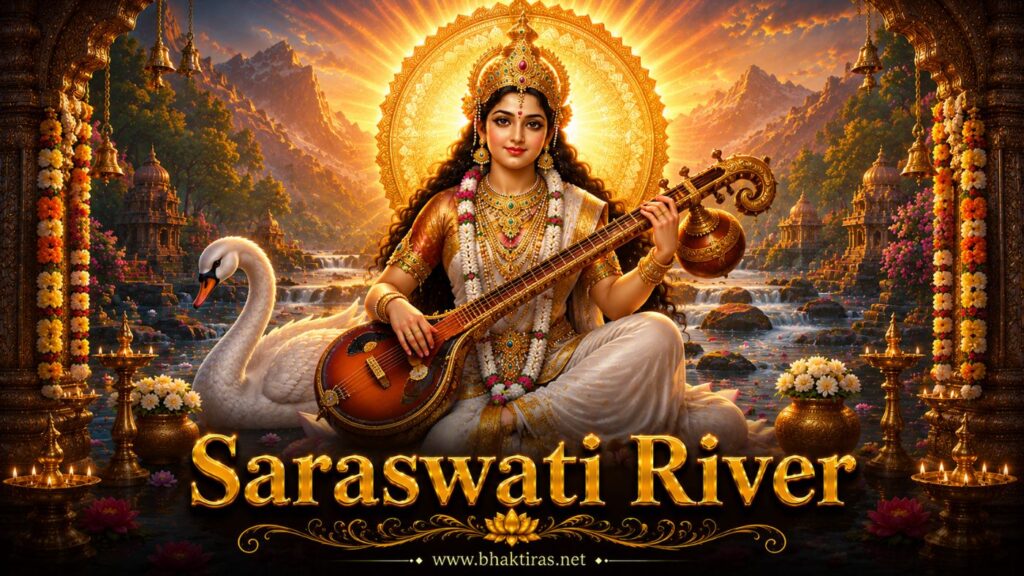
What Is the Saraswati River
Before she became an idea, the Saraswati was water – a wide, moving river in the north-west of the subcontinent, one of the great streams the Rigveda’s poets knew and loved. To the people who lived along her, she was not a symbol at all. She was the current that filled their fields, carried their words, and held their earliest prayers.A real river, first
The oldest layers of the Rigveda speak of the Saraswati as a mighty flow between the Yamuna and the Sutlej, part of the region the hymns call Sapta-Sindhu, the Land of Seven Rivers. Much of early Vedic life gathered on her banks, and a good deal of the hymn-making that became India’s oldest scripture was done within sound of her water.
A river that faded
Over long centuries the Saraswati is said to have weakened, shifted, and finally vanished from the surface. Tradition calls this the Vinasana, the disappearance. What had been a full river became a memory carried in verses, in place-names, and in the belief that she still flows unseen beneath the ground.
A river turned inward
As her waters withdrew, her meaning deepened. The physical river slowly became the river of wisdom, and the goddess who once meant flowing water came to mean flowing speech and knowledge. Her page here is about the river and her river-goddess; the knowledge-goddess she merged into has her own story.
The Best of Rivers in the Rigveda
No river in the Rigveda is praised more warmly than the Saraswati. She is called ambitame, naditame, devitame – the best of mothers, the best of rivers, the best of goddesses. Three superlatives in a single breath, and each one true to how her people felt about her.Mother, river, goddess
The hymns address her as a nourishing mother who gives food and children, as a river whose current is swift and generous, and as a goddess who hears prayer and grants wisdom. The poets do not separate these roles. The same water that watered the barley also carried the songs, and the same power that filled the channel was felt as a listening presence.
A river praised for her strength
The Rigveda calls her fierce and unbroken, a stream that cuts through the ground with the force of a swollen flood. She is described as fed from the mountains and rushing to the sea, wide and loud. This is the voice of people who watched a large, powerful river with their own eyes – not a distant legend, but the water they crossed and drank.
Civilisation on her banks
Settlements, sacrifices and schools of memory clustered along the Saraswati. She was a highway and a boundary, a source of grain and a place of ritual. When the sages sat to compose and recite, they sat within her world. Much of the earliest Sanskrit culture – its grammar of praise, its habit of thanking rivers as mothers – took shape in the country she watered. That is why later texts remember her not just as one river among seven, but as the heart of the whole region.
The Disappearance – the Hidden River
The most haunting fact about the Saraswati is that she did not simply shrink. She is said to have gone away – to have sunk into the sand and continued beneath the earth. Tradition marks the place of her sinking as the Vinasana, and treats her vanishing not as death but as a kind of withdrawal.The Vinasana
Later texts describe the Saraswati flowing out of the hills, running strong across the plains, and then losing herself in the desert sands at a spot called Vinasana – ‘the disappearing’. Beyond that point the surface river ends. The tradition insists she does not stop there; she simply travels hidden, an underground current still moving toward the sea and toward her meeting with the other rivers.
Loss without abandonment
The idea that she flows unseen changed grief into faith. If the Saraswati had merely dried up, she would have been mourned and forgotten. Instead, her people held that she was still present, only invisible – a river you could no longer see but could still worship. That belief is the seed of everything that follows, above all her role at Prayag.
The Invisible Stream at Prayag
At Prayag – the city now called Prayagraj – the Ganga and the Yamuna meet in plain sight, one pale, one dark, folding into a single stream. Tradition adds a third river to this meeting: the Saraswati, arriving unseen from below to join the two. This threefold union is the Triveni Sangam, the confluence of three rivers.The third river
Pilgrims who bathe at the Sangam bathe in three rivers at once, even though only two are visible. The Saraswati is believed to rise here from her hidden course and mingle her waters with the Ganga and Yamuna. Her invisibility is the whole point – she is the sacred stream you take on faith, the grace present without proof.
Why the confluence matters
The Sangam at Prayag is among the holiest bathing places in India, and the Saraswati is the reason it is called Triveni, ‘three braids’. Her presence lifts the meeting of two great rivers into a meeting of three, and the great gatherings held here draw their sanctity in part from her unseen arrival.
From River to Goddess of Wisdom
As the physical river faded, her meaning did not fade with her. Instead it turned inward and upward. The Saraswati of flowing water became, over time, the Saraswati of flowing knowledge – and the river-goddess and the goddess of learning grew together into one shining figure.Water becomes wisdom
The Vedic mind already felt the two as close. A river that carried life and speech was easily heard as a goddess who inspired thought and eloquence. As the river withdrew from the land, worshippers kept her alive by praising the part of her that could not dry up – her power to clear the mind, to loosen the tongue, to carry wisdom the way a current carries water.
One name, two rivers
By the time of the Puranas, the name Saraswati belonged as much to the goddess seated with veena and book as to the lost stream. The change was not a replacement but a merging. The knowledge-goddess is her own figure, with her own worship, her own festivals and her own story – but she carries the river’s name, and something of the river’s memory, within her.
Two pages, one river
It helps to keep the distinction clear. This page honours the sacred river and her river-goddess – the water praised in the Rigveda, the stream that vanished, the invisible third at Prayag. The goddess of speech, arts and learning who grew out of that river has a separate profile of her own. You can read about the knowledge-goddess at Goddess Saraswati. They share a name and a source, and the river flows quietly through both.
The Search for the Lost River
For as long as people have remembered the Saraswati, they have wondered where she went. The question sits at the meeting of faith, memory and the visible marks the land still carries.The Ghaggar-Hakra channels
Across present-day Haryana, Punjab and Rajasthan runs a system of mostly dry riverbeds known as the Ghaggar-Hakra. Their wide, ancient channels trace the path of a large river that once flowed where little water runs today. Many people connect these beds with the Saraswati of the hymns – a broad course that matches the direction and grandeur the Rigveda describes, now emptied of its old flood.
Faith and the land
How exactly the ancient river relates to those channels is a matter of long study and gentle debate. What the tradition holds is simpler and steadier: that the Saraswati was real, that she was great, and that her going was a true loss remembered ever since. Belief does not wait on a final map. Along her supposed course, small shrines and place-names still keep her name alive.
How the Saraswati Is Remembered
Though her waters are hidden, the Saraswati is remembered in living practice and in the sanctity of particular places. To honour her, worshippers turn to the sites and rites that keep her presence near.- Snan at the Triveni Sangam, Prayag: Bathing at the confluence of Ganga, Yamuna and the invisible Saraswati is the central way of touching her waters – the pilgrim receives all three rivers at once.
- Kurukshetra: The wide sacred field of Kurukshetra lies along her ancient course, and its tirthas and tanks preserve her memory in the land of the Mahabharata.
- Pushkar and the western tirthas: Old pilgrimage sites in Rajasthan and the west keep the Saraswati’s name in their lore, honouring the river once believed to have flowed nearby.
- The great gatherings at Prayag: The immense bathing assemblies held at the Sangam draw their holiness in part from her unseen arrival as the third river.
- Prayer to her river-goddess: Devotees invoke the Saraswati for purity, for a clear mind, and for the steady inner flow of wisdom she is believed to give.
- Remembering her in speech: Because she became the current of words, simply naming her with reverence – in study, in recitation, at the start of learning – is itself a way of keeping her alive.
Prayers & Mantras
The Saraswati is invoked with short, ancient prayers that ask for purity and for the clear flow of wisdom. The simplest and most beloved is a single line of salutation, easy to say and fit for the start of any study or day.The salutation mantra
Devanagari: ॐ सरस्वत्यै नमः
Transliteration: Om Saraswatyai Namah
Meaning: ‘Om, salutations to Saraswati.’ A brief bow to the river-goddess, offered for purity of heart and clarity of mind – a way of asking that her hidden current run through one’s own thought and speech.
Frequently Asked Questions about the Saraswati River
What is the Saraswati River?
The Saraswati is an ancient sacred river praised in the Rigveda as the best of mothers, rivers and goddesses. Early Vedic civilisation and much hymn-composition flourished on her banks. She is said to have later dried up and gone underground, and she is honoured as both a river and a river-goddess.
Where is the Saraswati River now?
The surface river has vanished. Tradition holds that she sank into the sand at a place called Vinasana and flows on hidden beneath the earth. Her memory survives in the dry Ghaggar-Hakra channels of north-west India and, above all, as the invisible third river at Prayag.
Is the river Saraswati the same as goddess Saraswati?
They share a name and a source but are treated as distinct. This page is about the sacred river and its river-goddess. Over time she merged with Saraswati, the goddess of knowledge, speech and the arts, who has her own separate worship and her own profile page here.
Why is the Saraswati called the invisible river at Prayag?
At Prayag the Ganga and Yamuna meet visibly, and tradition adds the Saraswati as a third stream arriving unseen from her hidden underground course. This threefold meeting is the Triveni Sangam, so pilgrims who bathe there are said to bathe in three rivers at once.
What does the Vinasana mean?
Vinasana means 'the disappearance' or 'the place of vanishing'. It names the spot where the Saraswati is said to have sunk into the desert sands and gone underground. The tradition treats this not as her death but as a withdrawal – she continues, only hidden from sight.
Why is the Saraswati praised so highly in the Rigveda?
Because she was central to the world of the hymns. Vedic life, ritual and the making of the earliest Sanskrit poetry gathered along her banks. The poets called her ambitame, naditame, devitame – best of mothers, rivers and goddesses – a river they trusted for food, purity and inspiration.
What is the Saraswati River worshipped for today?
She is honoured for purity, for the sanctity of the confluence at Prayag, and for the steady inner flow of wisdom she is believed to give. Bathing at the Triveni Sangam and invoking her river-goddess are the main ways devotees still turn to her.
The river you cannot see is honoured still – may her hidden current run clear and steady through your heart and your words.