
Santoshi Mata
संतोषी माता
Santoshi Mata is the gentle Hindu goddess of contentment and satisfaction, worshipped in countless ordinary homes. Traditionally the daughter of Lord Ganesha, she is honoured mainly through the Solah Shukravar Vrat, a fast kept on sixteen Fridays with offerings of jaggery and roasted gram. Devotees turn to her for domestic peace and the fulfilment of modest, heartfelt wishes.
Who Is Santoshi Mata?
Santoshi Mata is the goddess of santosh – contentment, the quiet satisfaction of having enough. She is not a distant cosmic power but a homely presence, the goddess millions of families keep close in a small framed picture near the kitchen or the prayer shelf. Her promise is gentle and human: peace at home, a little more ease, the fulfilment of a modest wish held close to the heart.
What sets her apart is her accessibility. There is no elaborate ritual required to reach her, no costly materials, no priest needed. A woman with a handful of jaggery and roasted gram, a clean corner, and a sincere heart can keep her Friday vow. This simplicity is exactly why so many ordinary households took her in.
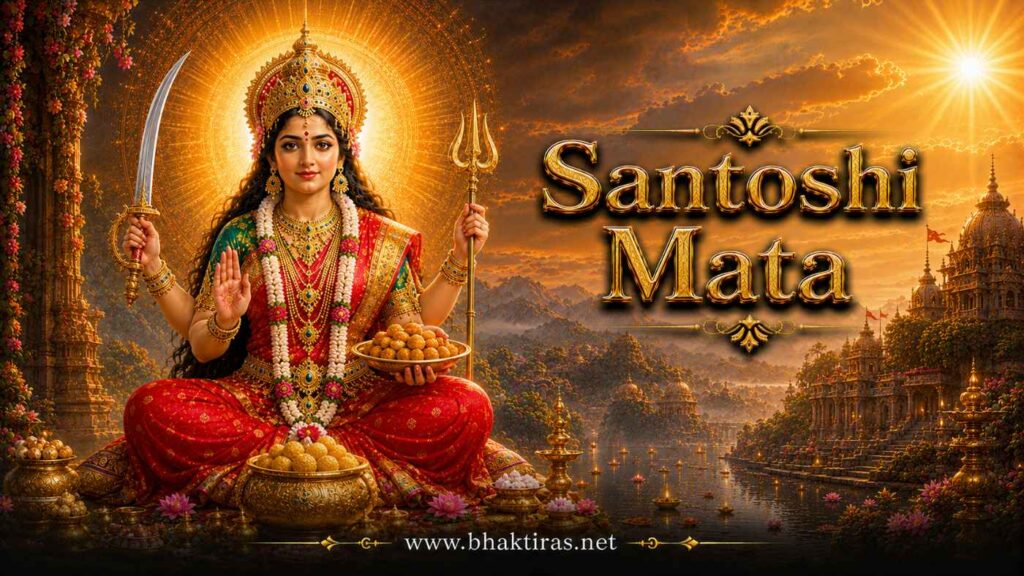
Her image is calm and youthful. She sits on a lotus, often shown with a trident in one hand and a sword or a bowl in the other, her face soft and reassuring. Where some deities inspire awe, Santoshi Mata inspires comfort. She is the goddess you turn to when you simply want your family to be well and your troubles to settle.
To understand her fully, it helps to know where she comes from and why her devotion spread the way it did.
The Daughter of Lord Ganesha
Tradition holds Santoshi Mata to be the daughter of Lord Ganesha, which makes her a granddaughter of Shiva and Parvati. The story most often told links her birth to a festival of Raksha Bandhan.
On that day, Ganesha’s sister came to tie the sacred thread on his wrist. Watching this bond of affection between brother and sister, Ganesha’s own two sons, Shubha and Labha (whose names mean the auspicious and the gain), asked their father for a sister of their own. Moved by their wish, Ganesha brought forth a daughter. She arose from the flames of his contentment and satisfaction, and so she was named Santoshi, the one born of santosh. Shubha and Labha at last had a sister to tie the thread on their wrists.
This lineage matters. As the child of Ganesha, the remover of obstacles, and grandchild of the great householder pair Shiva and Parvati, Santoshi Mata belongs firmly to the family sphere. She is a goddess of the home and its everyday hopes, and her origin story roots her in the warmth of family love rather than in battle or cosmic drama.
The Goddess of Contentment
The heart of Santoshi Mata’s worship is a single idea: santosh, contentment. In her devotion, contentment is not passive resignation. It is the grace to feel your needs met, to find peace with what you have while gently hoping for what you lack.
Devotees rarely approach her with grand demands. Her blessings are the size of real life – a quarrel in the family that finally cools, a son who finds steady work, a debt that eases, a marriage that grows kinder, a sick child who recovers. These are the modest wishes she is famous for granting, and there is dignity in that. She meets people where they actually live.
There is a quiet moral logic to her worship too. The one who keeps her fast is asked to avoid sourness, and this carries meaning beyond the plate. Contentment and a sour, complaining spirit cannot sit together. To seek her blessing is, in part, to soften one’s own temper and to make room for gratitude. In this sense Santoshi Mata does not only give peace; she teaches the disposition that receives it.
The Solah Shukravar Vrat
Santoshi Mata is worshipped chiefly through the Solah Shukravar Vrat, a fast kept on sixteen consecutive Fridays. It is a simple, structured vow that a devotee undertakes with a wish in mind, and its rules are easy to follow but meant to be kept faithfully.
- The vrat is observed on sixteen Fridays in a row, without breaking the sequence.
- On the morning of each Friday, the devotee bathes, cleans a small worship space, and lights a lamp before the image of Santoshi Mata.
- The chief offering is gur (jaggery) and roasted chana (gram), placed before the goddess and later shared as prasad.
- The Vrat Katha, the fasting story of Santoshi Mata, is read or heard during the worship.
- The devotee eats only once during the day and keeps to simple, plain food.
- Nothing sour (khatta) is eaten or given on the vrat day – no lemon, tamarind, curd or other sour foods, and the household is asked not to consume them either.
- When the wish is fulfilled or the sixteen Fridays are complete, the fast is closed with the Udyapan ceremony, in which a small number of boys are fed a meal of kheer and puri, and gur and chana are distributed.
The Udyapan is important: it marks the vow kept with thanks rather than left open. And the rule about sour food is followed carefully, since it is believed that any lapse can undo the blessing. The whole vrat is modest enough that almost anyone can keep it, which is a large part of why it took root in so many homes.
The Story of the Faithful Wife
The Vrat Katha of Santoshi Mata
The best loved story of Santoshi Mata is the Vrat Katha, told at every Friday worship. In it, a poor young wife is treated harshly in her husband’s home, given the heaviest chores and the least kindness, while her husband leaves in search of work and does not return for a long while.
Worn down but not broken, she learns of the Solah Shukravar Vrat and begins to keep it, offering the little gur and chana she can gather and reading the goddess’s story each Friday with a steady heart. Slowly her circumstances begin to turn. Word comes of her husband; he prospers in a distant place and at last starts for home.
Near the completion of her vow, jealous relatives try to trip her up, tempting her with sour food to break the fast and ruin the blessing. She keeps her discipline. When the sixteen Fridays are done she performs the Udyapan, feeding the young boys and sharing the prasad, and Santoshi Mata’s grace settles fully on her home. Her husband returns, the family is restored, and she is honoured at last.
The lesson of the katha is plain and heartening. Steady faith, patience under hardship, and a fast kept honestly to the end draw the goddess’s blessing. It is a story ordinary people recognise, which is why it has been repeated in millions of homes.
How Santoshi Mata Is Worshipped
Worship of Santoshi Mata is home-centred and unfussy. Most of it happens on Fridays in a corner of the house rather than in a grand temple, though shrines to her do exist. The heart of the practice looks like this:
- Keep a clean image or picture of Santoshi Mata in the worship space and light a lamp and incense before her.
- Offer a small quantity of gur (jaggery) and roasted chana (gram), her two signature offerings.
- Read or listen to the Santoshi Mata Vrat Katha, the fasting story, especially when keeping the Friday vow.
- Recite her mantra or simply speak your wish to her with a sincere and calm heart.
- Strictly avoid sour food on the vrat day, keeping the whole household to the same rule.
- Sing her aarti at the close of the worship and distribute the gur and chana as prasad.
- Complete the sixteen-Friday vow with the Udyapan, feeding a few young boys and sharing the blessed food.
The tone throughout is gentle and grateful. There is no bargaining, only a quiet asking and a steady keeping of the promise made.
Her Rise in Popular Devotion
Santoshi Mata’s worship is a relatively modern devotion, and it is a genuine and widely loved one. While her origins lie in older folk and household tradition, her name became known across the whole of India in the 1970s.
The turning point was the 1975 Hindi film Jai Santoshi Maa. Made on a small budget and without famous stars, it told the story of a devoted wife and the goddess who blesses her faith. To almost everyone’s surprise it became one of the most watched films of its year. Audiences did not simply watch it; they treated the cinema hall as a place of worship, removing their shoes, offering coins to the screen, and returning again and again.
The film carried Santoshi Mata’s name and her Friday vrat into homes far beyond her earlier regional following. Women in particular took up the Solah Shukravar Vrat in large numbers, and her image spread through calendars, prints and small shrines. What began as a modest household devotion grew, in a single decade, into a movement kept by millions. It is a rare and striking example of living faith taking shape within living memory, and it deserves to be honoured on its own terms as a true and heartfelt tradition.
Prayers and Mantras
Devotees call on Santoshi Mata with simple prayers, often just speaking their wish to her, and with her traditional mantra. The core mantra names her lineage as the daughter of Ganesha and calls her the great Maya, the gentle power behind all fulfilment.
Devanagari: ॐ श्री संतोषी महामाया गजानन्दस्य पुत्रिका
Transliteration: Om Shri Santoshi Mahamaya Gajanandasya Putrika
Meaning: Om, I bow to the revered Santoshi, the great Maya, the daughter of the joyful one, Ganesha. It is a prayer that honours her origin and asks her calming grace upon the home.
Repeated softly on a Friday, before her lamp and her offering of gur and chana, the mantra is less a demand than a settling of the heart in her presence.
Frequently Asked Questions about Santoshi Mata
Who is Santoshi Mata?
Santoshi Mata is the Hindu goddess of contentment and satisfaction, worshipped mainly in ordinary households. Traditionally the daughter of Lord Ganesha, she grants domestic peace and the fulfilment of modest wishes. She is honoured chiefly through the Solah Shukravar Vrat, a fast kept on sixteen Fridays with offerings of jaggery and roasted gram.
How do you do the Santoshi Mata Friday vrat?
Keep the fast on sixteen consecutive Fridays. Each Friday, bathe, clean a small worship space, light a lamp before her image, offer gur and roasted chana, and read her Vrat Katha. Eat once during the day, avoid all sour food, and complete the vow with the Udyapan ceremony feeding young boys.
Why must you avoid sour food during her vrat?
Avoiding sour food is the strictest rule of her fast. On a symbolic level, sourness represents a bitter, complaining spirit that cannot sit beside contentment. On the devotional level, it is believed that eating anything sour on the vrat day, or giving it to others in the home, can undo the goddess's blessing, so the whole household keeps the rule.
Who are the parents of Santoshi Mata?
Tradition names Lord Ganesha as her father, which makes her a granddaughter of Shiva and Parvati. In the popular story she was born of Ganesha's own contentment when his sons Shubha and Labha asked him for a sister. She is thus regarded as a goddess of the family, rooted in household love.
What do you offer to Santoshi Mata?
Her two signature offerings are gur (jaggery) and roasted chana (gram), simple foods that almost any home can provide. These are placed before her image during Friday worship and later shared as prasad. The offering deliberately stays humble, in keeping with her nature as a goddess of ordinary, contented households.
What is the significance of the 1975 film Jai Santoshi Maa?
The film Jai Santoshi Maa carried Santoshi Mata's devotion across all of India. Though modest in budget, it drew huge audiences who treated screenings almost like worship. After its release, the Solah Shukravar Vrat spread rapidly, especially among women, turning a regional household devotion into a movement kept by millions.
What is the Udyapan of the Santoshi Mata vrat?
The Udyapan is the closing ceremony of the sixteen-Friday vow, performed once the fast is complete or the wish fulfilled. In it, a small number of young boys are fed a meal, often kheer and puri, and gur and chana are distributed. It marks the vow kept with gratitude rather than left open.
Whatever small wish you hold, may Santoshi Mata bless your home with peace, plenty enough, and a heart at rest.