
Mangal Dev
मंगल
Mangal Dev, also called Mangala or Angaraka, is the planet Mars among the nine Navagraha. He governs energy, courage, strength, land and property, and siblings. Born of the Earth goddess Bhumi, he is worshipped on Tuesdays with red offerings, and Hanuman is his linked protector deity.
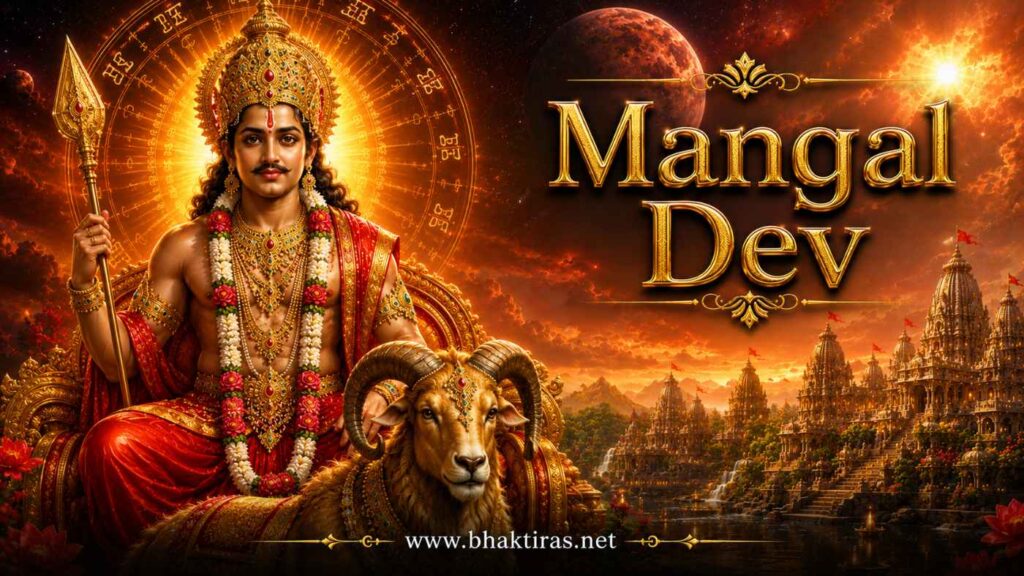
Who Is Mangal Dev?
Mangal Dev is the deity of the planet Mars, one of the nine Navagraha that Hindu tradition honours as living cosmic forces rather than distant rocks in the sky. His name, मंगल, carries the sense of the auspicious and the well-wishing, though the planet he rules is fierce, hot and full of drive. Astrologers know him by many names – Kuja (the crooked one, for his looping path), Angaraka (the burning ember), Bhauma (child of the Earth) and Lohitanga (the red-limbed one).
In images and temple murtis he appears with a deep red body, four arms, and a calm yet commanding face. He carries a trishula, a gada and a spear, and rides a ram, the animal whose butting strength mirrors his own nature. Some depictions place him instead on a chariot drawn by fiery steeds. Red is his colour through and through: red flowers, red cloth, red sandal paste and red coral all belong to his worship.
What makes Mangala special among the planets is his link to the ground beneath our feet. He is the son of Bhumi, the Earth herself, which is why matters of land, property, real estate and physical labour fall under his care. Alongside these he rules energy, courage, competition, athletic strength, and the bond between brothers and sisters.
Devotees turn to Mangal Dev when they need resolve, protection from conflict, or steadiness in questions of property and family. His worship is woven into the weekly rhythm of Hindu life through Tuesday (Mangalvar), the day set aside for him and for his close ally Hanuman.
The Red Planet – Energy, Courage & Strength
Long before telescopes revealed the rust-red dust of Mars, the sages of India had already read the planet’s ruddy glow and named it for fire and blood. Mangala is the karaka, or natural significator, of raw energy. Where the Sun gives life and the Moon gives feeling, Mars gives the push to act – the will to begin, to compete, and to see a task through against resistance.
His domain covers physical vitality, muscular strength and stamina, which is why athletes, soldiers, surgeons and anyone in demanding physical work are said to draw on his influence. He also governs courage in the face of danger and the capacity to defend what is yours. In older texts he is called the commander-in-chief among the planets, the one who marshals discipline and drive.
Yet the same heat that fuels courage can spill into anger, haste and quarrel when it runs unchecked. This is the honest teaching around Mangala: his energy is a tool, and like any strong tool it serves best in steady hands. Worship of Mangal Dev is understood not as pleading for favours but as learning to hold his fire well – to be brave without being reckless, firm without being harsh.
Birth & Iconography
The look of Mangal Dev is unmistakable, and each element carries a meaning drawn from the Puranas and from astrological lore. The cards below unpack the parts of his familiar form.
Red Body
His deep red or coral-coloured skin marks him as the planet of fire and blood, the source of his epithet Lohitanga, ‘the red-limbed one’. Worshippers echo this with red flowers, cloth and sandal paste.
Four Arms
Mangala is usually shown with four arms, a sign of divine capability. The hands hold his weapons and gestures of blessing, showing that his strength is meant to protect as well as to fight.
Ram Mount
His vahana is a ram, an animal of headlong strength and butting courage. The choice fits a deity of drive and confrontation; some images replace it with a chariot pulled by fiery horses.
Trishula
The trident he carries links him to Shiva’s fierce, transformative power and marks his authority over conflict. It stands for the piercing focus needed to cut through obstacles.
Gada
The heavy mace is a weapon of sheer force and steadfastness. In his hand it represents the crushing strength Mars grants and the protection he offers to the devoted.
Spear
The spear points to precision in battle and to swift, decisive action. Together his three weapons picture a deity ready to defend, to strike true, and to guard land and kin.
Mangala Among the Navagraha
Within the family of nine planets, Mangala holds a clear and important place. He is the natural ruler of two zodiac signs – Aries (Mesha), a fire sign of initiative and leadership, and Scorpio (Vrischika), a water sign of depth, intensity and hidden strength. He reaches his highest expression, or exaltation, in Capricorn (Makara), where his drive gains structure and staying power.
In a birth chart, astrologers read Mars for a person’s energy levels, temper, drive to achieve, physical health and injuries, and courage under pressure. Because he is the son of the Earth, he also signifies land, buildings, property dealings and immovable wealth. His connection to siblings, especially younger brothers, is another well-known theme, as is his role in matters of marriage and physical partnership.
A strong, well-placed Mars is said to give confidence, athletic vigour, leadership and the grit to build something lasting. A troubled Mars may show up as impatience, conflict or accidents, which is where remedies and steady worship come in. It is worth remembering that all of this is a matter of faith and tradition, offered as guidance and reassurance, not as fixed prophecy.
Understanding Mangal Dosha / Manglik
Few astrological terms are searched more anxiously than Mangal Dosha, also called being Manglik or Kuja Dosha. It deserves a calm, clear explanation rather than fear. In simple terms, a person is called Manglik when Mars sits in certain houses of their birth chart – traditionally the 1st, 4th, 7th, 8th or 12th. The old belief is that this placement can add friction to married life if two charts are poorly matched.
Here is the important part: being Manglik is common, and it is not a curse or a flaw in a person. Many happily married people are Manglik. Classical astrology itself lists numerous conditions that reduce or cancel the effect entirely – when both partners are Manglik, when Mars is in its own or friendly sign, or when other planets balance the chart. In much of India, the usual counsel is simple matching and a few devotional remedies, not alarm.
Common remedies are gentle and constructive: worshipping Hanuman on Tuesdays, reciting the Hanuman Chalisa, observing a Tuesday fast, offering red items and doing charity, or, in some traditions, wearing a red coral after proper guidance. These practices are meant to build patience and goodwill within a marriage. If Mangal Dosha ever weighs on your mind, treat it as one small thread in a much larger life – a matter of faith to be met with prayer and understanding, never with dread.
How Mangal Dev Is Worshipped
Worship of Mangal Dev centres on Tuesday (Mangalvar), his weekly day, and leans heavily on the colour red. The practices below are simple, home-friendly and rooted in long tradition.
- Keeping a Tuesday vrat (fast), often taken until sunset, dedicated to Mangala and to Hanuman together.
- Offering red flowers, red sandal paste, red cloth and masoor (red lentils) at his image or at a Hanuman shrine.
- Reciting the Hanuman Chalisa and Hanuman-related prayers, since Hanuman is Mangala’s beloved protector deity.
- Chanting the Mangal beej mantra ‘Om Am Angarakaya Namah’ or the Navagraha stotra verse for Mars.
- Wearing a red coral (Moonga) in gold or copper, only after guidance from a trusted astrologer.
- Giving in charity items linked to Mars – red cloth, jaggery, copper, masoor dal or wheat – to those in need on Tuesdays.
Temples & Sacred Sites
A handful of temples across India are devoted specially to Mangal Dev, and pilgrims visit them for Tuesday worship and for relief from Mars-related concerns.
- Mangalnath Temple, Ujjain – the most famous shrine to Mars, on the bank of the Shipra river and traditionally regarded as the very birthplace of Mangala. Devotees perform Bhat Puja here for Mangal Dosha.
- Vaitheeswaran Koil, Tamil Nadu – a celebrated Navagraha temple where Angaraka (Mars) is worshipped, drawing those seeking health and relief from planetary afflictions.
- Amreshwar (Amleshwar) Mahadev, near Ujjain – a Shiva shrine long associated with Mangala worship in the region, visited alongside Mangalnath.
- Navagraha temples across South India, where a dedicated shrine to Mangala takes its place among all nine planetary deities.
A Story from the Scriptures
Two well-loved accounts describe how Mangala came into being, and both tie him to the Earth and to Shiva.
Born of the Earth
In one Puranic tradition, Mangala is the child of Bhumi Devi, the goddess Earth herself. This is why he carries the name Bhauma, ‘son of the Earth’, and why the planet governs land, soil, property and immovable wealth. The red of Mars is read as the red of the fertile, iron-rich earth, and his fierce strength as the solid, enduring power of the ground on which everything is built. Honouring Mangala, in this view, is also a way of honouring the Earth that sustains us.
A Drop of Shiva's Sweat
Another beloved story tells that Mangala was born from a single drop of Shiva’s sweat that fell to the Earth during his deep meditation or fierce exertion. The Earth received the glowing drop and nurtured it into a radiant red child. This account explains Mangala’s blazing energy and his link to Shiva’s trident, and it beautifully binds together the two parents of the planet – the ascetic fire of Shiva above and the receiving, nurturing Earth below.
Prayers & Mantras
Chanting the mantras of Mangal Dev on a Tuesday, with a steady mind and a red offering, is the simplest and most common form of his worship. The primary beej mantra is ॐ अं अंगारकाय नमः – Om Am Angarakaya Namah – a bow to Angaraka, the burning ember. It is traditionally repeated in cycles of 108 using a coral or rudraksha mala. The Navagraha stotra also carries a dedicated verse for Mangala, धरणीगर्भसम्भूतं (Dharani-garbha-sambhutam), which praises him as the one born from the womb of the Earth, radiant as lightning, holding a spear in his hand. Reciting these with sincerity, alongside the Hanuman Chalisa, is the heart of Tuesday devotion to Mars.
Frequently Asked Questions about Mangal Dev
Who is Mangal Dev?
Mangal Dev is the Hindu deity of the planet Mars, one of the nine Navagraha. Also called Mangala, Angaraka, Kuja and Bhauma, he governs energy, courage, strength, land and property, and siblings. He is depicted with a red body riding a ram, and is worshipped chiefly on Tuesdays.
Why is Tuesday the day for Mangal Dev?
Tuesday, or Mangalvar, is named directly after Mangala and is set aside for his worship. The day is also sacred to Hanuman, who is closely linked to Mars as a protector deity. Devotees fast, offer red items, recite the Hanuman Chalisa, and chant the Mangal mantra on this day.
What is Mangal Dosha or being Manglik?
Mangal Dosha, or being Manglik, means Mars sits in certain houses of a birth chart (traditionally the 1st, 4th, 7th, 8th or 12th). Tradition suggests it may add friction to marriage if charts are poorly matched. It is common, not a flaw, and many classical conditions cancel it. It is a matter of faith, best met with calm and simple remedies.
What are the common remedies for Mangal Dosha?
Gentle, constructive remedies are advised: worshipping Hanuman on Tuesdays, reciting the Hanuman Chalisa, observing a Tuesday fast, offering red items, giving charity, and sometimes wearing red coral after proper guidance. These are meant to build patience and goodwill, not to cause worry. If two Mangliks marry, the effect is traditionally considered balanced.
Which zodiac signs does Mangala rule?
Mangala rules two signs of the zodiac – Aries (Mesha), a fire sign of initiative, and Scorpio (Vrischika), a water sign of depth and intensity. He reaches his exaltation in Capricorn (Makara), where his energy gains structure and endurance.
What gemstone is linked to Mangal Dev?
Red Coral, called Moonga in Hindi, is the gemstone of Mars. It is traditionally worn in gold or copper to strengthen a weak or afflicted Mars in the birth chart. As with all gemstones, it should only be worn after guidance from a trusted astrologer, and always as a matter of personal faith.
Where is the most famous temple of Mangal Dev?
The Mangalnath Temple in Ujjain, on the bank of the Shipra river, is the best-known shrine to Mars and is traditionally believed to be his birthplace. Devotees visit especially on Tuesdays and perform Bhat Puja there for relief from Mangal Dosha. Vaitheeswaran Koil in Tamil Nadu is another important site.
How are Hanuman and Kartikeya connected to Mangala?
Both Hanuman and Kartikeya (Murugan) are considered protector deities linked to Mars, and worshipping them is a widely recommended remedy for a troubled Mangala. Hanuman shares the Tuesday day of worship, and his qualities of strength, courage and steadiness reflect the best of what Mangala represents.
What does the name Angaraka mean?
Angaraka means 'burning ember' or 'live coal', a name that captures the fiery, red glow of Mars. It is one of Mangala's most common titles and appears in his primary mantra, 'Om Am Angarakaya Namah'. Other epithets include Kuja (the crooked one), Bhauma (son of the Earth) and Lohitanga (the red-limbed one).
May Mangal Dev grant you steady courage, calm strength, and the resolve to build a good life on firm ground.