
Lord Vishwakarma
विश्वकर्मा
Lord Vishwakarma is the divine architect and engineer of the gods in Hinduism. He designed the palaces and cities of the deities, forged their weapons, and is honoured as the patron of every person who builds, crafts, and works with their hands. Craftsmen and factories worship him each September on Vishwakarma Puja.
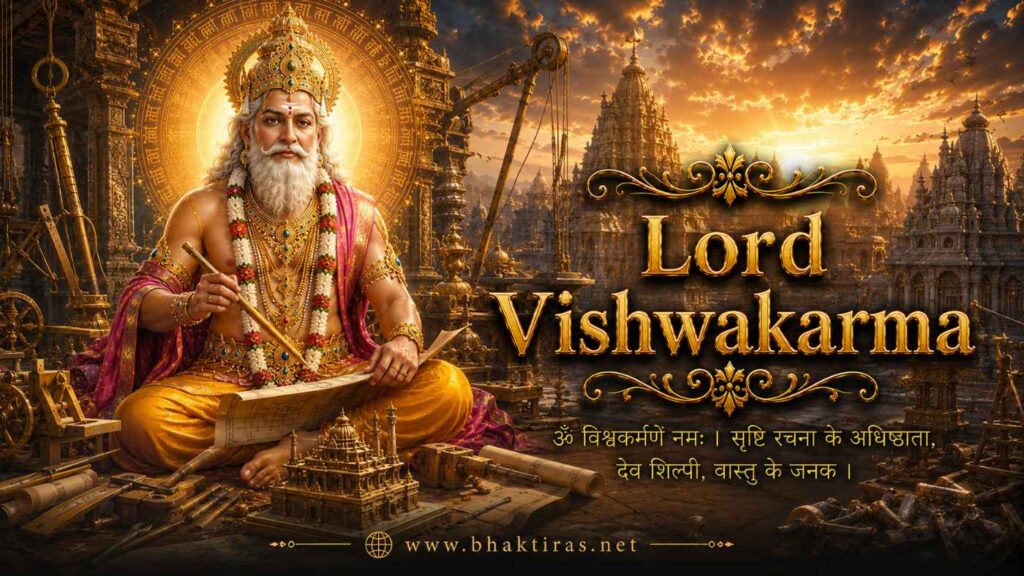
Who Is Lord Vishwakarma
Lord Vishwakarma is the god of making. When the deities needed a palace, a chariot, a throne, or a weapon that could turn the tide of a cosmic war, they went to him. His name means the maker of all, and the old texts credit him with shaping the very tools and structures that hold the divine world together. He is the mind behind the design and the hand behind the craft.
In the Rig Veda he appears as a creator figure, the one who fashions and orders the universe with skill and thought. Later texts often speak of him under the name Tvashta, the celestial smith, and the two figures blend together over time into the Vishwakarma we know today – Devashilpi, the artisan of the gods.
What makes Vishwakarma different from many other deities is how grounded he is in ordinary human effort. He is not distant. A carpenter measuring a plank, a mechanic tuning an engine, an engineer drawing a bridge – each is doing, in a small way, what he does at a cosmic scale. That is why he became the deity of working people rather than of kings or priests alone.
He is usually shown with four faces and four arms, holding the instruments of his trade, calm and watchful, a craftsman studying his work before he begins.
The Architect of the Gods – His Great Creations
The scriptures fill Vishwakarma’s portfolio with wonders. He is the builder behind some of the most famous places in Hindu myth and epic, cities and halls raised at the request of gods and heroes.
Hastinapura too is tied to his craft in the tradition. Across these stories one idea repeats – when something needed to be truly well made, the gods called Vishwakarma.
Maker of the Divine Weapons
Vishwakarma was not only an architect. He was the armourer of heaven, the one who forged the weapons that the great gods carry into battle against the forces of chaos.
He is credited with the Sudarshana Chakra, Vishnu’s spinning discus, and with the Trishula, the trident of Shiva. The most striking story belongs to the Vajra, the thunderbolt of Indra. When the gods needed a weapon strong enough to defeat the demon Vritra, the sage Dadhichi offered his own bones so that a weapon could be made from them. Vishwakarma shaped those bones into the Vajra, an instrument born from the highest sacrifice.
A related tradition tells how Vishwakarma took the god Surya, whose radiance was too fierce to bear, and trimmed away part of that blazing brilliance on his lathe. From the shavings of the sun’s own light he is said to have fashioned Vishnu’s discus, Shiva’s trident, and other divine arms. In every version the message is the same – the weapons that protect the cosmos passed through his workshop first.
Iconography & Symbols
Images of Vishwakarma carry the marks of his trade. Each symbol says something about who he is.
Vishwakarma Puja – the Festival of Craftsmen
Once a year the workshops of India turn into temples. Vishwakarma Puja falls on 17 September, on Kanya Sankranti, when the sun moves into Virgo – one of the few Hindu festivals fixed by the solar calendar, which is why the date rarely shifts.
On this day factories, garages, printing presses, foundries, and small artisan shops pause their work. Machines are cleaned and decorated. Workers set down their tools and then honour them – lathes, drills, sewing machines, tractors, autos, and computers all receive flowers, tilak, and prayers. It is a striking sight: the same equipment that runs all year is, for one morning, garlanded and worshipped.
An image or photograph of Vishwakarma is set up, prayers are offered for skill and safety in the year ahead, and prasad is shared among the workforce. In West Bengal, Odisha, Bihar, Jharkhand, and across industrial India the festival is especially vivid, with kite-flying in some regions adding to the celebration. At its heart the puja is a thank-you – to the god of making, and to the tools that let people earn an honest living.
How Lord Vishwakarma Is Worshipped
Worship of Vishwakarma is practical and heartfelt, centred on the work people actually do. A typical observance includes these steps.
Beyond the festival, many artisans keep a small image of the god at their workbench and offer a quiet prayer before beginning a difficult or important job.
The Vishwakarma Community & Dignity of Work
Vishwakarma is more than a festival deity. He is the ancestor-figure of the Vishwakarma community, also called Panchal, a group of traditional artisans that includes carpenters, blacksmiths, goldsmiths, sculptors, and metalworkers. For them he is not only a god to worship but a lineage to belong to, and their craft is understood as a sacred inheritance passed from hand to hand.
This is where his deeper meaning lives. In a world that often ranks thinkers above makers, Vishwakarma quietly insists that building is holy work. The person who shapes wood, hammers iron, or wires a circuit is doing something the gods themselves valued enough to have their own patron for. Skill, care, and the patience to make a thing well are treated as forms of devotion.
That spirit reaches far past any single community today. Engineers signing off a design, mechanics under a bonnet, tailors at a machine, coders at a keyboard – all can find a place in his story. Vishwakarma turns ordinary labour into something worthy of respect, and reminds working people that their hands carry a bit of the divine.
A Story from the Scriptures
Two well-loved traditions show Vishwakarma’s genius and his limits.
Prayers & Mantras
Devotees invoke Vishwakarma with simple, sincere mantras, especially on his puja day and before starting new work. The most common is the mool mantra, short enough to be repeated at the workbench.
Frequently Asked Questions about Lord Vishwakarma
May Lord Vishwakarma bless every hand that builds and every mind that makes – and may your work always be done with skill, care, and joy.