
Lord Varuna
वरुण
Varuna is one of the oldest Vedic gods, first honoured as the sovereign keeper of Rta – the moral and cosmic order. All-seeing and watchful through his spies, he punished falsehood with his noose. In later Hindu tradition he became the god of water, oceans and rivers, and the guardian of the West.
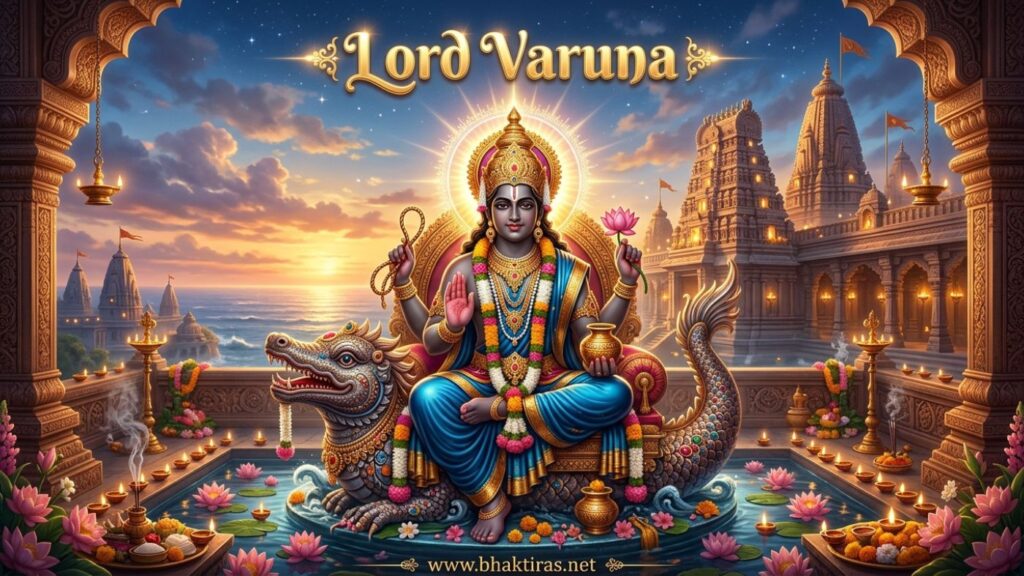
Who Is Lord Varuna
Few gods in the Hindu tradition have travelled such a long road as Varuna. In the earliest layers of the Rigveda, he is a towering figure – a king among the gods, seated above the sky, watching every deed done on earth. The Sanskrit name Varuna is often linked to the root meaning to cover or to envelop, fitting for a god whose gaze wrapped around the whole world and whose noose could bind any wrongdoer.
He belongs to the Adityas, the shining sons of the goddess Aditi, and in the oldest hymns he is far more than a nature-spirit. Varuna is the guardian of Rta – the deep rhythm that keeps the sun on its path, the seasons in their turn, and truth in its place. Nothing escaped him. The rivers ran, the stars rose, and men spoke honestly, all because Varuna kept watch.
Over the centuries his role narrowed. As younger gods like Indra and later Vishnu and Shiva rose to the centre of worship, Varuna settled into a more specific office: lord of the waters. The oceans, the rivers, the rain-clouds and the springs all came under his care. Sailors and fishing families prayed to him before setting out, and farmers called on him when the fields went dry.
Yet the memory of his old greatness never fully faded. Even as a water-god, Varuna kept his ancient dignity as a judge of truth and a punisher of falsehood, and he remained one of the eight Dikpalas – the divine guardians of the directions – holding the western quarter of the world.
Keeper of Rta – the Cosmic Order
To understand the early Varuna, you have to understand Rta. It is one of the great ideas of the Rigveda: the underlying order that holds the universe together – physical, moral and ritual all at once. Rivers flow to the sea by Rta. The sun rises by Rta. A promise kept, a word of truth spoken, a rite performed correctly – these too are Rta. And the god who upheld this order, who saw that it was not broken, was Varuna.
The hymns picture him as all-seeing. He was said to send out his messengers, sometimes called his spies, who moved through the world and reported back every action of every person. A man could hide nothing from Varuna – not a lie told in the dark, not a debt left unpaid, not a vow broken in secret. Because of this, he was both loved and feared: a father who forgives the repentant, but also a stern king who binds the guilty with his pasha, the noose.
Sickness, especially dropsy and other diseases linked to water, was sometimes seen as Varuna’s punishment for sin, and there are moving hymns in which a worshipper begs the god to loosen his bonds and forgive. This blend of tenderness and severity gives the early Varuna a moral depth that few Vedic gods share.
He rarely stood alone. Varuna was most often invoked together with Mitra, forming the pair Mitra-Varuna. Where Varuna watched over the vast, awe-inspiring side of law and the night sky, Mitra governed the friendly bonds of contracts, agreements and the light of day. Together they were the twin guardians of truth and covenant – two faces of the same cosmic justice.
Iconography & Symbols
In later art and temple sculpture, Varuna takes on a settled form as the calm, kingly god of the waters. A few emblems mark him out wherever he appears.
Makara Mount
Varuna rides the Makara, a mythical sea-creature usually shown as a crocodile with the tail of a fish. It carries him through the depths of the ocean and later lent its shape to the Makara arch (torana) seen over many temple doorways.
The Pasha (Noose)
His chief weapon is the pasha, a coiled rope or noose. Once used to bind those who broke the cosmic law, it stays with him as the ocean-lord – a reminder that even the god of water is a keeper of order.
White Complexion
Varuna is usually described as fair or white in colour, seated on his Makara. The pale, luminous hue evokes water, foam and the moonlit sea, matching his gentle yet vast character.
Umbrella & Water Pot
He often holds a royal umbrella (chhatra), a mark of his old sovereignty, and a vessel of water. Some depictions add a conch or a lotus, tying him to the ocean and to purity.
From Sky-Sovereign to Ocean-Lord
The change in Varuna’s rank is one of the most studied shifts in Hindu mythology. In the oldest hymns he is a god of the heavens – a celestial emperor whose seat is above the sky, from where he oversees the whole moral universe. His waters, in that early vision, were as much the cosmic waters of the upper firmament as any earthly sea.
As the Vedic age gave way to the epics and the Puranas, the spotlight moved. Indra rose as the warrior-king of the gods, and later the great devotional currents around Vishnu and Shiva reshaped worship entirely. In this new order Varuna was honoured but no longer supreme. His authority contracted from the whole cosmos down to a single, though still immense, element: water.
By the time of the Puranas, Varuna is firmly the Jal Devta – lord of oceans, rivers, lakes and rain. He is counted among the Lokapalas who guard the directions, and his palace Sukha is said to lie beneath the sea, filled with all the treasures the waters hold. It is a smaller kingdom than he once ruled, yet a rich and beautiful one, and his old character as a truthful, law-keeping sovereign travels with him into it.
Guardian of the West
Among his surviving honours, Varuna holds a permanent place as one of the eight Dikpalas (also called Lokapalas) – the divine guardians who watch over the directions of space. Varuna is the keeper of the West, the quarter where the sun sets into the waters.
This assignment fits him perfectly. In Indian thought the west is linked with the ocean and with endings that lead to renewal, just as the setting sun sinks into the sea only to rise again. In temple architecture and in ritual mandalas, the western side is often marked with Varuna’s presence, his Makara and his noose showing that this direction is under the ocean-lord’s protection.
When a temple or a home is consecrated, the Dikpalas are invoked to guard every side, and Varuna is called to stand watch over the west – a quiet continuation of his ancient duty of keeping order, now measured out in the geometry of sacred space.
How Lord Varuna Is Worshipped
Varuna is rarely the focus of large public festivals today, yet his worship survives in living, practical forms – wherever people depend on water and rain. His rituals are simple, heartfelt and tied to real need.
- Varuna Yajna / Jal Puja for rain – When the monsoon fails or a region faces drought, priests and villagers perform a Varuna Yajna, offering prayers and oblations to call down rain. Related Parjanya rites invoke the rain-cloud alongside Varuna, asking the waters to return to the fields.
- Offerings by coastal and fishing communities – Along India’s long coastline, fishing families honour Varuna before the boats go out and during sea festivals, offering coconuts, flowers and prayers for a safe voyage and a good catch. To them he is the living lord of the sea whose mood decides their fortune.
- Water reverence in ritual – Varuna is present whenever water is sanctified. He is invoked in the achamana and in the reverence shown to rivers and the sea, and the same spirit of gratitude to the water-giving divine runs through water-facing observances such as the Chhath offerings made to the sun standing in a river.
In each of these, the mood is the same: a quiet acknowledgement that water is life, and that the god who governs it is owed both thanks and respect.
A Story from the Scriptures
The Noose That Binds the Untruthful
The most enduring image of Varuna is of a god holding a noose ready for the wrongdoer. In the Vedic hymns, worshippers who felt weighed down by sin or sickness pictured themselves caught in Varuna’s bonds – the pasha tightening because a vow had been broken or a lie told. Their prayer was not for escape through cleverness but for forgiveness: they confessed their fault and begged Varuna to loosen the cords. In one much-loved passage a devotee pleads that if he has wronged the god through thoughtlessness, drink or anger, Varuna should not strike him down but set him free. The story of the noose is really a story about conscience – a reminder that truth was sacred, and that the god of order both saw everything and could forgive.
King Harishchandra's Vow to Varuna
A famous tale tells of King Harishchandra, who had no son and prayed to Varuna for one. Varuna granted the wish on the condition that the boy be offered back to him in sacrifice. When the son, Rohita, was born, the king kept delaying the promised offering out of a father’s love, always finding a new reason to wait. Displeased, Varuna afflicted the king with illness, and a long and difficult chain of events followed before the debt was finally resolved. The story became a byword for the seriousness of a vow made to Varuna – the god who never forgets a promise, and who expects truth to be honoured even when it is hard.
Prayers & Mantras
Devotees invoke Varuna with short, ancient mantras, often at the water’s edge, before a voyage, or when praying for rain. The simplest and most widely used is the bija salutation to his name.
Frequently Asked Questions about Lord Varuna
Who is Lord Varuna?
Varuna is the Vedic god of water, oceans and rivers, and once the supreme keeper of Rta – the cosmic and moral order. He rides the makara, a sea-creature, carries the pasha or noose, and guards the western direction. Sailors, fishermen and farmers still invoke him for safe waters and timely rain.
What is Lord Varuna the god of?
Varuna governs all waters – the oceans, rivers, rain and the hidden depths – and, in the oldest hymns, the cosmic law that keeps the sun, stars and seasons in order. He is the divine witness who sees every truth and lie, binding wrongdoers with his noose and freeing the honest who pray to him.
Why is Varuna called the keeper of Rta?
In the Rigveda, Varuna upholds Rta, the underlying order that governs both nature and morality. He watches over vows, punishes falsehood and disease, and releases those who repent. Paired with Mitra, he represents the awesome, all-seeing side of divine authority that keeps the universe and human conduct in balance.
Which direction does Lord Varuna guard?
Varuna is the Dikpala, or guardian, of the West. In temple layouts, rituals and vastu, the western quarter is placed under his protection. As lord of water he is naturally linked to the setting sun sinking into the western ocean, and offerings for rain and safe voyages turn toward his direction.
How is Lord Varuna worshipped?
Varuna is invoked chiefly for rain and for safety on water. Farmers facing drought perform the Varuna Yajna or Japa, offering water and prayers by rivers and tanks. Fishing and seafaring communities honour him before voyages, and any ritual bath or water-offering (arghya) quietly acknowledges him as the lord of all waters.
What are Varuna's weapon and vehicle?
Varuna carries the pasha, a noose with which he binds those who break truth or law, and is often shown with an umbrella or water pot. His vahana is the makara, a mythical crocodile-like sea-creature that also serves as his emblem, marking him as sovereign of the deep and flowing waters.
What is the Varuna mantra?
The simple mantra is 'Om Varunaya Namah', a bow to the lord of waters. Vedic worship also uses hymns from the Rigveda addressed to Varuna and the pair Mitra-Varuna. The mantra is chanted during rain prayers, water rituals and before journeys across seas and rivers, seeking his protection and grace.
May Lord Varuna keep your path clear and your heart honest, and may his waters bring rain to the fields and calm to the sea.