
Ketu Dev
केतु
Ketu Dev is one of the nine Navagraha, a shadow planet marking the descending or south lunar node. He is the headless body of the asura Svarbhanu, twin to Rahu. In astrology he rules detachment, spirituality, intuition, past-life gifts and moksha, guiding the soul toward liberation and letting go.
Who Is Ketu Dev?
Ketu Dev is the ninth and quietest of the Navagraha, the nine celestial forces of Hindu thought. Unlike the Sun or Mars, he is not a glowing sphere you can point to in the night sky. He is a Chhaya Graha, a shadow planet – a precise point where the Moon’s path crosses the Sun’s, the descending or south node. Astronomers call this the south lunar node; devotees have long felt its pull as something far more personal.
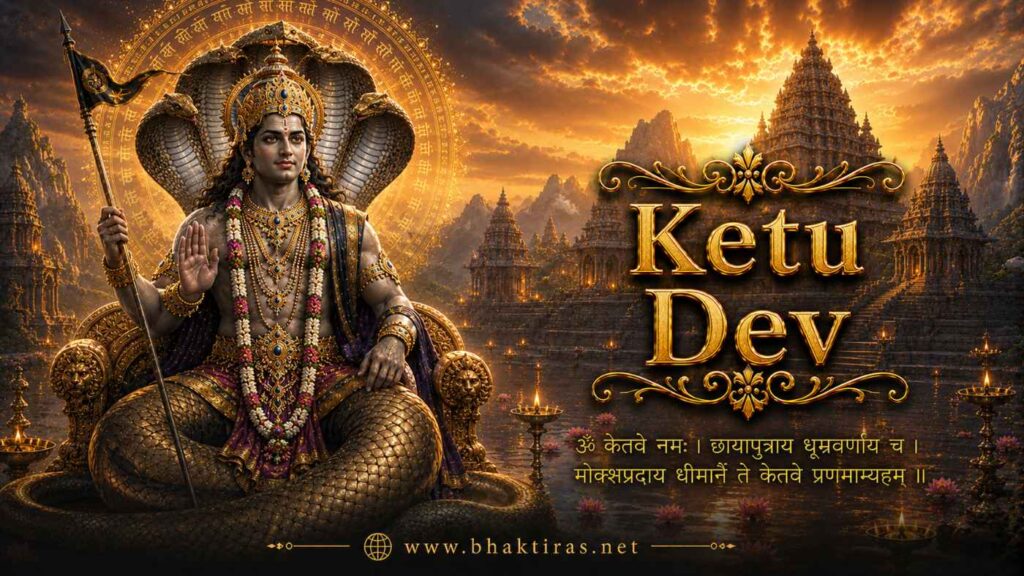
In the old stories Ketu is a severed being: the Svarbhanu asura was cut in two, and while the head became Rahu, the tail-end body became Ketu. So he is often drawn as a headless torso ending in a serpent’s coil, sometimes carrying a small banner – the flag that gives him his name. There is a stillness to him that comes from having lost the head, the seat of appetite and ego.
Where his twin Rahu chases the world – fame, hunger, obsession – Ketu turns the other way. He loosens attachments, dims worldly cravings and points the soul inward. Astrologers call him the moksha karaka, the significator of liberation. His touch can feel like loss, but it is often loss that clears space for something deeper.
Ketu is also linked to comets and smoke – Dhumaketu means ‘smoky comet.’ In older skies a comet’s sudden arrival read as an omen, and Ketu carries that same quality of the unexpected: things ending without warning, doors closing so that a hidden one can open.
Rahu & Ketu – Two Halves of One Story
The Churning and the Stolen Nectar
When the devas and asuras churned the ocean of milk (the Samudra Manthan), the prize was amrita, the nectar of immortality. The devas, unwilling to share it, arranged for Vishnu to appear as the enchantress Mohini and dole it out only to the gods. But one clever asura, Svarbhanu, slipped into the row of devas in disguise and drank a sip.
The Beheading
The Sun and Moon recognised the intruder and alerted Mohini. Before the nectar could pass his throat, Vishnu’s discus, the Sudarshana Chakra, sliced through his neck. Yet the sip had already reached his mouth – so both halves became immortal. The head lived on as Rahu; the headless body lived on as Ketu. Two grahas born from one asura, forever set at opposite points of the sky.
Why They Sit Opposite
This is why Rahu and Ketu are always exactly 180 degrees apart on the ecliptic – they are two ends of the same severed being. Rahu, the head, still hungers, still swallows (which is how eclipses were explained). Ketu, the body without a head, has no appetite left; what remains in him is instinct, memory and a longing for release. The grudge against the Sun and Moon is remembered in every eclipse, when the nodes and the luminaries align.
Iconography & Symbols
Ketu’s images are unusual among the grahas, shaped by his strange origin. A few features appear again and again:
The Headless Serpent Body
His most telling form: a torso that trails off into a coiled serpent tail, with no head at all. This is the body of Svarbhanu, and the missing head is the whole point – Ketu acts without ego, on pure instinct.
The Banner or Flag
The word ‘Ketu’ itself can mean banner, sign or comet’s tail. In some depictions he holds or is marked by a small flag, the emblem that flutters at the tail-end of the celestial serpent.
The Vulture Vahana
Ketu rides a vulture, and in some regional texts a fish or an eagle. The vulture, a bird of carrion and endings, fits his role as the graha of what falls away, decays and returns to the earth.
The Smoky Form
He is painted in dusky grey and ash tones, a smoky figure carrying gada and chakra. This colour ties him to Dhumaketu, the comet trailing smoke across an uneasy sky.
Ketu in Astrology – the Planet of Liberation
In a birth chart, Ketu points to where the soul has already travelled. Astrologers read him as a store of past-life karma – skills you seem to be born with, instincts that need no teaching. A well-placed Ketu can give sudden intuition, spiritual depth, a knack for something you never formally learned, and a gift for research, healing or mysticism.
He is the moksha karaka, the opposite of Rahu’s worldly craving. Where Rahu says ‘more,’ Ketu says ‘enough.’ His transits can bring a quiet dissatisfaction with things that once seemed important – a job, a status, a possession – and that dis-ease is often what turns a person toward prayer, simplicity or the inner life.
Ketu’s harder side shows as confusion, sudden loss, or a sense of being cut off. Because he has no head, his effects can feel unfocused – things slip away without clear reason. Yet even the losses tend to serve a purpose: they strip away what the soul no longer needs to carry. Read kindly, Ketu is less a punisher than a teacher of letting go.
Understanding the Rahu-Ketu Axis & Kaal Sarp Dosha
Because Rahu and Ketu sit exactly opposite each other, astrologers speak of the Rahu-Ketu axis – a single line through the chart that describes the soul’s direction of travel. Ketu shows the comfortable past you are meant to grow out of; Rahu shows the unfamiliar future you are meant to grow into. Read together, the axis is a map of this life’s inner work.
When every planet in a chart falls on one side of this axis – all hemmed between Rahu and Ketu – some traditions call it Kaal Sarp Dosha. It has a fearsome reputation, but it is worth holding calmly. Many well-known, accomplished people are said to have this pattern. It is best understood as a life with strong, concentrated themes rather than a curse, and classical astrology offers gentle remedies – Ganesha and Bhairava worship, Nag Panchami observance, and steady spiritual practice – to ease it. If a chart worries you, sit with a thoughtful astrologer rather than a frightening headline.
How Ketu Dev Is Worshipped
Ketu is rarely worshipped for gain; he is honoured to soften his sharper effects and to invite the peace of detachment. Traditional practices include:
- Tuesday observance – Tuesday is Ketu’s day; many recite his mantra or visit a Navagraha shrine then.
- Cat’s Eye (Lehsunia) – the honey-and-smoke gemstone linked to Ketu, worn only after careful astrological advice, never casually.
- Ganesha and Bhairava worship – Lord Ganesha and Kaal Bhairava are the guardian deities for Ketu; prayers to them are the most common remedy.
- Feeding dogs – offering food to dogs, and caring for stray animals, is a classic act of charity for pacifying Ketu.
- Charity and simplicity – donating grey or brown cloth, sesame, blankets or supporting spiritual causes, and cultivating a simpler, less grasping life.
Temples & Sacred Sites
Ketu, like all the Navagraha, is honoured in the nine-planet shrines found in most South Indian temples, usually as a small figure in the outer courtyard. But he has his own dedicated sthalam as well:
- Keezhaperumpallam (Naganathaswamy Temple), Tamil Nadu – the Ketu sthalam of the nine Navagraha temples near Kumbakonam, where Shiva is worshipped as Naganathaswamy and Ketu is prayed to for relief from serpent-related and karmic afflictions.
- Navagraha shrines nationwide – in temples across India, devotees circle Ketu’s small icon along with the other eight grahas, offering a lamp and a quiet word for peace of mind.
- Kaal Sarp remedy centres – certain temples associated with Nag worship, such as those at Trimbakeshwar and other serpent shrines, draw those seeking to ease the Rahu-Ketu axis.
Prayers & Mantras
Ketu’s mantras are short and steady, meant to be repeated in a calm mind. The simplest is his seed mantra, best chanted on a Tuesday or during a Ketu period, ideally after guidance from a teacher or astrologer:
ॐ कें केतवे नमः
Om Kem Ketave Namah
‘I bow to Ketu.’ The seed sound Kem carries the vibration of the graha, and the salutation offers the mind’s restlessness to him, asking for clarity, detachment and grace on the path of letting go.
Frequently Asked Questions about Ketu Dev
Is Ketu good or bad?
Neither, really. Ketu is the graha of detachment and liberation, so his lessons can feel like loss – a job ending, an attachment loosening. But that same force clears space for spiritual growth, intuition and peace. A well-placed Ketu gives deep insight and past-life gifts. He is a teacher of letting go, not a villain.
What is the difference between Rahu and Ketu?
They are two halves of one asura, Svarbhanu, cut in two by Vishnu. Rahu is the head – hungry, ambitious, chasing worldly desire and fame. Ketu is the headless body – detached, spiritual, pointing toward moksha and inner release. Rahu pulls you into the world; Ketu draws you beyond it. They always sit exactly opposite in the chart.
Why is Ketu shown without a head?
Because he is literally the beheaded body of Svarbhanu. When the asura sipped the stolen nectar, Vishnu's discus cut through his neck, but immortality had already taken hold. The head became Rahu and the headless torso became Ketu, drawn as a body ending in a serpent's coil – acting on instinct, free of ego and appetite.
What is Ketu's connection to comets?
One of Ketu's names is Dhumaketu, 'smoky comet.' In older times, the sudden appearance of a comet was read as an omen, and Ketu carries that same quality of the unexpected – abrupt endings, surprises, things arriving or leaving without warning. His smoky grey colour reflects this comet-and-ash imagery.
How is Ketu linked to Lord Ganesha?
Lord Ganesha is regarded as the presiding deity for Ketu, and worshipping him is the gentlest, most trusted remedy for a troublesome Ketu. Some traditions even see Ketu's headless, serpent-bodied form echoed in Ganesha's own story of losing and gaining a head. Praying to Ganesha is said to steady Ketu's scattered effects.
Should I fear Kaal Sarp Dosha?
It is best not to. Kaal Sarp Dosha simply describes a chart where all planets fall between Rahu and Ketu – a life with strong, focused themes. Many successful people are said to have it. Rather than fear it, treat it as a call to spiritual discipline. Ganesha and Bhairava worship, Nag Panchami and steady practice are the classical ways to ease it.
What gemstone is used for Ketu?
The Cat's Eye, known in Hindi as Lehsunia and in Sanskrit as Vaidurya, is Ketu's gemstone. Its shifting band of light mirrors his mysterious nature. Like all planetary gems, it is powerful and should be worn only after a careful reading of your chart by a qualified astrologer, never bought and worn on a whim.
Which day is best for worshipping Ketu?
Tuesday is traditionally Ketu's day, shared with Mars as a graha of intensity. Devotees chant his mantra, light a lamp, feed dogs, or visit a Navagraha shrine then. During a Ketu dasha or antardasha, the practice is often kept up more regularly, alongside Ganesha and Bhairava worship for extra grace.
Whether you meet Ketu through the stars or simply through a season of loss and letting go, may his smoky light lead you gently toward peace, and toward the freedom that lies on the far side of holding on.