
Rahu Dev
राहु
Rahu is one of the nine Navagraha, a shadow planet and the north lunar node. Born from the severed head of the asura Svarbhanu, he governs desire, ambition, obsession and sudden change. In astrology Rahu amplifies whatever he touches – not an evil force, but a demanding teacher of detachment.
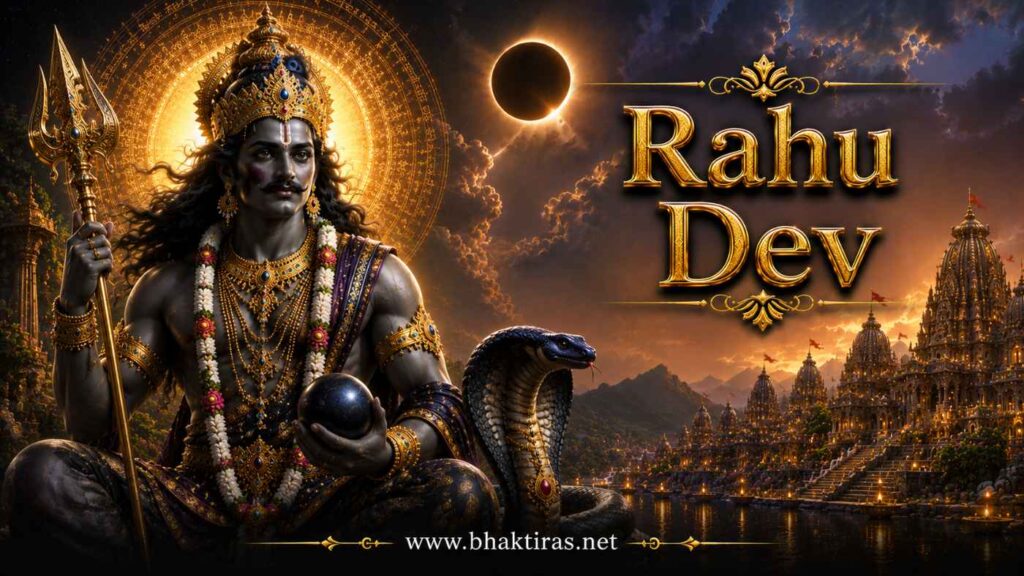
Who Is Rahu Dev?
You may have heard Rahu spoken of in a hushed, cautious tone, as if his very name carries a shadow. And in a literal sense it does – Rahu is a Chhaya Graha, a shadow planet, one of the nine Navagraha who shape human destiny in Jyotisha, the Vedic science of the sky. But he is not a star or a rock you can point to. Rahu is a mathematical point, the ascending or north node of the Moon – the place where the Moon’s path crosses the Sun’s. It is at these crossing points that eclipses happen, and that is the heart of his story.
What makes Rahu fascinating is that he has no body. He is only a head – a serpent-head, forever hungry, forever reaching. This is not a poetic flourish; it comes directly from the legend of how he was born, which we will come to shortly. Because he is all appetite and no fullness, Rahu came to represent the part of us that always wants more: more experience, more recognition, more of whatever we have decided we cannot live without.
It would be easy to file Rahu under ‘bad planet’ and move on. That would be a mistake, and an unfair one. In the older understanding, Rahu is a teacher – a hard teacher, yes, but a teacher of detachment. He pushes a person toward their deepest cravings so that, having chased them, they can finally see through them. He rules the foreign, the modern, the taboo and the unconventional, and he can lift an ordinary life to sudden heights just as quickly as he can unsettle it.
The Story of Svarbhanu and the Nectar
To understand Rahu, you have to go back to the churning of the ocean – the Samudra Manthan. The devas and asuras had joined forces to churn the cosmic sea, using the mountain Mandara as a churning-rod and the serpent Vasuki as the rope. After enormous effort, up rose Amrita, the nectar of immortality. Both sides wanted it, and both knew the other could not be trusted with it.
The trick, and the beheading
Lord Vishnu took the form of Mohini, a woman of such beauty that the asuras were happy to let her serve the nectar. She began pouring it only for the devas. But one asura, sharp and quick, was named Svarbhanu. He slipped away, disguised himself as a deva, and sat quietly in their line. The nectar reached his lips and he swallowed. At that very moment the Sun (Surya) and the Moon (Chandra) recognised him and cried out. Mohini spun round and, with the discus Sudarshana, cut off his head. But it was too late – the nectar had already touched his throat. His head could not die.
How one asura became two grahas
The severed head became Rahu. The headless body became Ketu, the south lunar node and Rahu’s eternal counterpart. So the two shadow planets are, in the deepest sense, one being split in two – Rahu the grasping head, Ketu the detached body. This is why they always sit exactly opposite each other in a birth chart, and why their meanings mirror one another: Rahu reaches outward toward the world, Ketu turns inward toward release.
There is a quiet lesson folded into this legend. Rahu got what he wanted – immortality – but at the cost of ever being whole again. He is proof that a craving fulfilled is not the same as a craving healed. That tension is exactly what he brings into a human life.
Why Rahu Causes Eclipses
Rahu never forgot who exposed him. Surya and Chandra had raised the alarm the moment he tasted the nectar, and it cost him his body. So, the tradition says, Rahu chases the Sun and the Moon across the sky in revenge. When he catches one and swallows it, the light goes out – and we, on Earth, see an eclipse. But because he has no torso, the swallowed light soon slips out through his open neck, and the Sun or Moon returns.
This is where astronomy and myth meet beautifully. Eclipses really do occur only when the Sun and Moon line up at the lunar nodes – the very points that Rahu and Ketu represent. So the ancient image of a shadow-demon ‘eating’ the Sun is, in its own language, a precise description of what actually happens in the sky. In many households, the hours of an eclipse are still treated as a time for stillness, prayer and inward reflection rather than ordinary activity – a gentle acknowledgement of Rahu’s grip on the light.
Iconography and Symbols
Rahu is one of the most striking figures among the Navagraha precisely because of what is missing from him. Artists depict him with care, and every detail carries meaning.
A head without a body
Rahu is shown as a head alone, or as a serpent-head – the mark of the being who was severed but could not die. He has no torso, which is why the light he swallows always escapes. Symbolically, this is desire without a place to rest: endless hunger with nowhere to keep what it takes in.
The smoky, dark form
His complexion is smoky, dusky or black, and he is often draped in blue or dark robes. This shadow-colour marks him as a graha of tamas – of obscurity, mystery and the hidden. He is what lies in the dark corners of a horoscope and of the mind.
The lion mount and black horses
Rahu’s vahana is the lion, and his chariot is said to be drawn by eight black horses. The lion speaks of raw ambition and fearless drive; the black horses of a force that runs on, tireless and hard to rein in – much like an obsession once it has taken hold.
The Chandrahasa sword
In his hands Rahu often carries the Chandrahasa, a crescent-shaped sword, along with a shield and other emblems. The sword is the cutting edge of his energy – sharp, decisive, capable of sudden gains and equally sudden breaks.
Rahu in Astrology – the Amplifier
If a single word could describe Rahu’s work in a horoscope, it would be amplifier. He magnifies. Wherever he sits, the affairs of that house grow larger than life – more intense, more desired, more charged with a sense that ‘this matters more than anything’. That is why his placement can lift a person to unusual success, and also why it can pull them into fixation.
Rahu governs ambition, desire and the drive to rise beyond one’s origins. He is at home with everything modern, foreign, unconventional or taboo – technology, travel, fame, the outsider’s path, the roads less walked. People with a strong Rahu often feel a restless pull toward something they cannot quite name, and following that pull can be the making of them.
The shadow side is illusion. Rahu can wrap a craving in a glow so convincing that a person chases it long past the point of reason – the endless scroll, the status that never satisfies, the ‘one more’ that is never the last. Yet even here he is doing his job. By letting us taste our obsession to the full, Rahu eventually shows us its emptiness, and turns us – often exhausted, often wiser – toward the inner release that his other half, Ketu, quietly offers. He is demanding, not malicious. A teacher, not a villain.
Understanding Rahu Kaal and Kaal Sarp Dosha
Two terms come up again and again around Rahu, and both are often explained in ways that stir more fear than understanding. Let us take them calmly.
Rahu Kaal is simply a time window. Each day is divided into eight parts between sunrise and sunset, and one of those parts is said to belong to Rahu. During this stretch – which shifts by weekday – many people prefer to avoid starting important new work, journeys or ceremonies. It is not a ‘dangerous’ hour and nothing bad automatically happens in it; it is treated as less auspicious for fresh beginnings, that is all. Everyday tasks and existing work carry on as usual. Many devotees actually find Rahu Kaal a good time for quiet prayer, especially to Durga.
Kaal Sarp Dosha is a chart pattern that forms when all seven classical planets fall on one side, hemmed in between Rahu and Ketu. It has a fearsome name and an even more fearsome reputation, much of it exaggerated. In a balanced reading it points to a life with strong karmic themes – intense drive, delayed rewards, a path that tests patience before it gives its gifts. Many accomplished people carry this yoga and have thrived. Simple, sincere remedies and steady effort are the traditional response, not panic.
A gentle reminder throughout: astrology is a matter of faith and personal reflection, not fixed prophecy. Rahu’s teachings are best received as encouragement toward awareness and detachment – never as a reason for dread.
How Rahu Dev Is Worshipped
Rahu is honoured not to ‘please a demon’ but to soften a strong karmic influence and turn its energy toward growth. Worship is usually kept simple, steady and sincere. Common practices include:
- Saturday observance – Saturday is Rahu’s day; many light a lamp and offer prayers to him, often alongside Shani.
- Hessonite (Gomed) – the honey-brown gemstone linked to Rahu, worn only on the advice of a qualified astrologer, never casually.
- Durga and Bhairava – devotees turn to Goddess Durga and to Lord Bhairava, whose grace is said to calm and channel Rahu’s force.
- Coconut and blue flowers – offering a coconut, along with dark-blue or mustard-coloured flowers and sesame, is a traditional gesture at Rahu shrines.
- Charity and service – giving to the needy, feeding the poor, and donating dark items such as sesame, blankets or blue cloth are classic Rahu remedies.
- Chanting the Rahu Beej mantra – regular, quiet recitation of Rahu’s seed mantra is one of the most accessible and widely trusted practices.
None of this needs to be elaborate or costly. What Rahu responds to, the tradition says, is honesty and discipline – the very qualities his lessons are meant to build.
Temples and Sacred Sites
Because Rahu is a graha rather than a personal deity with grand shrines everywhere, his most important temples are the Navagraha sites of South India, where each planet has its own sthalam. Two are especially connected with him:
- Thirunageswaram (Naganathaswamy Temple), Tamil Nadu – the great Rahu sthalam near Kumbakonam, famed for the milk abhishekam poured over Rahu, which is said to turn a bluish hue as it flows. Devotees come here to seek relief from Rahu-related and Kaal Sarp concerns.
- Sri Kalahasti, Andhra Pradesh – a renowned Rahu-Ketu kshetram where special poojas for both nodes are performed. Many visit to address Kaal Sarp Dosha in a calm, prayerful way.
Beyond these, Rahu is worshipped at the Navagraha shrines found within countless temples across India, where his image takes its place among the nine planetary lords – each facing a fixed direction, together holding the balance of cosmic order.
Prayers and Mantras
Sound is one of the gentlest and most trusted ways to draw near to Rahu. His mantras are recited to steady the mind, ease the sharper edges of his influence, and invite clarity where there was confusion. The simplest is his mool (root) mantra:
ॐ रां राहवे नमः
Om Raam Rahave Namah
‘Om, I bow to Rahu.’
More devoted practitioners chant the Rahu Beej mantra – ॐ भ्रां भ्रीं भ्रौं सः राहवे नमः (Om Bhraam Bhreem Bhraum Sah Rahave Namah) – traditionally repeated in cycles of eighteen thousand over a period of discipline, or in shorter daily rounds. The Rahu Stotra and the wider Navagraha Stotra are also recited to honour all nine planets together. As always, chant slowly, with attention rather than haste – Rahu, the lord of restless craving, is calmed above all by stillness.
Frequently Asked Questions about Rahu Dev
Is Rahu bad or evil?
No. Rahu is often feared, but in tradition he is a teacher, not a villain. He amplifies desire and ambition so that a person can eventually see through their cravings and learn detachment. He can bring sudden success as readily as challenges. His lessons are demanding, but their aim is growth and awareness, not harm.
What is Rahu Kaal?
Rahu Kaal is a daily time window, one of eight parts of the day between sunrise and sunset, said to belong to Rahu. It shifts by weekday. Many people avoid beginning important new tasks, journeys or ceremonies during it. Nothing bad automatically happens – it is simply considered less auspicious for fresh starts, and is a fine time for quiet prayer.
What is Kaal Sarp Dosha?
Kaal Sarp Dosha is a chart pattern where all seven classical planets sit between Rahu and Ketu. Its reputation is more frightening than the reality. It usually points to strong karmic themes – intense drive and rewards that come after patience. Many successful people carry it. Sincere remedies and steady effort are the traditional response, not fear.
How did Rahu come into being?
During the churning of the ocean, the asura Svarbhanu disguised himself as a deva to sip the nectar of immortality. The Sun and Moon exposed him, and Vishnu, as Mohini, beheaded him with the Sudarshana discus. But the nectar had reached his throat, so his head could not die. That immortal head became Rahu; the body became Ketu.
Why is Rahu blamed for eclipses?
The legend says Rahu chases the Sun and Moon in revenge for exposing him, and when he catches and swallows one, its light vanishes – an eclipse. Because he has no body, the light soon escapes his open neck. Fittingly, eclipses truly occur only at the lunar nodes that Rahu and Ketu represent, so myth and astronomy align.
What does Rahu govern in astrology?
Rahu governs worldly desire, ambition, obsession and the drive to rise beyond one's origins. He rules the foreign, the modern, the unconventional and the taboo, and he can bring sudden gains or upheavals. Wherever he sits in a chart, he magnifies that area of life – offering both great opportunity and the risk of fixation and illusion.
What are common remedies for Rahu?
Traditional remedies include observing Saturday with prayer, worshipping Durga and Bhairava, offering a coconut and dark flowers, and chanting the Rahu Beej mantra. Charity – especially giving sesame, blankets or dark cloth to the needy – is highly valued. The hessonite (Gomed) gemstone is worn only on a qualified astrologer's advice, never casually.
Which temples are dedicated to Rahu?
The most important is Thirunageswaram (Naganathaswamy Temple) near Kumbakonam in Tamil Nadu, the Rahu sthalam among the Navagraha temples. Sri Kalahasti in Andhra Pradesh is a famed Rahu-Ketu kshetram where Kaal Sarp poojas are performed. Rahu is also honoured at the Navagraha shrines found within temples across India.
What is Rahu's relationship with Ketu?
Rahu and Ketu are two halves of one being – the head and body of Svarbhanu, split by Vishnu's discus. Rahu, the head, reaches outward toward worldly desire; Ketu, the body, turns inward toward detachment and spiritual release. They always sit exactly opposite each other in a birth chart, mirroring one another's lessons.
May Rahu Dev turn your restless longings into wisdom, and your struggles into quiet strength.