
Goddess Yamuna
यमुना
Yamuna is the sacred river of Braj worshipped as a loving goddess. Daughter of Surya the sun god and sister of Yama, the lord of death, she frees devotees from the fear of dying. Above all she is Krishna's own river, whose dark waters flowed through Vrindavan and cradled his childhood play.
Who Is Goddess Yamuna?
Yamuna is the second-holiest river of India, and in the hearts of Braj she is not water alone but a living, feeling goddess. Where the Ganga is spoken of as a mother who cleanses, Yamuna is loved as something softer and more intimate – a sister, a friend, a beloved. Her waters run dark and cool, and people of Vrindavan say that colour is no accident. She carries the very shade of Krishna’s skin, as though the river had fallen in love with him long ago and kept his likeness in her current.She is called Suryaja, born of the sun, and Kalindi, daughter of the Kalinda mountain from which she descends. To bathe in her is believed to soften a hard heart and open it to devotion. Pilgrims who come to her ghats do not only ask for the washing away of sins; they ask, quietly, for the gift of loving God the way the gopis loved him. That is Yamuna’s particular grace – she gives bhakti, tender and unafraid.Daughter of the Sun, Sister of Death
Yamuna was born to Surya, the burning sun, and his wife Sanjna. From that same union came her twin, Yama, who would grow to become the lord of death and the judge of departed souls. Brother and sister, one presiding over the ending of life and the other flowing through it as a gentle stream – the pairing shapes much of what devotees feel about her.Because Yama is her twin, Yamuna is woven into the way Hindus think about dying. It is said that those who bathe in her waters with a true heart need not dread the moment when Yama’s messengers come, for the sister softens the brother. Death, in her company, loses its terror. She does not deny that life ends; she stands at the crossing and makes it kind. This is why so many prayers to Yamuna ask not for long life but for fearlessness – abhaya – in the face of what must come.The River of Krishna's Braj
To understand Yamuna, walk her banks in Braj. Here she becomes wholly Krishna’s. The whole geography of his childhood is written along her edge – Gokul where the infant was carried across her flooding waters, the groves of Vrindavan where he grazed the cows, and the countless ghats where the gopis came at dawn to fill their pots and, always, to catch a glimpse of him.It was on the sand of the Yamuna, under a full moon, that the raas-leela unfolded – the great circle dance in which Krishna multiplied himself so that each cowherd girl felt he danced with her alone. The river was witness and confidant to every hidden meeting, every song, every ache of longing. Braj devotees speak to Yamuna as they would to an old friend who knows all their secrets, because she truly does. She held Krishna’s laughter and the gopis’ tears in the same current.Krishna and the Serpent Kaliya
The most famous story set in Yamuna’s waters is the taming of Kaliya. In one dark pool of the river lived a many-hooded serpent whose venom had poisoned the water for miles. Birds fell dead if they flew over it, cattle sickened, and no one of Braj dared come near that bend of the Yamuna.Into the Poisoned Pool
One day a ball thrown by the boys landed in that cursed water. Young Krishna, without a moment’s fear, climbed a kadamba tree that leaned over the pool and leapt straight in. The serpent rose, coiling around the child, its many heads hissing fire. The gopas and gopis on the bank cried out, certain the boy was lost. But Krishna slipped free, grew heavy as the whole world, and rose onto the serpent’s hoods to dance.
The Dance on the Hoods
Krishna danced upon Kaliya’s crowns, each stamp of his small feet crushing the serpent’s pride and breaking its heads one by one. When Kaliya’s wives came weeping to plead for their lord’s life, Krishna showed mercy. He spared the serpent but banished it from the Yamuna, sending it far to the sea. From that hour the river ran clean and sweet again, and Braj could drink from her once more.
Yamuna and Bhai Dooj
The bond between Yamuna and her twin gives the festival of Bhai Dooj, also called Yama Dwitiya, its heart. The old story tells that Yama, busy with the endless work of receiving souls, had long stayed away from his sister. When at last he came to visit her on the second day after Diwali, Yamuna welcomed him with such warmth – a tilak on his forehead, a meal cooked with her own hands, a home lit with love – that Yama was deeply moved.In his gladness Yama granted a boon: any brother who, on this day, receives a tilak and a meal from his sister on the banks of the Yamuna, and any who bathes in her waters together with his sister, would be freed from the fear of untimely death. This is why sisters and brothers still gather at her ghats on Yama Dwitiya, and why the simple rite of a sister’s blessing carries, in Braj, the weight of Yamuna’s own promise. The festival is her gift to every family.Iconography and Symbols
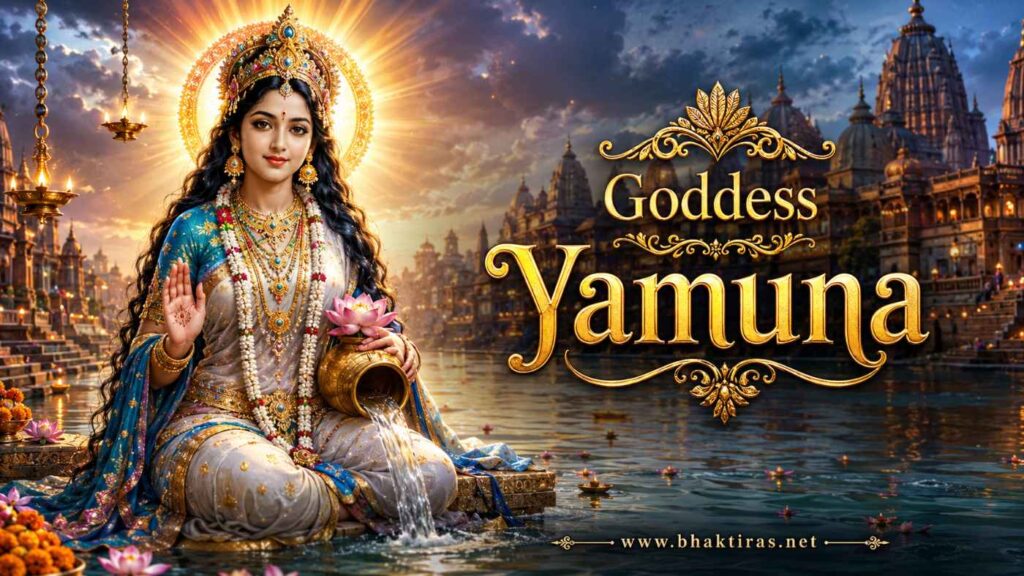
Yamuna is shown as a graceful woman whose colouring and companions all speak of her nature.Dark-Blue Waters
Her deep, cool, blue-black complexion mirrors Krishna’s own. The colour marks her as his beloved and sets her apart from the fair, milky current of the Ganga. Where they meet at Prayag, the two shades flow visibly side by side.
The Turtle Mount
Yamuna rides upon a turtle (kurma), a creature at home in slow, patient water. The turtle speaks of steadiness, of depth, and of a strength that does not need to hurry – the quiet endurance of a river that has flowed for ages.
The Lotus
In her hand she often holds a lotus, the bloom that rises unstained from muddy water. It is the emblem of purity born of the world’s mire, and of the pure devotion she awakens in those who come to her.
The Water Pot
A brimming pot (kalasha) in her other hand shows her as the giver of life-sustaining water and of abundance. From her flow the fields of the plains and the gardens of Braj alike.
How Goddess Yamuna Is Worshipped
Devotion to Yamuna is warm and daily, tied closely to the rhythm of life along her banks. Common forms of her worship include:- Bathing in her waters at dawn, especially at Vishram Ghat in Mathura and the ghats of Vrindavan, with a prayer for devotion and freedom from fear.
- Offering a lit lamp on a leaf-boat (deepdaan) that floats out onto the dark current at dusk.
- Chanting the Yamunashtakam, the eight-verse hymn composed by Vallabhacharya in her praise, dear to the Pushtimarg tradition.
- Reciting her simple seed prayer Om Yamunayai Namah while pouring water in her honour.
- Celebrating Yamuna Chhath (Yamuna Jayanti), her appearance day in the month of Chaitra, with special aarti and river festivals.
- Performing the Bhai Dooj tilak and shared bath with a brother on Yama Dwitiya for protection from untimely death.
- Making offerings of flowers, dark-blue cloth, and sweets, and joining the evening Yamuna aarti as lamps are waved over the water.
Temples and Sacred Sites
Yamuna is worshipped along her whole course, but a few places hold her presence most strongly:- Yamunotri in Uttarakhand – her Himalayan source and a Char Dham shrine, where a temple to the goddess sits beside hot springs at the foot of the glacier.
- Vishram Ghat, Mathura – the central ghat of Krishna’s birth-city, where the grand evening Yamuna aarti draws pilgrims each day and the goddess is worshipped in her own shrine.
- Keshi Ghat and the ghats of Vrindavan – beloved bathing steps where devotees recall the raas-leela and offer lamps to the dark water.
- Gokul and GAthirasi ghats along the Braj bank, tied to the infant Krishna’s crossing and childhood.
Prayers and Mantras
Yamuna is invoked with short, loving mantras and with the beautiful Yamunashtakam. Her core seed prayer is simple enough for anyone to hold in the heart while offering water to her.Devanagari: ॐ यमुनायै नमः
Transliteration: Om Yamunayai Namah
Meaning: I bow to Goddess Yamuna. Spoken while pouring or touching her water, this prayer asks the loving river to purify the mind, awaken devotion for Krishna, and dissolve the fear of death – the threefold grace for which she is cherished in Braj.
Frequently Asked Questions about Goddess Yamuna
Who is Goddess Yamuna?
Yamuna is the second-holiest river of India, worshipped as a loving goddess. She is the daughter of Surya the sun god and the twin sister of Yama, lord of death. Most of all she is Krishna's own river, whose dark waters flowed through the Braj of his childhood.
Why is Yamuna linked to Yama and Bhai Dooj?
Yamuna and Yama are twins, born to Surya and Sanjna. When Yama visited her on the second day after Diwali, she welcomed him so lovingly that he blessed all who honour the day. So on Bhai Dooj, or Yama Dwitiya, a sister's tilak on her banks is believed to free a brother from the fear of untimely death.
What is the connection between Yamuna and Krishna?
Yamuna is the beloved river of Krishna's Braj. Her dark waters mirror his complexion, she witnessed the raas-leela on her sands, and it was in her pool that he subdued the serpent Kaliya. In some traditions she weds Krishna as Kalindi, becoming one of his queens.
Why are Yamuna's waters described as dark?
Devotees of Braj say the river carries the very colour of Krishna's blue-black skin, as a sign of her love for him. This deep hue also sets her apart from the fair Ganga, most visibly where the two rivers meet at Prayag and flow side by side.
What is the story of Kaliya in the Yamuna?
A venomous many-hooded serpent named Kaliya had poisoned a pool of the Yamuna. The child Krishna leapt in, rose onto the serpent's hoods, and danced until Kaliya surrendered. Krishna spared him but banished him to the sea, and the river ran clean again. The tale is called the Kaliya-mardana.
Where does the Yamuna begin?
The Yamuna rises at Yamunotri in the Himalayas of Uttarakhand, one of the four Char Dham shrines. A temple to the goddess stands there beside hot springs at the foot of the Champasar glacier, and pilgrims begin her worship at this source.
What blessings does Goddess Yamuna give?
Yamuna is honoured as a giver of purification, of pure devotion (bhakti) to Krishna, and above all of fearlessness before death. Bathing in her waters or worshipping her is believed to soften the heart, awaken love for God, and remove the dread of Yama's summons.
May the dark, loving waters of Yamuna carry your heart to Krishna and set you free from every fear.