
Goddess Subhadra
सुभद्रा
Subhadra is the beloved younger sister of Krishna and Balarama and the daughter of Vasudeva. She married Arjuna and became the mother of Abhimanyu, and she is worshipped as the divine sister who rides the great chariot at Puri, Odisha, beside Jagannath and Balabhadra during the Rath Yatra.
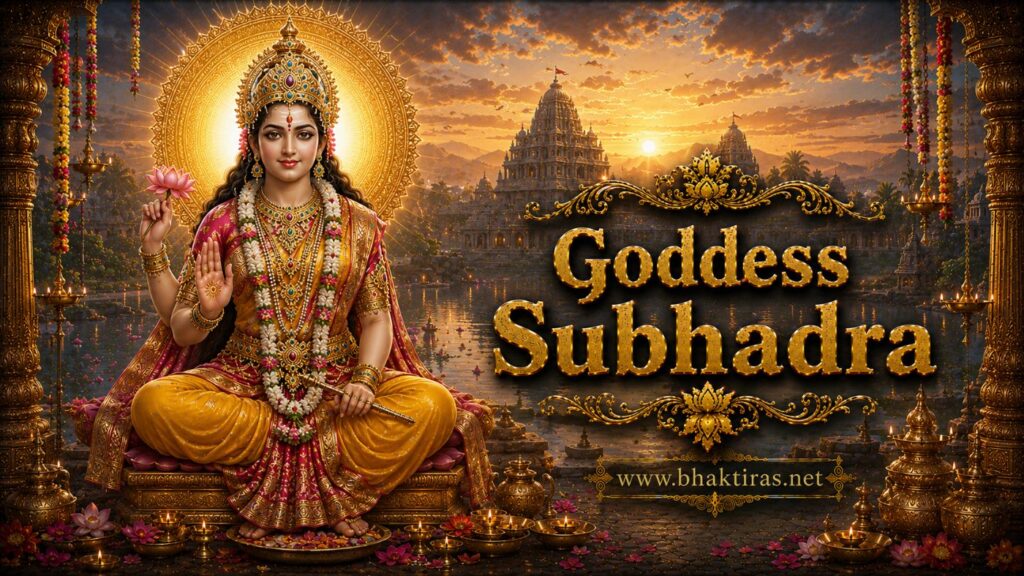
Who Is Goddess Subhadra?
Subhadra is the divine sister of the Yadava household, a daughter of Vasudeva and a sister to Krishna and Balarama. Her name means the greatly auspicious one, and she carries that blessing wherever she is invoked, especially as a protector of the bond between brother and sister.
Though she appears in the Mahabharata as a princess and later as Arjuna’s wife, devotees see something deeper in her. In Odisha and far beyond, Subhadra is honoured as a form of the Goddess herself, an aspect of Yogamaya, the great power of illusion and grace who works alongside Krishna in his cosmic play.
What makes her unique among Hindu deities is her place on the chariot at Puri. There she does not stand behind her brothers as an attendant but rides between them as an equal presence, a goddess in her own right at the centre of one of India’s largest festivals.
Krishna's Sister and Her Divine Family
Subhadra was born into the Yadava clan of Mathura and Dwarka, the daughter of Vasudeva. Tradition names her mother as Rohini, and she is counted among the close family of Devaki’s household, growing up as the cherished younger sister of Krishna and Balarama.
Her brothers shaped her destiny in loving ways. Balarama, ever the elder guardian, had his own wishes for her marriage, while Krishna, the wise strategist, guided events toward the match he foresaw as right. Between the two brothers she is often pictured as the gentle centre of the family, and the affection of these three siblings is remembered every year when they journey together on their chariots at Puri.
Her Marriage to Arjuna and Abhimanyu
The Mahabharata tells how Subhadra came to marry Arjuna, the great Pandava archer. During Arjuna’s pilgrimage he stayed at Dwarka, and he and Subhadra grew fond of one another. Because a straightforward proposal risked complications within the clan, Krishna quietly encouraged Arjuna to carry her away in an honourable elopement, a course that in the warrior tradition of the time was seen as brave and fitting.
When Balarama’s initial anger cooled, the union was blessed and celebrated. From Subhadra and Arjuna was born Abhimanyu, one of the most luminous young heroes of the epic, remembered for his courage in the battle of Kurukshetra. Through Abhimanyu and his son Parikshit, Subhadra’s line carried the royal succession forward after the great war, making her a mother of kings as well as a sister of the divine.
Subhadra at Puri and the Rath Yatra
Subhadra’s most visible worship today is at the Jagannath Temple in Puri, Odisha. There the three deities – Jagannath (a form of Krishna), Balabhadra (Balarama) and Subhadra between them – are carved in the temple’s distinctive wooden style with large round eyes and are venerated as a divine trio.
Each year during the Rath Yatra, or chariot festival, the three are placed on enormous wooden chariots and pulled through the streets by thousands of devotees. Subhadra rides in her own chariot, traditionally called Darpadalana, the one that crushes pride. In her Puri form she is often identified with Yogamaya, the sister-power of Krishna, so that the festival honours not only a family reunion but the presence of the Goddess at the heart of the procession. To pull her chariot, or even to glimpse her, is held to be deeply auspicious.
Legends and Significance
The sister who chose her hero
The tale of Subhadra’s marriage is often retold as a story of a woman’s own will. Rather than being a passive prize, Subhadra is shown as favouring Arjuna and cooperating in the plan Krishna set in motion. In several versions she herself takes the reins of the chariot as they depart Dwarka, a small but striking detail that storytellers use to show her spirit and agency within the epic.
The goddess who guards the bond of siblings
Because Subhadra sits forever between her two brothers at Puri, she has become the presiding goddess of the brother-sister bond. Devotees invoke her when praying for family harmony, and her festival is celebrated as a rare public image of siblings honoured together as gods. Her identification with Yogamaya also links her to the protective power that, in Krishna’s birth story, shielded the divine child – a reminder that beneath her gentle role lies the strength of the great Goddess.
Frequently Asked Questions
Who is Goddess Subhadra?
Subhadra is the younger sister of Krishna and Balarama and the daughter of Vasudeva. She married Arjuna and became the mother of Abhimanyu, and she is worshipped as a divine sister and an aspect of Yogamaya, especially at Puri in Odisha.
Why is Subhadra worshipped at Puri?
At the Jagannath Temple in Puri she is enshrined between Jagannath (Krishna) and Balabhadra (Balarama) as a divine trio. During the annual Rath Yatra she rides her own chariot, and she is venerated there as a form of Yogamaya, the Goddess.
Whom did Subhadra marry?
Subhadra married Arjuna, the Pandava archer. According to the Mahabharata, Krishna encouraged their union, and it was celebrated by the family after Balarama's initial displeasure was resolved.
Who was Subhadra's son?
Her son was Abhimanyu, a heroic warrior of the Mahabharata famed for his valour at Kurukshetra. Abhimanyu's son Parikshit later continued the royal line, so Subhadra is remembered as a mother of kings.
Is Subhadra considered a goddess or a princess?
She is both. In the Mahabharata she appears as a Yadava princess, but in devotional tradition, especially at Puri, she is worshipped as a goddess and identified with Yogamaya or Bhadra, an aspect of the Divine Mother.
May Subhadra, the auspicious sister of Puri, bless every home with harmony and the enduring love of family.