
Goddess Ratri
रात्रि
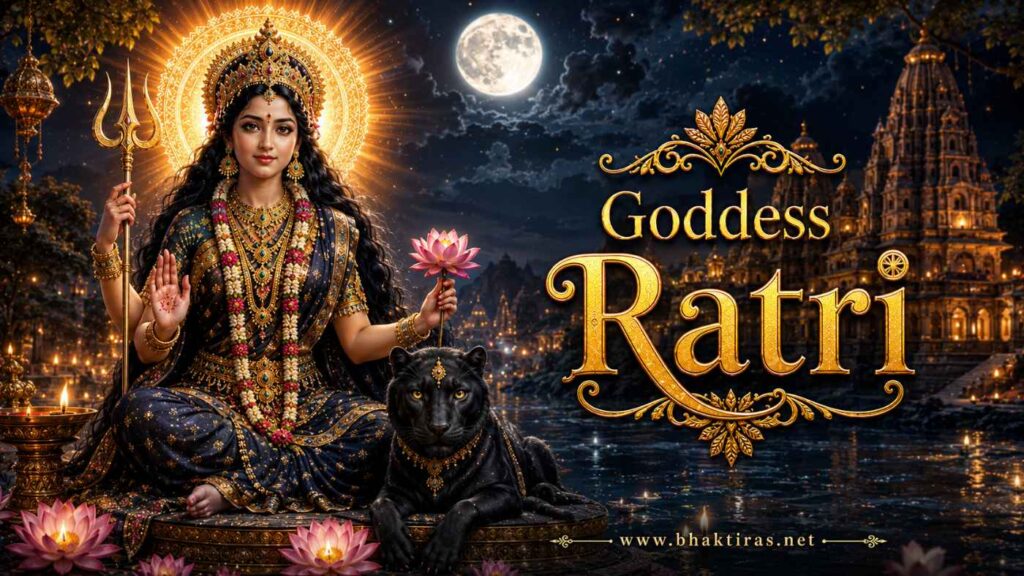
Ratri is the Vedic goddess of night, honoured in the Rigveda's Ratri Sukta. She is not darkness as evil, but the calm, star-covered night who spreads across the sky, gives rest to every creature, and guards them until dawn. Devotees pray to her for peaceful sleep and safety through the dark hours. She is the sister of Ushas, the dawn.
Who Is Goddess Ratri?
Ratri is the goddess of night in the oldest layer of Hindu thought. Her name is simply the Sanskrit word for night, and the people who first sang to her did not fear her. They welcomed her the way a tired household welcomes the end of a long day. When the sun set and the work stopped, Ratri arrived – quiet, wide, and full of stars.The night that watches over sleepers
In the Vedic imagination she is a living presence, not an empty absence of light. She comes down over the villages and forests and covers them like a mother drawing a blanket over a child. Cattle settle, birds fold their wings, and human beings lie down to rest. Ratri holds all of this in her keeping. She is asked to let the sleepers sleep without harm and to send the danger of the dark somewhere far away.
A goddess of trust, not terror
Many cultures made the night into a place of monsters. The Vedic seers did something gentler. They saw that night always ends, that the stars are steady, and that darkness itself can be kind. So they turned to Ratri with affection and confidence. She is the goddess you speak to when you close your eyes and hope the morning will come, and in her hymn the singer trusts that it will.
The Star-Mantled Night of the Rigveda
Ratri’s fame rests on one short and beautiful hymn in the tenth book of the Rigveda, known as the Ratri Sukta. It is one of the few Vedic hymns addressed to a goddess in her own right, and its images have stayed alive for thousands of years.She fills the sky with her eyes
The hymn describes Ratri approaching and looking out with many eyes – the countless stars. She puts on her ornaments of light and spreads herself across the high and low places until she has filled the whole hollow of the sky. There is nothing gloomy in the picture. She is described as immortal and radiant, a shining darkness rather than a dead one. The night here is not empty; it is dressed, adorned, and alive.
A prayer whispered into the dark
As the hymn goes on, the singer speaks to her more personally. He asks her to keep the wolf and the she-wolf away, to keep off the thief, and to let the night pass easily. There is a tender request in it: take our tiredness the way a cowherd takes home the cattle, and give us safe passage to the other shore of the dark. The Ratri Sukta reads like something said quietly at bedtime, and that intimacy is exactly why it has lasted.
Not Darkness, but Rest and Protection
The heart of Ratri’s worship is not fear but comfort. The people who sang to her were farmers and herders who lived close to real dangers, and they asked her for two very ordinary, very precious things: sleep and safety.The gift of sleep
Ratri is the one who lets the whole world lie down. Under her mantle the labour of the day is set aside and rest becomes possible. To pray to her is to ask for sleep that heals – deep, unbroken, and free of dread – so that the sleeper rises whole in the morning.
A guard against the dark
The night hid real threats: prowling animals, thieves moving between houses, and the many unseen dangers the imagination adds after sunset. Ratri is asked to hold all of these at a distance. She becomes a wall of quiet around the sleeping home, turning the dark from a threat into a shelter.
The promise of morning
Her protection carries a promise inside it. Night is not endless. Ratri is asked to be like a boat that carries her worshippers safely to the far bank, where dawn waits. Trusting her means trusting that the dark will end well and the light will return.
Ratri and Ushas – Night and Dawn
Ratri is never far from her sister Ushas, the goddess of dawn. The two of them share the turning of the sky between them, and the old hymns love to picture them as sisters who take turns.Two sisters, one sky
As one leaves, the other arrives. When Ratri gathers up her stars and withdraws, Ushas opens the eastern horizon with her rose-coloured light. When Ushas has finished her round of morning, Ratri returns to spread the calm of evening. They do not quarrel over their shared home; they hand it back and forth in an unbroken rhythm, night giving way to dawn and dawn giving way again to night.
The comfort of the pattern
This sisterhood is more than a pretty image. It carries the deepest reassurance the hymns offer – that darkness and light belong together and follow each other faithfully. Because Ushas is always coming, Ratri is never something to fear. The night is simply the sister who watches while the dawn is away, keeping the world safe until it is time to wake it again.
The Fierce Night – Link to Kali and Durga
The gentle Vedic Ratri did not disappear as Hindu thought grew. In later traditions the idea of the goddess-as-night deepened and took on a stronger, more powerful face, drawing near to Kali and Durga.Night as the great mother's power
In the later understanding, night is not only rest but also the vast, dark ground from which everything comes and to which everything returns. This is close to how Kali is imagined – dark, boundless, holding both dissolution and shelter. Ratri’s calm darkness and Kali’s fierce darkness turn out to be two moods of the same feminine mystery, the softness and the strength of the same night.
Ratri within the Durga Saptashati
The tie is not only poetic. The Ratri Sukta is recited within the Durga Saptashati, the great scripture of the Goddess, where the night-power is invoked as Maharatri, the great night. Here Ratri stands as the goddess who both lulls the world to sleep and, when needed, rises with terrible force to protect it. The one who gives peaceful rest is also the one who can guard fiercely.
Iconography and Symbols
Ratri belongs to an early age of worship that thought in images of sky and word more than in carved statues. Her symbols are the things of the night itself.The mantle of stars
Her chief ornament is the star-filled sky. The hymn pictures her putting on the stars as jewellery and looking out through them as through countless eyes. The night sky, glittering from edge to edge, is her true image and her robe.
The covering darkness
Ratri is imagined as a soft, wide covering that settles over the earth. This darkness is calm and full, not black and threatening. It is the symbol of rest, of things laid down, and of the world gathered under one shelter.
The boat to the far shore
One tender image asks her to ferry her worshippers safely across the night, as if darkness were a river and morning the opposite bank. The crossing stands for protection through danger and the sure arrival of dawn.
The paired dawn
Wherever Ratri appears, the light of Ushas is implied close behind. Her symbolism always holds the promise of returning light, so darkness in her keeping is never final.
How Goddess Ratri Is Remembered
Ratri lives on wherever the night is treated as sacred and wherever people ask for safe rest. Her memory is quiet and domestic more than grand and public.- Bedtime prayers – the oldest way of honouring her is the simplest: a word of trust said before sleep, asking for a peaceful night and a safe waking.
- Recitation of the Ratri Sukta – the Rigvedic hymn is still chanted, especially by those who value the Vedic prayers, as a blessing over the night.
- Within the Durga Saptashati – devotees who read the Saptashati encounter Ratri as the night-power of the Goddess, keeping her presence alive in living worship.
- Night vigils and Ratri observances – sacred nights such as the great nights of the Goddess carry her spirit, when staying awake in prayer is itself an offering to the night.
- A feeling more than a shrine – Ratri is remembered less in temples and more in the ordinary trust that the dark will pass, that sleep will heal, and that something watchful holds the world until morning.
Prayers and Mantras
A short prayer to Ratri is the natural close to a day. It is spoken softly, in gratitude for rest and in trust of protection through the dark. The simplest invocation offers loving salutation to the goddess of night.Ratri Mantra
ॐ रात्र्यै नमः
Om Ratryai Namah
Om, salutations to Ratri, the goddess of night. This gentle line places the coming night in her care, asking for calm sleep and safe keeping until dawn.
The spirit of the Ratri Sukta
The Rigvedic hymn’s own prayer can be carried in the heart: that the night pass easily, that wolf and thief be kept far, that tiredness be gathered up and taken away, and that the worshipper be ferried safely to the shore of morning.
Frequently Asked Questions about Goddess Ratri
Who is Goddess Ratri?
Ratri is the Vedic goddess of night, praised in the Rigveda's Ratri Sukta. She is the calm, star-covered night who spreads over the sky, gives rest to all beings, and guards them until dawn. Devotees turn to her for peaceful sleep and safety through the dark, trusting her sister Ushas to bring the morning.
Is Ratri an evil goddess?
No. Ratri is not a goddess of evil or of darkness as harm. The Vedic hymns treat her with love as a gentle, protective mother of the night. Her darkness is restful and sheltering, not sinister. She keeps danger away from sleepers and always gives way to the light of dawn.
What is the Ratri Sukta?
The Ratri Sukta is a short hymn in the tenth book of the Rigveda addressed to Ratri, the goddess of night. It describes her filling the sky with stars like many eyes and asks her to keep away the wolf and the thief and to grant a safe, easy passage through the dark until morning.
What does Ratri protect people from?
The Ratri Sukta asks her to keep away the dangers of the night – wolves and other prowling animals, thieves, and the unseen fears that come after dark. She is prayed to for a peaceful, unbroken sleep and for the safe keeping of the home and its sleepers until the first light of dawn.
How is Ratri related to Ushas?
Ratri and Ushas are sisters, the goddesses of night and dawn. They share the sky by turns: as Ratri withdraws with her stars, Ushas opens the morning, and as Ushas finishes, Ratri returns with the evening. Their faithful rhythm is why the night is trusted, since dawn is always coming behind it.
Is Ratri connected to Kali or Durga?
Yes. In later thought Ratri's night-power draws near to Kali and Durga, the fierce forms of the great Goddess. The Ratri Sukta is recited within the Durga Saptashati, where she appears as Maharatri, the great night – the same feminine mystery that gives gentle rest and can also rise fiercely to protect.
How do devotees worship Ratri?
Ratri is honoured most in quiet, everyday ways: a prayer of trust said before sleep, the chanting of the Ratri Sukta, and her presence in the Durga Saptashati. Sacred night vigils also carry her spirit. Her worship asks mainly that the night be met with calm and gratitude rather than fear.
May Goddess Ratri spread her mantle of stars over your home tonight, take away the weariness of the day, and keep you in peace until the light of dawn returns.