
Goddess Matangi
मातंगी
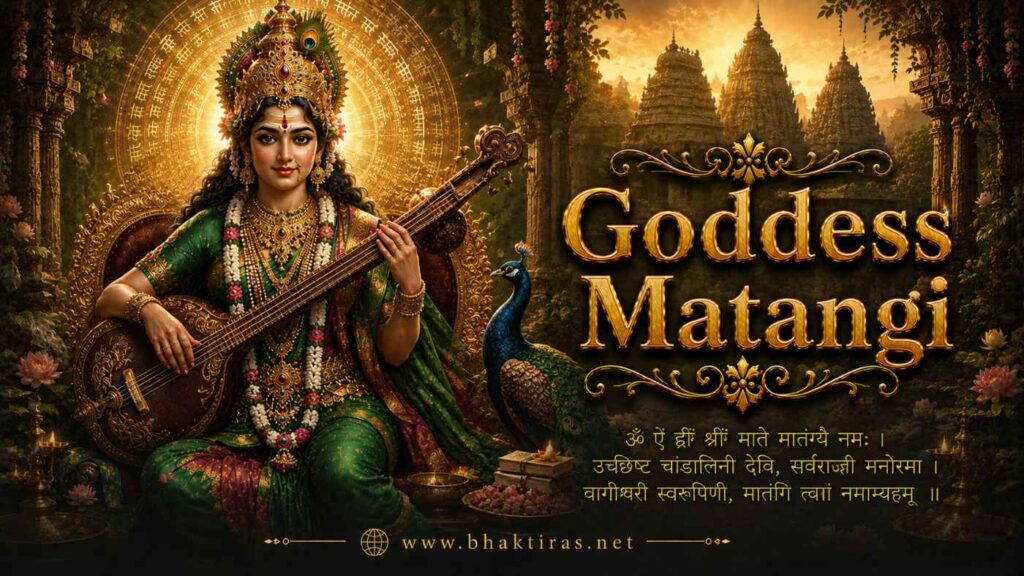
Matangi is the ninth of the ten Mahavidyas, the emerald-green goddess of speech, music, and inner knowledge. Often called the Tantric Saraswati, she holds a veena and rules eloquence, the arts, and the power of the spoken word. Worshipped in her Uchchhishta form, she welcomes what others reject and points to a sacredness beyond social rank.
Who Is Goddess Matangi?
Among the ten Mahavidyas – the wisdom goddesses of Tantra – Matangi holds the ninth place. She is the goddess of the word: of speech that moves people, of music that carries feeling, and of the quiet inner knowing that no book can fully hold. Her skin is dark green, the colour of deep emerald, and she carries a veena, the long-necked lute of Indian classical music. Where some goddesses rule battle or wealth, Matangi rules expression itself.The goddess of speech
Matangi presides over vak, the living power of the spoken word. Every prayer, song, poem, and persuasive sentence draws on the force she governs. To worship her is to ask that one’s words carry truth, warmth, and effect.
A tantric goddess
She belongs to the ten Mahavidyas, a group of goddesses honoured chiefly in tantric practice. Her worship often steps outside conventional rules of purity, which is central to what she teaches rather than incidental to it.
Linked to Saraswati
Both Matangi and Saraswati rule speech, music, and learning, which is why Matangi is called the Tantric Saraswati. But their moods differ, and understanding that difference is part of knowing who Matangi is.
The Tantric Saraswati – Goddess of the Word
If Saraswati is the serene mistress of clear knowledge, Matangi is her more intense, more inward sister. She governs the same domains – speech, music, scholarship – but reaches them through a different path, one that runs closer to the raw ground of experience.Speech that carries weight
Matangi rules the kind of speech that changes minds – eloquence, timing, the ability to say the right thing so that it lands. Poets, debaters, teachers, and singers all draw on her gift. Her devotees ask not merely to speak, but to be heard.
Music and the arts
The veena in her hands marks her as a patron of music. Ragas, rhythm, and the disciplined joy of practice belong to her. She favours those who give years to an instrument or a craft, honouring the slow labour that makes art seem effortless.
Inner and esoteric knowledge
Beyond outward learning, Matangi guards the knowledge that is passed in whispers – the meaning behind a mantra, the sense that lives under the words. She is drawn to what is hidden, and she rewards patient, attentive seekers.
Iconography & Symbols
Matangi is a goddess you recognise by colour and by what she holds. Each detail carries meaning, and together they sketch her nature.Emerald-green body
Her dark green skin sets her apart from most goddesses. Green is the colour of growth, of the forest, and of a deep, cooling calm. It also links her to the parrot and to the lush eastern landscapes where her worship took root.
The veena
Her chief emblem is the veena, held or played. It signals her mastery of sound and music, and marks every note struck in devotion as an offering to her.
The parrot
A parrot often sits near her, sometimes on her hand. The bird that repeats and shapes human speech is a fitting companion for the goddess of the word, and it carries a note of playfulness into her image.
Sword, goad and noose
In her tantric forms she may hold a sword, a goad, and a noose. These are tools of control – cutting through confusion, guiding, and binding – reminders that command over speech is also command over minds.
Emerald and the colour of speech
Devotees associate her with emerald green in cloth, flowers, and ornament. Offering her green blooms or dressing her image in green is a simple, common way to honour her.
The Uchchhishta Form and the Divine Beyond Purity
One of Matangi’s most striking aspects is her worship as Uchchhishta Chandalini – the goddess who accepts uchchhishta, food that has already been tasted or left over, which orthodox custom treats as impure. This is not a strange footnote to her worship. It is the heart of what she has to teach.Beyond the rules of purity
By receiving offerings that convention rejects, Matangi steps past the lines that societies draw between pure and impure, high and low. She points to a reality in which the divine is not confined by such rankings, and in which grace is not reserved for the privileged.
The name Chandalini
The word chandalini refers to those placed at the very bottom of the old social order. Matangi wears this name openly. In doing so she stands with the excluded and turns a term of contempt into a title of the sacred.
A teaching of transcendence
Her worship asks the seeker to look past outward status and ritual cleanliness toward what actually matters – devotion, truth, and inner clarity. It is a pointed reminder that holiness is measured by the heart, not by birth or convention.
The Story of Her Origin
The offering to Shiva and Parvati
One well-loved account tells how Vishnu and Lakshmi once came to visit Shiva and Parvati. As is fitting for guests, they brought fine food. While the divine couples ate and talked, a few morsels fell to the ground – food that, by ordinary reckoning, had become uchchhishta, leftover and impure. From these fallen morsels arose a young woman, dark and lovely, who asked for the remnants as her share. The gods recognised her at once as a form of the Great Goddess, and she was named for the leftover food she gladly received.
The sage Matanga and his daughter
Another strand ties her to the sage Matanga, from whom she takes her name. In this telling the goddess appears in connection with his penance, sometimes as a daughter figure born of his devotion, sometimes as the deity his austerities call forth. Matanga longed for the power to bring all creatures under gentle sway, and the goddess who answered him carries that grace – the ability to charm and to draw others near through the sweetness of speech.
Why the stories matter
Both accounts return to the same point. Matangi comes into being through what others set aside, and she wields the power of the word. Her origin is a quiet argument that value lies where we least expect it, and that eloquence, not force, is the truest form of influence.
Among the Ten Mahavidyas
The ten Mahavidyas are a cluster of goddesses in Tantra, each embodying a distinct face of the one Great Goddess. They range from the fierce Kali and the fearsome Chhinnamasta to the gentle Kamala. Matangi holds the ninth place in this group.One goddess, many faces
The Mahavidyas teach that a single divine reality can be approached through many temperaments. Matangi offers the doorway of language and art, welcoming those whose devotion is expressed in words and music.
The wisdom of speech
Her particular wisdom is the wisdom of vak. Among the ten, she is the one who reminds us that knowledge unspoken helps no one, and that the disciplined, loving use of speech is itself a spiritual practice.
How She Is Worshipped
Matangi draws devotees who live by expression and learning. Her worship favours the green offerings she loves and a spirit that looks past outward status toward sincere feeling.- Students and scholars pray to her before exams and long study, asking for clear thought and retentive memory.
- Musicians, singers, and dancers honour her before a performance, treating each note and step as an offering to the goddess of the arts.
- Writers, poets, teachers, and public speakers seek her blessing for eloquence – the ability to say the right thing well and be truly heard.
- Devotees offer green flowers, green cloth, and green ornament, colours that match her emerald form.
- In keeping with her Uchchhishta aspect, some traditions offer food that has already been partaken of, a practice reserved for initiated tantric worship rather than everyday home rituals.
- Chanting her seed mantra Aim and her longer mantras is the most common daily devotion, often done quietly with a mala.
- Because she stands with the excluded, her worship carries a spirit of openness, welcoming devotees regardless of background or standing.
Temples & Sacred Sites
Matangi is honoured more often within tantric temple complexes and Mahavidya shrines than in large standalone temples of her own. A few places carry a special link to her.- The Kamakhya temple complex in Assam, the great seat of the Mahavidyas, where Matangi is worshipped among the ten wisdom goddesses.
- Shakti Peethas and Mahavidya shrines across eastern and southern India, where she receives worship alongside her sister goddesses.
- Raja Matangi shrines in the south, where she is revered as a royal, grace-bestowing form connected with the goddess Lalita.
- Household and lineage tantric altars, where initiated practitioners keep her image or yantra and offer daily worship.
- Temples of the broader Devi tradition, where a Matangi murti or panel is often included among depictions of the Mahavidyas.
Prayers & Mantras
Matangi’s mantras are prized for sharpening speech, steadying the mind for study, and drawing others near through gentle influence. Her seed sound is Aim, the same bija linked with Saraswati and the power of wisdom. Her fuller mantra names her in the Uchchhishta form and asks for the grace to win over all people through the beauty of one’s words.The seed mantra
ऐं (Aim) – the single-syllable bija of speech and learning. Repeated on its own, it is a simple invocation of Matangi’s grace over the mind and the tongue.
Meaning of the mantra
The longer mantra salutes the goddess in her Uchchhishta Chandalini form and asks her to make one’s words bring all people into willing accord – influence gained through eloquence and warmth rather than pressure.
Frequently Asked Questions about Goddess Matangi
Who is Goddess Matangi?
Matangi is the ninth of the ten Mahavidyas, the tantric wisdom goddesses. She is the emerald-green goddess of speech, music, learning, and inner knowledge, often called the Tantric Saraswati. She holds a veena and rules eloquence, the arts, and the power of the spoken word.
How is Matangi different from Saraswati?
Both goddesses rule speech, music, and learning, so Matangi is called the Tantric Saraswati. But Saraswati is serene, fair, and honoured widely in everyday worship, while Matangi is a dark-green tantric goddess whose Uchchhishta form deliberately steps past rules of purity. Saraswati is clear knowledge; Matangi is the deeper, more inward and esoteric side of the same power.
What does the Uchchhishta form mean?
Uchchhishta means food already tasted or left over, which orthodox custom calls impure. Matangi accepts such offerings, teaching that the sacred is not confined to the clean or the high-born. Her Uchchhishta form is a lesson in inclusion – grace reaches the discarded and overlooked as much as anyone else.
Why is Matangi green?
Her dark, emerald-green complexion sets her apart from most goddesses. Green is the colour of growth, the forest, and a deep calm, and it connects her to the parrot and to the lush eastern regions where her worship flourished. Devotees often offer her green flowers and cloth in keeping with this.
What does Matangi hold?
Her chief emblem is the veena, marking her as goddess of music and speech. A parrot, the bird of human-like speech, often accompanies her. In her tantric forms she may also carry a sword, a goad, and a noose – tools that stand for cutting through confusion, guiding, and holding the power of the word.
Who worships Matangi?
Students, scholars, musicians, dancers, writers, poets, teachers, and public speakers turn to her for clear thought and effective speech. She is also central to tantric practitioners who honour the ten Mahavidyas. Her worship welcomes devotees of every background, reflecting her stand with the excluded.
What is Matangi's connection to Kamakhya?
The Kamakhya temple complex in Assam is the great seat of the Mahavidyas, and Matangi is worshipped there among the ten wisdom goddesses. Her tantric roots run strong in eastern India, and Kamakhya is one of the most important centres for her veneration.
What is Matangi's seed mantra?
Her seed mantra is Aim (ऐं), the bija of speech and wisdom, the same syllable linked with Saraswati. Chanted alone or within her longer Uchchhishta mantra, it invokes her grace over the mind and the tongue, sharpening memory, study, and eloquence.
May Matangi bless your words with warmth and truth, your music with feeling, and your learning with light – and may you always remember that the sacred welcomes everyone.