
Budh Dev
बुध
Budh Dev is the planetary deity of Mercury and one of the nine Navagraha. He governs intellect, speech, commerce, wit and learning. Born of Chandra (the Moon) and Tara, he is a generally kind, benefic graha. Note carefully: this Budha is not Gautama Buddha, the founder of Buddhism – they are entirely separate figures who only share a similar-sounding name.
Who Is Budh Dev?
Before anything else, one point needs to be settled, because it trips up almost everyone who hears the name. Budha the planet-god is not the Buddha. Gautama Buddha, the prince who became the Enlightened One and founded Buddhism, is a historical teacher. Budha (बुध) is a graha – the deity of the planet Mercury and one of the nine celestial powers known as the Navagraha. They share a similar sound and both names come from the same root budh (to awaken, to know), but they are two completely different figures. Keep that clear and everything else falls into place.
Budh Dev presides over the mind and its finer faculties – intelligence, speech, reasoning, wit, memory and the skill of trade. When astrologers speak of a person who thinks quickly, argues well, writes cleanly or handles money with a sharp eye, they often credit a well-placed Budha in the birth chart. He is the graha of scholars, merchants, mathematicians, writers and negotiators.
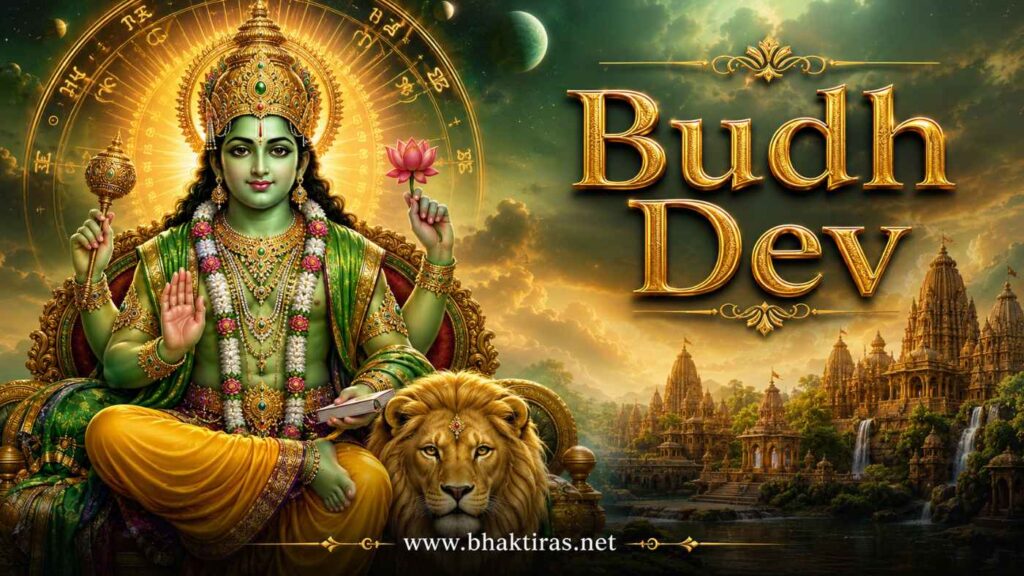
In images he appears youthful and calm, his skin the soft green of new leaves, seated in composure with the tools of a scholar-warrior in his four hands. He is counted among the gentler planets, a saumya graha whose influence, when clear, brings clarity of thought rather than trouble.
His character in the Puranas is a curious mix of high learning and an unusual, almost scandalous origin – a birth born of desire, jealousy and a war among the gods, which we come to next.
The Unusual Birth of Budha
Budha’s parentage is one of the more tangled tales in the Puranas. His mother is Tara, the wife of Brihaspati (Jupiter), the guru of the gods. His father, however, is not Brihaspati at all – it is Chandra, the Moon.
The story goes that Chandra, dazzled by Tara’s beauty, carried her away to his own realm. Brihaspati demanded her return, and when Chandra refused, the quarrel widened until it split the heavens. Gods, sages and even the asuras took sides in a great conflict the texts call the Tarakamaya war – the war fought over Tara. Only when Brahma himself stepped in was Tara restored to her husband.
By then she was carrying a child. When the radiant, brilliant infant was born, both Chandra and Brihaspati claimed him. Tara at last named Chandra as the father, and so Budha came into the world – a son of the Moon, glowing with intelligence from birth. His epithets remember both parents: Saumya and Soumya mark him as the son of Soma (Chandra), while Rauhineya ties him to Rohini, Chandra’s beloved. From an origin marked by conflict, he grew into the steadiest and most reasonable of the grahas.
Iconography & Symbols
Budh Dev’s form is quiet and scholarly, and every detail carries meaning. He is usually shown with four arms, green in colour, seated on a lion or riding a chariot pulled by lions or horses. Here is what the symbols say.
Green Body
His leaf-green complexion links him to growth, freshness and the living intelligence of a mind at work. Green is his colour across ritual, dress and offering.
Four Arms
The four hands show his command over the mind’s many powers – learning, expression, defence and steadiness – held together in balance.
Lion Mount
His vahana is the lion, an emblem of courage and mastery. In some accounts he rides a chariot drawn by lions or by swift horses across the sky.
Sword
The sword stands for a sharp, discriminating intellect – the ability to cut through confusion and separate truth from error.
Shield
The shield marks protection and prudence, the caution of a wise mind that guards itself against rash judgement.
Mace
The mace (gada) signals authority and the strength that steadies knowledge, so that wisdom is not merely clever but firm.
Lotus
The lotus, often held in one hand, is purity of mind – thought that stays unstained even while rooted in the ordinary world.
What Mercury Governs – Intellect & Commerce
In Jyotisha, Budha rules two rasis: Gemini (Mithuna) and Virgo (Kanya). Between them these signs cover much of what we mean by a working mind – Gemini the quick, curious, communicative side, and Virgo the precise, analytical, detail-loving side.
Because of this, Budha’s domain is broad and very human. He governs speech and writing, so orators, journalists, poets and teachers look to him. He governs commerce and calculation, so traders, accountants, bankers and businesspeople feel his hand in a good deal or a clean ledger. He governs logic and analysis, so mathematicians, scientists, lawyers and students of every kind draw on his clarity.
A strong Budha in a chart is read as a nimble intellect, easy speech, good humour and a talent for handling money and people. A weak or troubled Budha may show as scattered thinking, poor communication or difficulty in study and trade. Since so much of daily success rests on how well we think, speak and reckon, few grahas touch ordinary life as directly as Budh Dev.
Budha Among the Navagraha
Among the nine grahas, Budha holds a gentle and cooperative place. He is regarded as a benefic graha by nature – a saumya graha whose influence tends toward good when he is well placed. Yet he is also famously adaptable: astrologers say he takes on the character of the planets he sits with, turning benefic in benefic company and harsher in harsh company. This mirrors his role as the mind, which so easily reflects its surroundings.
His sacred day is Wednesday (Budhvar), when worship, fasting and green offerings are considered most fruitful. His gemstone is the emerald (Panna), a clear green stone worn to strengthen his good effects. His metal is often taken as bronze or brass, and his direction the north. When Budha needs steadying, the classical remedy is devotion to Vishnu, the deity who presides over him. Together these – the day, the colour, the stone and the presiding deity – form the practical grammar of honouring Mercury.
How Budh Dev Is Worshipped
Worship of Budh Dev is simple, green and steady, and it is most often taken up by those who want a clearer mind, better studies, or success in speech and trade. These are the common practices.
- Keep the Wednesday vrat (Budhvar) – a light fast on Budha’s day, breaking it after prayers to the graha.
- Offer green things – green cloth, green flowers, green fruit, and wear green while worshipping.
- Recite the Vishnu Sahasranama or Vishnu’s names, since Vishnu is Budha’s presiding deity and the classical remedy.
- Wear an emerald (Panna), set in gold or silver, after proper astrological guidance, to strengthen a weak Budha.
- Feed green gram (moong) and give green lentils, spinach or green vegetables in charity, especially on Wednesdays.
- Chant the Budha beej mantra Om Bum Budhaya Namah in rounds of 108 for a settled, focused mind.
Temples & Sacred Sites
Budh Dev is honoured mainly within Navagraha shrines, where all nine planets are worshipped together, but a few sites give him pride of place. These are worth knowing.
- Thiruvenkadu (Swetaranyeswarar temple), Tamil Nadu – the celebrated Budhan sthalam, where Mercury is worshipped as the ruling graha; it is one of the nine Navagraha temples of the Chola country.
- Navagraha temples across Tamil Nadu – the classic circuit of nine planet temples, each dedicated to one graha, visited in a single pilgrimage for planetary blessings.
- Navagraha shrines in temples nationwide – most large Shiva and Vishnu temples across India keep a Navagraha panel where devotees circle and offer to Budha along with the other eight.
A Story from the Scriptures
Two threads run through Budha’s tale – the war that gave him birth, and the strange marriage that gave him a line of kings.
Born of the War over Tara
As the Puranas tell it, the Moon god Chandra took Tara, wife of the gods’ guru Brihaspati, and refused to give her back. The heavens split into camps and fought the Tarakamaya war until Brahma made peace and returned Tara to her husband. She was already with child, and the boy born of Chandra was Budha – brilliant, calm and wise, claimed by two fathers but named for the Moon. His very existence is a reminder that even a beginning marked by conflict can yield something clear and steady.
Ila, Pururavas and the Lunar Dynasty
Budha married Ila, a figure whose story shifts between man and woman in the telling. From their union was born Pururavas, a noble and famous king. Through Pururavas began the Chandravamsha, the Lunar dynasty – the great royal line that would include Yayati, the Kauravas and Pandavas of the Mahabharata, and Krishna’s own Yadava kin. So the quiet planet of the intellect stands at the head of one of the two grand royal lineages of Hindu tradition.
Prayers & Mantras
Budha’s mantras are short and are chanted especially on Wednesdays, in rounds of 108, to steady the mind and strengthen his good effects. The core prayer is his beej (seed) mantra.
Beej Mantra: ॐ बुं बुधाय नमः – Om Bum Budhaya Namah – “Om, salutations to Budha.” The seed sound Bum carries Mercury’s energy of clear thought and speech.
Vedic Mantra: the traditional Navagraha verse ॐ प्रियङ्गुकलिकाश्यामं रूपेणाप्रतिमं बुधम्। सौम्यं सौम्यगुणोपेतं तं बुधं प्रणमाम्यहम्॥ – honouring Budha, dark-green as the priyangu bud, matchless in form, gentle and full of gentle virtue. Beyond these, recitation of the Vishnu Sahasranama is the favoured remedy, since Vishnu presides over Mercury.
Frequently Asked Questions about Budh Dev
Is Budha the same as Gautama Buddha?
No. They are entirely separate. Budha is the planet-god of Mercury and one of the nine Navagraha in Hindu astrology, born of Chandra and Tara. Gautama Buddha is the historical prince who attained enlightenment and founded Buddhism. The names sound alike and share the root budh (to awaken), but the figures are unrelated.
What does Budh Dev govern in a horoscope?
Budha rules intelligence, speech, writing, logic, memory, commerce and analysis. A well-placed Mercury gives quick thinking, clear communication, wit and skill with money and trade. He rules the signs Gemini and Virgo, so his strength affects study, business, negotiation and every task that depends on a sharp, orderly mind.
Who are the parents of Budha?
Budha's mother is Tara, the wife of Brihaspati (Jupiter, guru of the gods), and his father is Chandra, the Moon. He was born after Chandra took Tara away, sparking the Tarakamaya war among the gods. Once peace was restored, Tara named Chandra as the father, and Budha grew into the wisest of the grahas.
Which day and gemstone belong to Budh Dev?
Budha's sacred day is Wednesday, called Budhvar, when his worship and fasting are most fruitful. His gemstone is the emerald, known as Panna, a clear green stone worn to strengthen Mercury's good effects. His colour is green throughout – green cloth, green offerings and green food are central to honouring him.
How can I strengthen a weak Budha?
Common remedies include keeping the Wednesday fast, wearing green, offering green gram and green vegetables in charity, and chanting Om Bum Budhaya Namah. Since Vishnu is Budha's presiding deity, reciting the Vishnu Sahasranama is the classical remedy. An emerald may be worn, but only after proper astrological guidance.
Why is Budha considered a benefic planet?
Budha is a saumya graha, gentle by nature, and his clear intellect is generally helpful when he is well placed. He is also adaptable, taking on the qualities of the planets he sits with – benefic among benefics, harsher among malefics. This flexibility mirrors his role as the mind, which reflects its surroundings, so most astrologers treat him as broadly favourable.
What is the connection between Budha and the Lunar dynasty?
Budha married Ila, and their son was Pururavas, a celebrated king. Through Pururavas began the Chandravamsha, the Lunar dynasty – one of the two great royal lines of Hindu tradition. This line later included Yayati, the Kauravas and Pandavas of the Mahabharata, and the Yadavas of Krishna. So Budha stands as ancestor of a vast royal lineage.
May Budh Dev clear your mind, steady your speech and bless your work with wisdom – Om Bum Budhaya Namah.