
Kanda Shashti 2026 – Six Days for Lord Murugan's Victory
கந்த சஷ்டி
When is Kanda Shashti and Soorasamharam in 2026?
Kanda Shashti in 2026 climaxes with Soorasamharam on Sunday, 15 November, at the seaside Tiruchendur temple. The six-day fast (viratham) begins on 10 November and runs to the Sashti tithi, with Thirukalyanam, Murugan’s wedding to Deivanai, on 16 November.
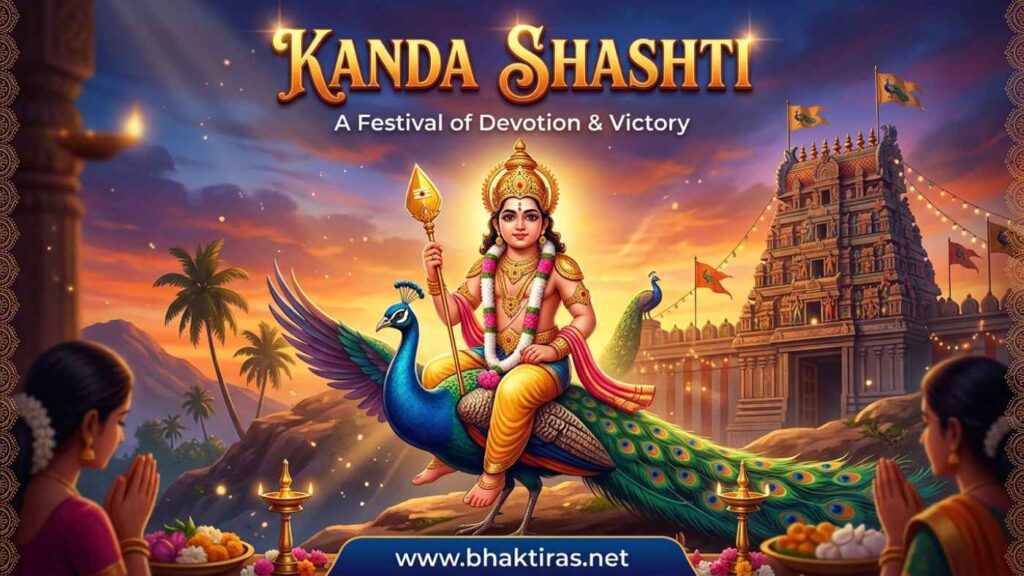
Kanda Shashti, also written Skanda Sashti, is the six-day Tamil festival that honours Lord Murugan’s victory over the shape-shifting demon Surapadman. It falls in the Tamil month of Aippasi, on the six lunar days leading up to Kartika Shukla Shashthi (October to November). Devotees keep a partial or fruit-only fast, recite the protective Kanda Sashti Kavacham, and gather in their thousands at Murugan hill shrines. The festival peaks on the sixth day with Soorasamharam, a spirited open-air re-enactment of the demon’s defeat, staged most famously on the shore at Tiruchendur.
Kanda Shashti 2026-2028: Dates & Calendar
The next Soorasamharam falls on 15 November 2026. Because Kanda Shashti tracks the moon, on the sixth lunar day of Aippasi, the date shifts each year across late October and November.
| Year | Soorasamharam | Day | Notes |
|---|---|---|---|
| 2026 | 15 November | Sunday | Six-day fast begins 10 Nov; Thirukalyanam 16 Nov |
| 2027 | 4 November | Thursday | Fast begins around 30 October |
| 2028 | 24 October | Tuesday | Approximate; confirm with temple panchang nearer the date |
At Tiruchendur, the Soorasamharam enactment is timed for the late afternoon, roughly 4 pm to 6 pm, when the killing of Surapadman is dramatised on the beach. Thirukalyanam, Murugan’s marriage to Deivanai, follows the next morning.
Why Kanda Shashti Is Celebrated
Kanda Shashti marks Lord Murugan’s defeat of the demon Surapadman, a story read as the triumph of light and grace over ego and cruelty.
In the old account, Surapadman and his brothers had grown so powerful through penance that the gods could not restrain them. Murugan, the son of Shiva and Parvati and the commander of the divine army, was born to end their tyranny. After a long battle he hurled his lance, the vel, and split Surapadman in two. Rather than destroy him outright, Murugan turned the two halves into a peacock, which became his mount, and a rooster, which became the emblem on his banner.
Good over evil
The core meaning is simple and deeply felt: arrogance and cruelty, however strong, cannot stand against divine justice. The demon is not merely killed but reformed, carried on Murugan’s own vehicle. Mercy sits inside the victory.
The power of the vel
Murugan’s weapon, the vel given by his mother Parvati, is worshipped in its own right. It stands for focused wisdom that cuts through delusion, which is why the Kavacham prayer repeatedly invokes its protection.
A vow, not just a watch
Keeping the six-day viratham is an act of discipline and devotion. Many take it as a personal vow after a prayer is answered, walking to a Murugan temple and often carrying a kavadi as thanks.
Deities & Figures Worshipped
Kanda Shashti centres entirely on Lord Murugan, worshipped under many Tamil names, along with his consort Deivanai on the wedding day.
Lord Murugan
Also called Skanda, Karthikeya, Subrahmanya, Kumara and Velan, Murugan is the youth-god of war, wisdom and the Tamil hills. Six of his most sacred shrines, the Arupadai Veedu, host the largest Kanda Shashti crowds.
Deivanai
Deivanai, the daughter of Indra, is Murugan’s consort in the northern tradition. The day after Soorasamharam, her wedding to Murugan is celebrated as Thirukalyanam, a joyful close to the six days of fasting.
Surapadman
The demon whose defeat the festival remembers. His transformation into Murugan’s peacock and rooster is the emotional heart of the Soorasamharam enactment, showing surrender and redemption rather than mere destruction.
Key Rituals, Step by Step
The observance runs across six days of fasting and prayer, building to the Soorasamharam on the final evening.
- Take the vow. On the day after the Aippasi new moon, devotees resolve to keep the six-day viratham, often at a Murugan temple, and set their intention for the fast.
- Keep the fast. Most follow a single light meal a day, or a fruit and milk diet, avoiding grains, onion, garlic and non-vegetarian food. Some elders keep a stricter fast; children and the unwell take a gentler form.
- Recite the Kavacham. Each day devotees read or listen to the Kanda Sashti Kavacham, the protective hymn composed by Devaraya Swamigal, which asks Murugan and his vel to guard the body from head to foot.
- Daily temple worship. Abhishekam and archanai are offered to Murugan, and many visit hill shrines such as Palani or Tiruttani, carrying milk pots or kavadi.
- Watch the six-day drama. Larger temples stage the story of the war over successive evenings, so the crowd follows the battle towards its final day.
- Soorasamharam. On the sixth evening, Murugan’s image is brought out and the killing of Surapadman is enacted, most spectacularly on the beach at Tiruchendur, where the demon becomes peacock and rooster before the deity.
- Break the fast. After the Soorasamharam darshan, devotees break the viratham, usually with prasadam and a simple meal shared among family.
- Thirukalyanam. The next day, the wedding of Murugan and Deivanai is celebrated, ending the festival on a note of union and blessing.
Special Foods of Kanda Shashti
Because most of the festival is a fast, the food is light and sattvic during the six days, with fuller cooking reserved for breaking the vow and the wedding day.
Fruit and milk
For six days many live on fruit, milk, and sometimes sabudana or a little sago, keeping the body light for prayer and avoiding grains, onion and garlic altogether.
Panagam and neer mor
Cooling drinks help through the fast: panagam, jaggery water spiced with dry ginger and cardamom, and neer mor, a thin buttermilk with curry leaves and ginger.
Panchamirtham
The famous Palani panchamirtham, a rich mix of banana, jaggery, ghee, honey, dates and cardamom, is offered to Murugan and shared as prasadam.
Sarkarai pongal
When the vow is broken, sweet pongal made of rice, moong dal, jaggery and ghee is a common offering and the first proper meal, often with vadai and payasam.
Where Kanda Shashti Is Celebrated
Though rooted in Tamil Nadu, the festival is kept wherever Murugan is worshipped, with each place adding its own flavour.
Tiruchendur, Tamil Nadu
The seashore temple hosts the grandest Soorasamharam, with the demon’s defeat staged on the sand before a huge crowd. It is the destination many devotees aim for on the sixth day.
Tiruparankundram & Palani
Among Murugan’s six sacred abodes, these hill shrines draw long queues of kavadi-bearers through the six days, with abhishekam and the Kavacham echoing through the temple.
Kerala
Malayali Murugan devotees keep the same six-day fast and worship at Subrahmanya temples, joining Tamil neighbours in reciting the Kavacham and observing the vow.
Tamil diaspora
In Sri Lanka, Malaysia, Singapore, Mauritius and beyond, Murugan temples hold their own Soorasamharam, keeping the festival alive far from its Tamil homeland.
Kanda Shashti Do's and Don'ts
A few simple points help you keep the vow with the right spirit and comfort.
Do
- Set a clear intention on day one before starting the fast
- Recite or listen to the Kanda Sashti Kavacham each day
- Keep to fruit, milk and sattvic food through the six days
- Drink plenty of water, panagam or buttermilk to stay hydrated
- Break the fast gently, with light prasadam before a full meal
Avoid
- Do not eat grains, onion, garlic or non-vegetarian food while fasting
- Do not force a strict fast on children, the elderly or the unwell
- Do not treat the vow as a diet; keep prayer at its centre
- Do not skip water; a fruit fast is not a dry fast
- Do not rush the darshan queue; the sixth-day crowds need patience
Frequently Asked Questions
When is Kanda Shashti and Soorasamharam in 2026?
Kanda Shashti in 2026 ends with Soorasamharam on Sunday, 15 November, at Tiruchendur. The six-day fast begins on 10 November, and Thirukalyanam, Murugan’s wedding, follows on 16 November.
When is Kanda Shashti in 2027 and 2028?
Soorasamharam falls on 4 November 2027 (Thursday). In 2028 it is expected around 24 October, though the exact date should be confirmed against a temple panchang, as Kanda Shashti moves each year with the Aippasi lunar cycle.
Why is Kanda Shashti celebrated?
Kanda Shashti celebrates Lord Murugan’s victory over the demon Surapadman, marking the triumph of good over evil. Murugan struck the demon with his vel and turned him into a peacock and a rooster, which became his mount and his banner, a story of both justice and mercy.
Which god is worshipped on Kanda Shashti?
Kanda Shashti is dedicated to Lord Murugan, also known as Skanda, Karthikeya and Subrahmanya, the youth-god of war and wisdom. On the day after Soorasamharam, his consort Deivanai is also honoured through the Thirukalyanam wedding.
What is Soorasamharam?
Soorasamharam is the dramatic re-enactment, on the sixth day of Kanda Shashti, of Murugan destroying the demon Surapadman with his vel. Staged most famously on the beach at Tiruchendur, it shows the demon transforming into Murugan’s peacock and rooster.
How do devotees keep the Kanda Shashti fast?
Devotees keep a six-day viratham, usually taking one light meal a day or living on fruit and milk, avoiding grains, onion, garlic and non-vegetarian food. Many recite the Kanda Sashti Kavacham daily and break the fast after the Soorasamharam darshan.
What is the Kanda Sashti Kavacham?
The Kanda Sashti Kavacham is a protective Tamil hymn to Lord Murugan, composed by Devaraya Swamigal, invoking his vel to guard the devotee from head to foot. It is recited or heard daily through the six days of the festival.
Where is Kanda Shashti celebrated most grandly?
Kanda Shashti is celebrated most grandly at the seaside Tiruchendur temple in Tamil Nadu, where the Soorasamharam is staged on the shore. Other major centres include Tiruparankundram, Palani and Murugan temples across Kerala and the Tamil diaspora.
May Lord Murugan’s vel clear every obstacle from your path this Kanda Shashti. Vetri Vel! Veera Vel!